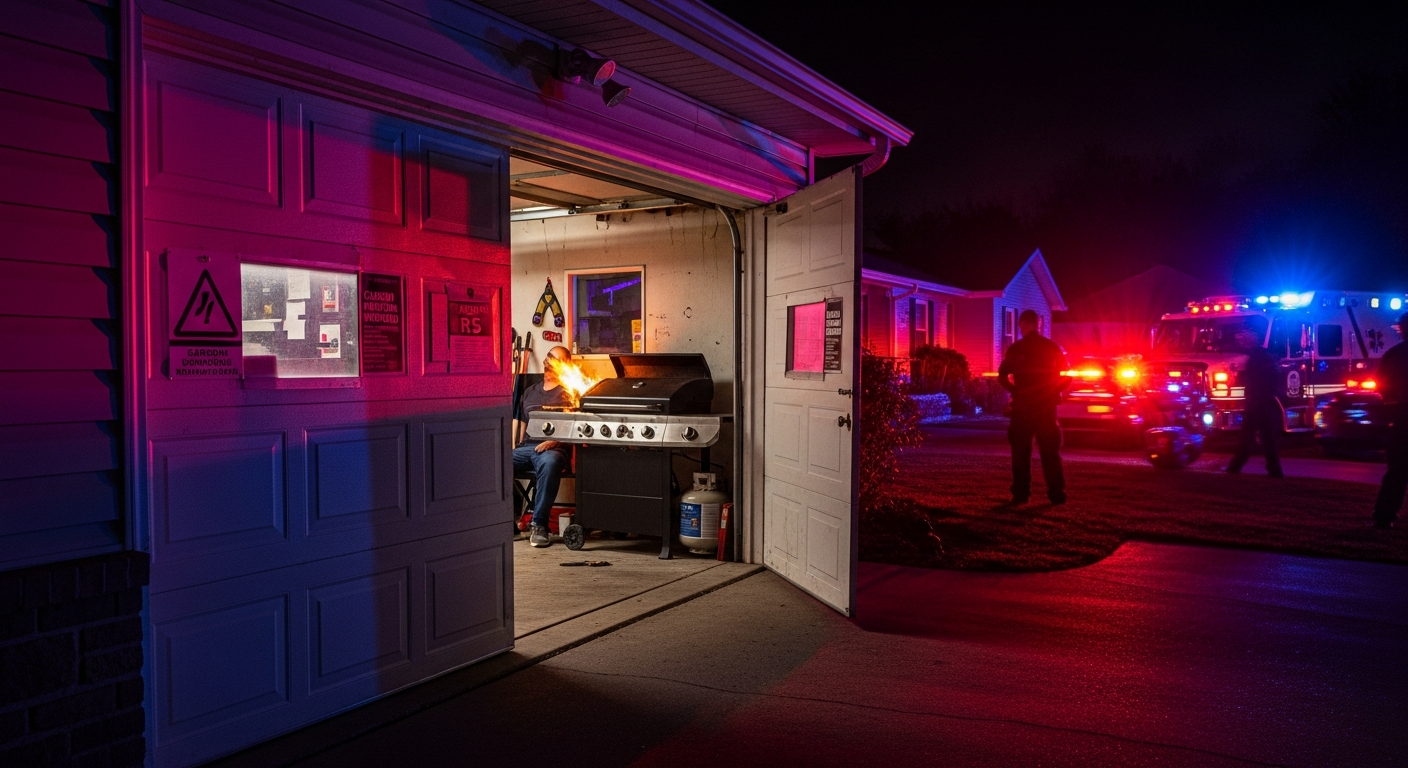
Carbon monoxide from grills sends thousands of Americans to emergency rooms every summer — and the Memorial Day through Labor Day stretch is when the risk peaks. The CDC and CPSC document dozens of CO fatalities each year linked specifically to charcoal and gas grills used in garages, screened porches, and partially enclosed spaces where CO has nowhere to go. Most victims didn't make an obvious mistake. They cracked the garage door. They grilled under the deck. They thought the breeze was enough. This guide covers exactly how grills produce CO, which scenarios are lethal versus manageable, what CO does inside a garage in under 15 minutes, and the specific placements that put your family at risk even when you think you are being careful.
How Grills Produce Carbon Monoxide — And Why It Never Stops During a Cookout
Every combustion process that burns carbon-containing fuel produces carbon monoxide as a byproduct of incomplete combustion. Charcoal and propane both contain carbon. Both produce CO — the difference is the rate and concentration. A charcoal grill produces CO from the moment the coals ignite until the last ember dies. During peak burning, a standard kettle grill produces CO at a rate that can raise concentrations in a 400-square-foot garage with the door open to 200 PPM within 30 minutes — four times the threshold for immediate action. A gas grill running at high heat produces CO at a lower rate, but the same accumulation dynamics apply in any enclosed or semi-enclosed space. Critically, CO production from a charcoal grill does not stop when you stop cooking. The coals continue burning and producing CO until they are fully extinguished, which takes 24–48 hours without intervention. Bringing a grill with hot coals into a garage to "let it cool down" — a common practice after a rain or cookout — is one of the most frequently documented causes of fatal CO poisoning from grills. The grill looks finished. The coals appear dark. CO production continues at dangerous levels. Takeaway: a grill is a CO source from ignition to full extinguishment — not just while you are actively cooking.
The Grilling Scenarios That Kill: What the CPSC Data Shows
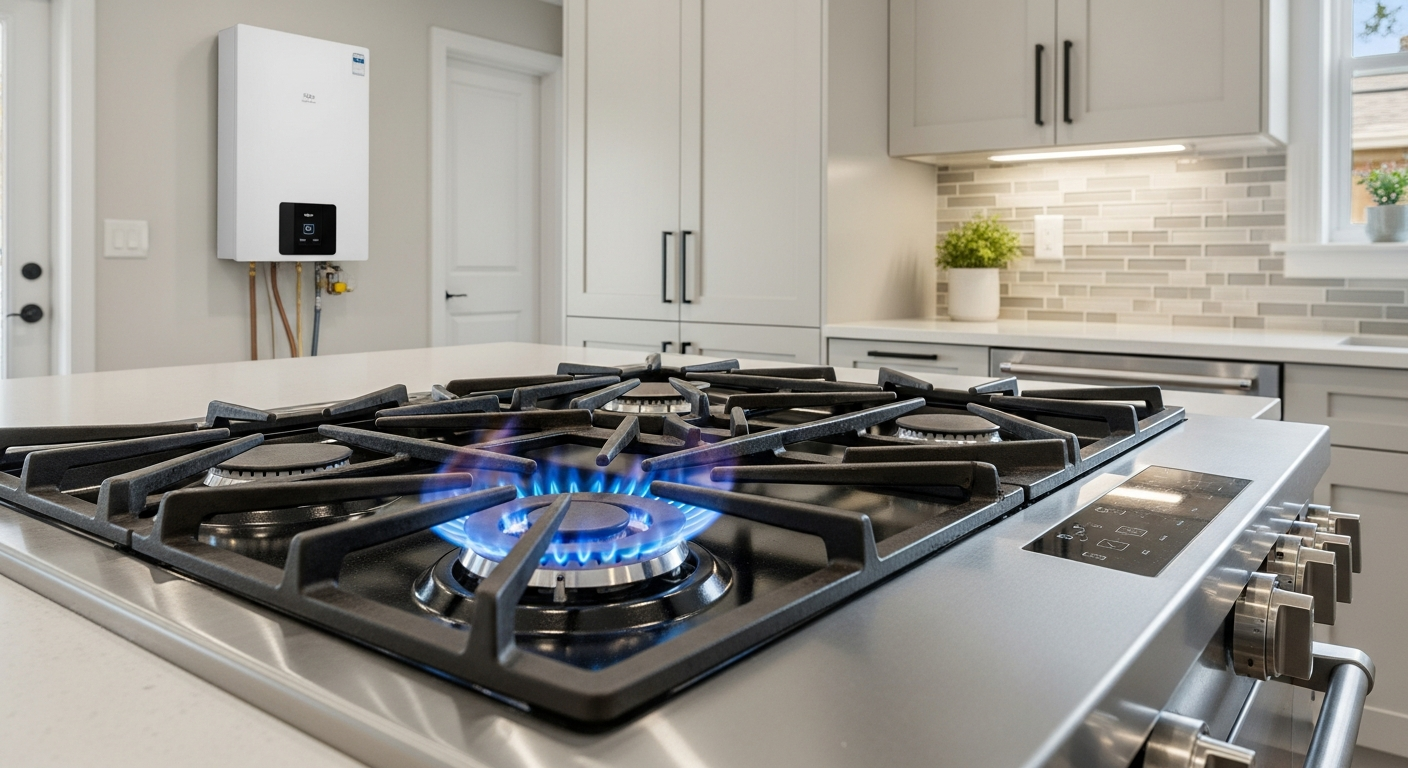
The Consumer Product Safety Commission has documented a consistent pattern in grill-related CO fatalities. The common factor in nearly every incident is not outdoor grilling — it is an enclosed or semi-enclosed space that prevents CO from dispersing. The specific scenarios that appear repeatedly in CPSC incident reports: **Garage grilling with door open or partially open.** This is the most common scenario. Homeowners assume an open garage door means adequate ventilation. It does not. CO accumulates near the floor and ceiling, and the doorway gap allows CO to enter the living space through any connected interior door. **Screened porches and covered patios.** A screened enclosure significantly reduces air exchange. CO produced under a solid patio roof or within a screened room can reach dangerous concentrations in less time than grilling without the enclosure. **Grilling under a deck or low overhang.** A second-floor deck or low roof overhang directly above a grill traps CO in the column of air below it. Even with open sides, CO recirculates back toward the cooking area and any structure walls nearby. According to NFPA data, the July 4th and Memorial Day weekends consistently show the highest grill-related CO incidents of any two weekends of the year — not because people are grilling more carelessly, but because they are grilling more frequently in conditions that happen to reduce ventilation. Carbon Monoxide in Cars: Garage Risks and How to Stay Safe Takeaway: the most dangerous grilling scenario is not outdoor cooking — it is any partial enclosure that prevents CO from dispersing into open air. Generator Carbon Monoxide: Why It Kills and How to Stay Safe
How CO from a Grill Enters Your Home Even When You Are Grilling Outside
Outdoor grilling does not eliminate CO risk if the grill is positioned near the home's exterior. CO produced outdoors can enter a house through negative pressure — the same mechanism that draws air in when a kitchen exhaust fan, bathroom fan, or HVAC system is running. A home in negative pressure pulls outside air through any available gap: window frames, under doors, dryer vents, fresh air intakes. If a grill is positioned within 10 feet of a window, door, or air intake and the home's ventilation is creating negative pressure, CO produced outdoors can accumulate indoors at levels the occupants would have no reason to expect. CPSC testing has shown that a grill positioned within 3 feet of an open window can raise indoor CO concentrations to 100 PPM within 45 minutes — even with no obstruction and no structure above the grill. The specific placement rules that reduce this risk: - Position the grill at least 10 feet from any window, door, or vent opening - Point the grill's exhaust away from the home, not toward any wall or window - Avoid grilling near fresh air intakes (typically near ground level on the exterior) - If the home's HVAC is running, check that the fresh air intake is not on the same side of the house as the grill Carbon Monoxide Detector Placement: Exactly Where to Put Yours Takeaway: outdoor grilling near the house with windows or intakes open is not a risk-free scenario — CO follows pressure differentials, not your intentions.
What Happens Inside a Garage in 10 Minutes With a Charcoal Grill

The speed of CO accumulation in enclosed spaces is what makes grill-related incidents so consistently fatal. People do not have time to recognize what is happening before concentrations become incapacitating. A standard two-car garage has roughly 600–800 cubic feet of air volume per car bay. A charcoal grill at peak burn produces CO at a rate that, in a space that size with the overhead door closed, can raise concentrations from zero to 200 PPM in under 10 minutes, and to 800 PPM — immediately dangerous to life and health per NIOSH standards — in under 25 minutes. With the overhead door cracked 2–3 feet, that timeline extends by roughly 40–50%. It is still dangerous within the timeframe a person might be expected to stay in the space. The NIOSH immediately dangerous to life or health threshold for CO is 1,200 PPM — but incapacitation and loss of judgment begin well below that level, at concentrations around 200–400 PPM, which a grill can produce in a garage in under 15 minutes. At 200–400 PPM, a person may feel a headache building and increasing fatigue before losing the coordination or judgment to move toward the exit. This is the window where CO poisoning progresses from survivable to fatal — and it can open and close in under 20 minutes. Carbon Monoxide PPM Levels Explained: What's Safe, What's Dangerous Takeaway: the speed of CO accumulation in any garage or enclosed structure from a grill is measured in minutes, not hours — there is no safe "just a few minutes" scenario in an enclosed space.
Practical Steps for Safer Grilling This Summer
The rules for safe grilling from a CO perspective are not complex, but they require deliberate positioning before each cookout — not assumptions about what "should be fine."
- Grill exclusively outdoors, on open ground — not in a garage, carport, screened porch, or under any overhead structure regardless of how open it appears
- Position the grill at least 10 feet from any door, window, or air vent opening on the structure
- Never bring a grill with hot or partially spent charcoal indoors or into a garage — treat coals as a CO source until they are cold enough to touch
- Keep a portable CO detector with a live PPM display near the grill area — particularly if cooking near the house, on a covered patio, or in any space with reduced airflow Portable Carbon Monoxide Detector for Travel: What to Look For in 2025
- If anyone at the cookout develops a headache, nausea, or dizziness, move everyone away from the grill and the structure immediately — CO poisoning in groups looks like food poisoning until the location test reveals it
- Extinguish charcoal with water after grilling rather than assuming it will burn out safely overnight
Carbon monoxide from grills kills people who followed most of the rules — they grilled outside, cracked the door, assumed the breeze was handling it. The margin for error with a CO source in any partially enclosed space is measured in minutes. A portable CO detector with a live PPM display at your cooking area shows you the real number in real time, before symptoms give your family's safety away to assumptions. The AirShield™ 3-in-1 Portable Carbon Monoxide Detector plugs into any outlet near your grilling area — patio, garage, or kitchen — and displays live CO, temperature, and humidity the moment it is powered on. Get yours at airshield.store before the next cookout.
Frequently Asked Questions
Sources & References
- CDC: Carbon Monoxide Poisoning — Seasonal Patterns — CDC data on CO poisoning incidence; charcoal grills and portable generators are leading warm-weather sources
- CPSC: Grill and Charcoal CO Warnings — CPSC consumer guidance on outdoor grill hazards and indoor/enclosed space use
- NFPA: Grill Fire and CO Statistics — NFPA annual report on grill-related fires and CO incidents — July 4th and Memorial Day weekends are peak risk dates
- NIOSH: Carbon Monoxide Hazard Recognition — NIOSH guidance on CO concentrations from charcoal combustion in enclosed or semi-enclosed spaces
Protect Your Home with AirShield™
The only portable CO detector that shows you real-time PPM readings on a live OLED display. Electrochemical sensor, multi-gas detection, UL listed.
Check Availability →
Loading comments...