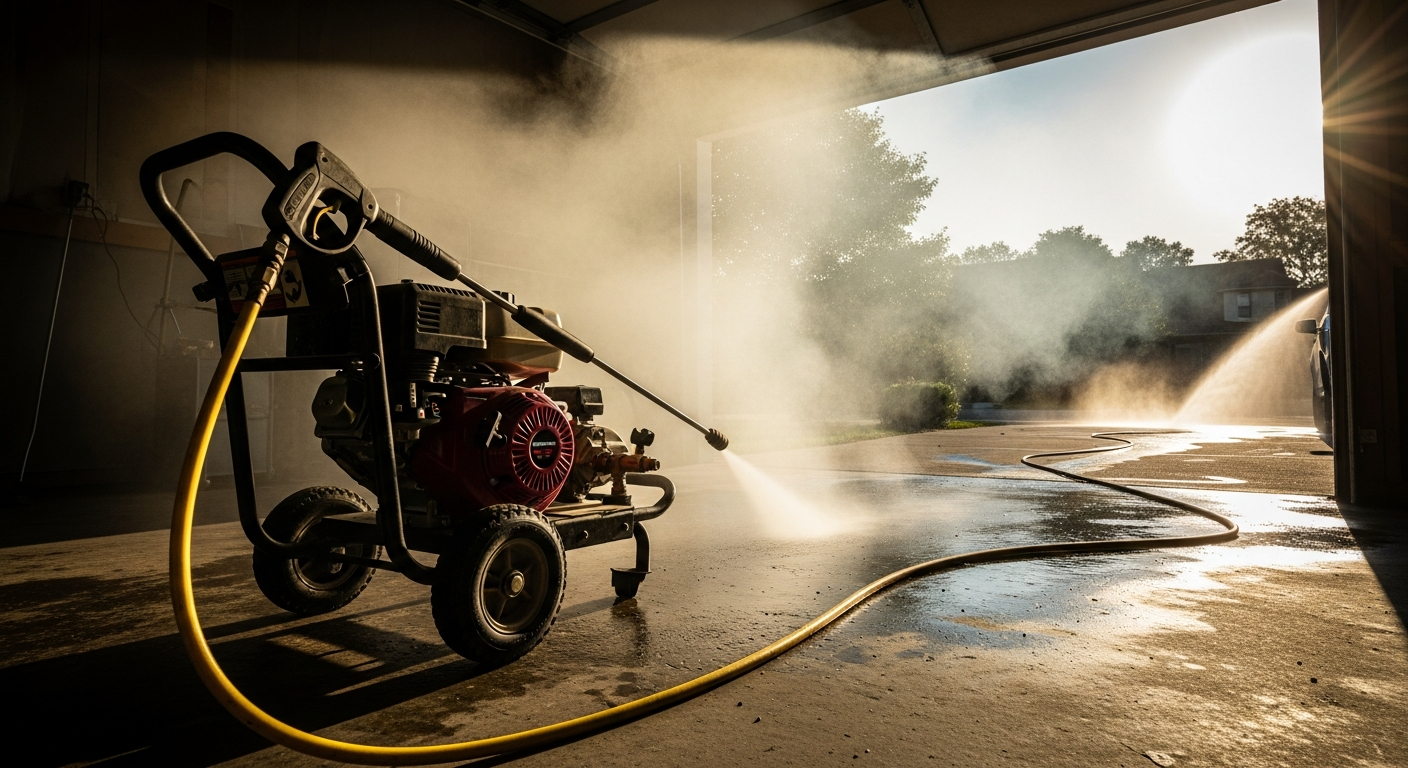
Summer is peak pressure-washing season. Driveways, decks, siding, fences, boats — the projects pile up as soon as the weather holds, and a gas-powered pressure washer is the fastest way through the list. It is also, ppm for ppm, one of the most concentrated sources of carbon monoxide in common residential use. Most people who own a gas pressure washer know, in the abstract, that gasoline engines produce exhaust. Almost none of them know how much, or how quickly that exhaust becomes dangerous in anything less than fully open air. This is the equipment that gets rolled into a garage between tasks, run right up against a house to wash the siding, or used to clean a boat under a covered slip — all situations where the airflow assumptions that make it safe outdoors simply don't hold. Here is what makes a pressure washer one of the more dangerous pieces of common home equipment, and the specific situations where that danger becomes real. What Causes Carbon Monoxide in a House? 7 Hidden Sources
Why Pressure Washers Produce So Much Carbon Monoxide
A gas pressure washer's small engine runs at sustained high load for the entire duration of the job — there's no idle setting while you're actively spraying, and most residential jobs take twenty minutes to several hours. Small gasoline engines of this type are generally less efficient and less well-regulated for emissions than a car engine, and they produce CO at a disproportionately high rate relative to their size. A gas pressure washer can generate carbon monoxide at a rate comparable to roughly 100 idling automobiles running simultaneously — making it one of the most concentrated common CO sources found in ordinary home use. This is a genuinely counterintuitive fact. A car is an obvious CO source; everyone knows not to run one in a closed garage. A pressure washer looks and feels like a cleaning tool, not combustion equipment, and its exhaust output is easy to underestimate by an order of magnitude. Carbon Monoxide in Cars: Garage Risks and How to Stay Safe Takeaway: a gas pressure washer's small engine produces CO at a rate that rivals dozens of idling cars, making it far more dangerous in enclosed or semi-enclosed spaces than its size suggests.
The Garage-Door-Open Mistake
The single most common way people get hurt with gas-powered equipment indoors is the belief that an open garage door provides sufficient ventilation. It doesn't, and the math is unforgiving when the source is producing CO at the rate a pressure washer does. An open garage door allows some air exchange, but it does not create the continuous, high-volume airflow needed to disperse CO as fast as a running gasoline engine produces it — especially in an attached garage, a garage with the door only partially open, or a space with limited cross-ventilation. The same partial-ventilation misconception responsible for most generator CO deaths applies directly to pressure washers, and because a pressure washer produces CO at such a high concentration, the margin for error is smaller, not larger. Generator Carbon Monoxide Dangers This Hurricane Season The task itself compounds the risk: pressure washing a garage floor, a car, or equipment stored inside a garage means the engine runs continuously in exactly the enclosed space the operator should be avoiding. Takeaway: an open garage door is not adequate ventilation for a running gas pressure washer — the same mistake that kills people with generators applies here, at a higher CO output.
Why the Symptoms Get Missed Mid-Task
Pressure washing is physically demanding. It involves standing for extended periods, holding a wand under recoil pressure, moving in the heat, and often working near a loud, running engine. Every one of those conditions produces its own baseline discomfort — fatigue, mild headache, a bit of dizziness from the heat. CO poisoning symptoms — headache, nausea, dizziness, confusion — arrive on top of that baseline and are nearly impossible to distinguish from ordinary task fatigue in the moment. Someone pressure washing their garage floor on a hot July afternoon has every reason to attribute a developing headache to the heat and the physical effort, right up until the point where confusion sets in and self-assessment becomes unreliable. This is the same pattern seen with generators and other gas equipment: the setting itself provides a plausible, benign explanation for exactly the symptoms that should trigger an immediate stop and move to fresh air. Carbon Monoxide Poisoning Symptoms: Signs & What to Do Takeaway: the physical demands of pressure washing produce symptoms that mask early CO poisoning, so any headache or dizziness during the task should prompt stopping immediately, not pushing through.
The Situations Where Risk Spikes
Certain pressure-washing scenarios carry substantially elevated risk compared to washing an open driveway in full sun. Washing inside or just outside a garage — cleaning the garage floor itself, or working on a car or equipment stored there — keeps the engine running in or immediately adjacent to an enclosed space for the full duration of the task. Washing a boat under a covered slip or in a marina structure with a roof creates the same enclosed-space dynamic on the water. Boats stored under any kind of roof or overhang should be pressure washed only with the engine positioned to vent fully away from the covered area, or moved to fully open space first. Cleaning siding or a deck immediately adjacent to open windows or doors can pull engine exhaust into the house through normal air infiltration, even though the pressure washer itself is technically outdoors. Carbon Monoxide in Your Garage Is Entering Your Home — Here Is How to Stop It Takeaway: proximity to any enclosure — a garage, a covered boat slip, an open window — turns an outdoor pressure-washing task into an indoor-equivalent CO risk.
Using a Gas Pressure Washer Safely
- Operate a gas pressure washer only in fully open outdoor space — never inside a garage, carport, or any covered structure
- Keep the engine at least 20 feet from open windows, doors, or air intakes while running
- Never pressure wash a boat under a covered slip or roofed marina structure with the engine running underneath it
- If cleaning a garage floor, move the pressure washer engine itself outside the garage and run a longer hose to reach the interior
- Treat any headache, dizziness, or nausea during the task as a signal to stop immediately and move to fresh air — don't attribute it automatically to heat or exertion
- Never assume an open garage door is sufficient ventilation for a running gasoline engine
- If working near an attached garage or enclosed structure for an extended job, place a portable CO detector with a live PPM display nearby to monitor the air in real time
A pressure washer doesn't look dangerous. It looks like a cleaning tool, and most of the time, used in open air, it is one. The danger appears the moment it runs anywhere near an enclosure — a garage, a covered slip, an open window — because its small engine produces carbon monoxide at a rate few people would guess by looking at it. Summer's list of cleaning projects isn't going anywhere, and neither is the risk of running gas equipment near enclosed space. The AirShield™ 3-in-1 Portable Carbon Monoxide Detector plugs into any outlet near your garage or work area and shows the live PPM reading in real time, so you know what the air actually contains before a headache becomes something worse. Visit airshield.store.
Frequently Asked Questions
Sources & References
- CPSC: Carbon Monoxide Information Center — CPSC guidance on CO risks from gasoline-powered equipment.
- CDC/NIOSH: Carbon Monoxide Hazards from Small Gasoline Engines — CDC and NIOSH data on CO output from small gasoline engines including pressure washers.
- CPSC: Portable Generator and Gas-Powered Tool Safety — CPSC statistical data on CO fatalities from gasoline-powered tools and equipment.
Protect Your Home with AirShield™
The only portable CO detector that shows you real-time PPM readings on a live OLED display. Electrochemical sensor, multi-gas detection, UL listed.
Check Availability →


Loading comments...