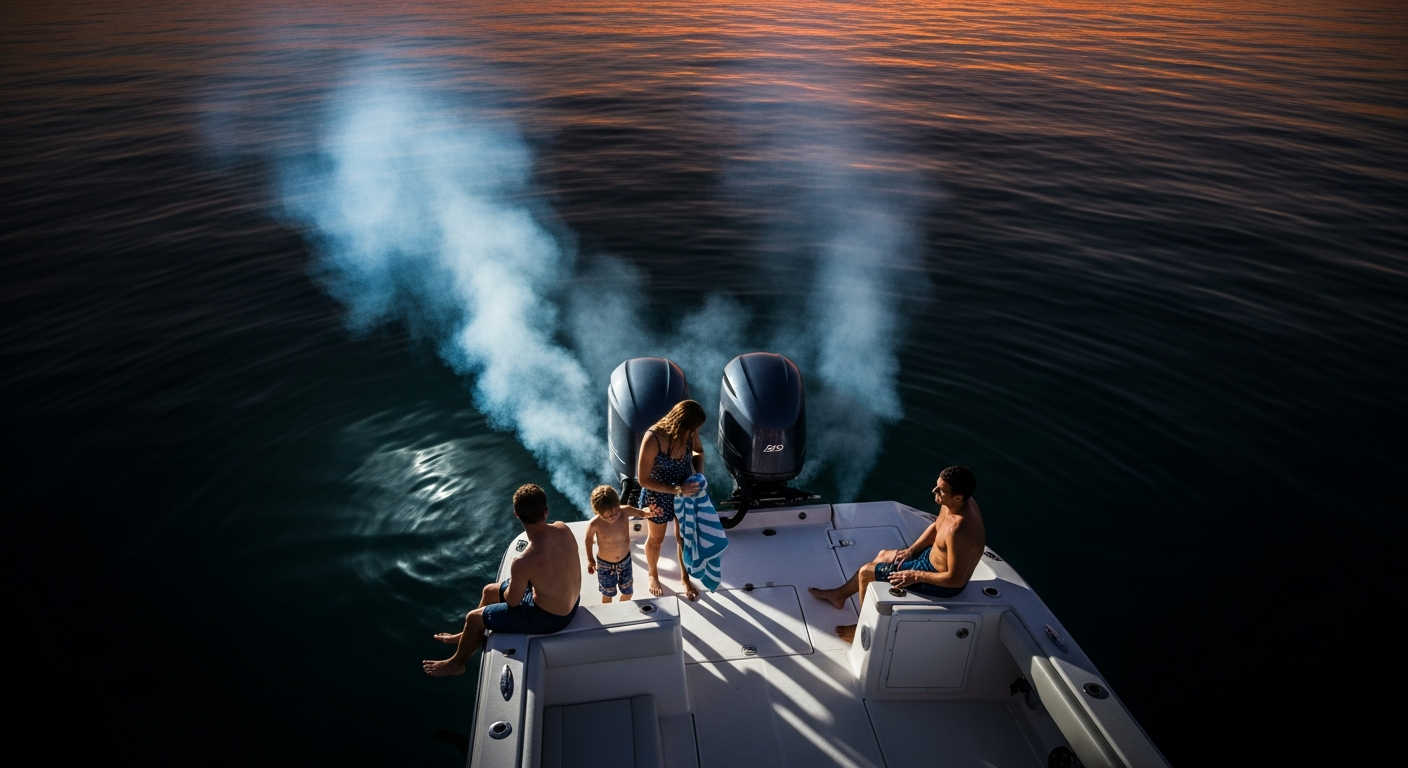
On June 16, 2026, a 9-year-old child died from carbon monoxide poisoning on a boat. It was a summer day. The family was on the water. The child was near the swim platform — the most dangerous spot on any motorized vessel — and by the time anyone realized what was happening, it was too late. Carbon monoxide doesn't appear on most boaters' risk lists. You think about life jackets, weather, wake, sunburn. You don't think about the exhaust from your own engines silently pooling at the back of the boat where children swim. This is a July 4th weekend read for anyone who spends time on the water. It's not about worst-case scenarios. Every summer, people die on boats from CO poisoning in broad daylight, on clear days, in full view of their families. The mechanism is well understood. The risk is preventable. And almost no one who boats knows about it. What Causes Carbon Monoxide in a House? 7 Hidden Sources
The Station-Back Effect: How Exhaust Gets Back Into Your Boat
A motorboat creates a low-pressure zone behind the stern as it moves through the water. It's the same physics that creates the draft behind a tractor-trailer on the highway — the object moving forward pulls air into the vacuum behind it. On a boat, that zone sits directly over the swim platform and transom. When you're idling, drifting at low speed, or anchored with the engine running, exhaust leaves the engine compartment and immediately enters that low-pressure zone. Instead of dispersing into open air, it gets pulled back toward the boat — up over the transom, across the swim platform, and directly into the cockpit. The phenomenon has multiple names: the station-back effect, exhaust recirculation, the back-waft zone. All of them describe the same thing: your boat's own exhaust being pulled toward the people on it. At the swim platform, exhaust concentrations can reach lethal CO levels in under two minutes when the engine is idling. Newer boat designs and improved engine placement have reduced — but not eliminated — the problem. Many popular recreational vessels, including pontoon boats, cabin cruisers, and houseboats, still have designs that channel exhaust toward passenger areas. Carbon Monoxide in Summer: 5 Hidden Risks This Season Takeaway: The physical design of most motorboats actively pulls exhaust back toward passengers — the station-back effect is not a freak condition, it's normal boat aerodynamics.
Why the Swim Platform Is the Most Dangerous Spot on the Water
The swim platform — the flat deck extending behind a boat's transom — is the exact intersection of where children play and where exhaust collects. Kids hang off the back. They sit with their legs in the water. They're close to engine level, deep inside the low-pressure exhaust recirculation zone. Children often don't recognize CO symptoms early. Adults may verbalize when they feel sick. Children attribute nausea to the boat ride, dizziness to the sun, drowsiness to a busy day on the water. The mismatch between where symptoms are most severe and who is least likely to report them makes children the highest-risk passengers on any motorized vessel. In documented cases of boat CO poisoning, children have been found unconscious at or near the swim platform while adults in the cockpit were still upright and functional — because the gas concentration was highest exactly where the children were sitting. CO is not evenly distributed on a boat — it accumulates in pockets, and the heaviest pockets form at the stern. The USCG and CPSC have both issued explicit warnings about swim platform CO exposure. The CPSC notes that it is possible for CO to reach dangerous concentrations at the swim platform even when the boat is underway at normal speeds, not just while idling. Why Is Carbon Monoxide Dangerous? The Science Explained Takeaway: The swim platform concentrates exhaust directly where children play — CO levels there can be lethal while the cockpit still feels fine.
Why Boaters Never See It Coming
Carbon monoxide on a boat produces the same symptoms it always does: headache, nausea, dizziness, confusion. The problem is that every one of those symptoms is also a symptom of a day on the water. Seasickness? Headache, nausea, dizziness. Too much sun? Headache, dizziness, fatigue. Dehydration — guaranteed on a hot July day — matches every single CO symptom on the list. Boaters who are CO poisoned often think they're just having a bad day on the water. They sit down. They have water. They rest. They tell their kids to relax in the shade — often at the back of the boat, near the swim platform. The wind from the boat's motion creates a sensation of fresh air that makes it nearly impossible to feel like you're being poisoned. You feel the breeze. The sky is open. There's no enclosed space to blame. This is what makes boat CO poisoning so dangerous: it happens in open air, in daylight, in conditions that look nothing like a CO emergency. No enclosed room. No smell. No visible warning. Just a family on a sunny day and an invisible gas accumulating exactly where they're sitting. Hotel Carbon Monoxide: Why You Should Bring Your Own Detector Takeaway: The sensory experience of boating — wind, open sky, fresh water smell — creates exactly the wrong mental model for recognizing CO poisoning in progress.
The Highest-Risk Situations on the Water
Not all boating conditions carry equal CO risk. The station-back effect is worst in specific scenarios that are extremely common on holiday weekends. Idling near a dock or anchored in a cove: with the engine running but the boat not moving, there's no forward airflow to dilute exhaust accumulation. The recirculation zone fills continuously. People sitting in the cockpit or at the transom receive a sustained exposure that builds over time. Slow trolling: fishing from a slowly moving boat puts the engine at a sustained partial load — high enough to generate CO, slow enough that exhaust never fully clears the stern. Heading directly into the wind: when the wind comes from the bow, it pushes exhaust back over the stern and holds it there. Many boaters run into the wind for cooling. They're also running into their own exhaust plume. Generator-powered houseboats are among the highest-risk vessels — the exhaust pattern is similar to a residential generator confined to an area where people sleep, and CO can accumulate in cabins overnight while occupants are unconscious. Takeaway: The riskiest scenarios all involve sustained engine operation near where passengers sit — exactly the conditions of a July 4th day on the water.
The Boat CO Safety Checklist
- Never allow anyone — especially children — to hang on or sit at the swim platform while the engine is running
- Move all swimmers clear of the swim platform before starting engines
- Turn the engine off completely before anyone enters the water off the back of the boat
- When anchored or idling, position passengers forward, away from the stern
- If heading into the wind with passengers aboard, minimize idle time
- On a houseboat, run generator exhaust away from sleeping areas and install a CO detector at cabin level
- Know the multiple victim pattern: if two or more passengers feel unwell simultaneously, shut the engine off and move everyone away from the stern
- Never ignore a child saying they feel sick or tired on the boat — CO symptoms in children often appear before adults notice anything
- If you have a portable CO detector with a live PPM display, check the reading any time the engine has been running for 15 minutes or more near passengers
The 9-year-old who died on June 16, 2026 was on a boat in the middle of a summer day. The air was open. The sky was clear. None of it made a difference, because the CO wasn't in the air — it was in the pocket of recirculated exhaust directly behind the boat, exactly where children sit and swim. The physics doesn't change. The station-back effect is present on virtually every motorized recreational vessel. What changes the outcome is measurement — knowing what the air at the back of your boat actually contains, in real time, before anyone starts feeling sick. The AirShield™ 3-in-1 Portable Carbon Monoxide Detector plugs in anywhere on the boat, runs continuously, and displays the live PPM reading so you know what the air contains before your body tells you something is wrong. Visit airshield.store.
Frequently Asked Questions
Sources & References
- CPSC: Boat Carbon Monoxide Safety — CPSC guidance and statistics on CO deaths related to boat exhaust and the swim platform.
- U.S. Coast Guard Boating Safety: Carbon Monoxide — USCG boating incident data and CO poisoning prevention guidance.
- CDC: Carbon Monoxide Poisoning Prevention — CDC overview of CO sources, symptoms, and prevention across settings including boats.
Protect Your Home with AirShield™
The only portable CO detector that shows you real-time PPM readings on a live OLED display. Electrochemical sensor, multi-gas detection, UL listed.
Check Availability →

Loading comments...