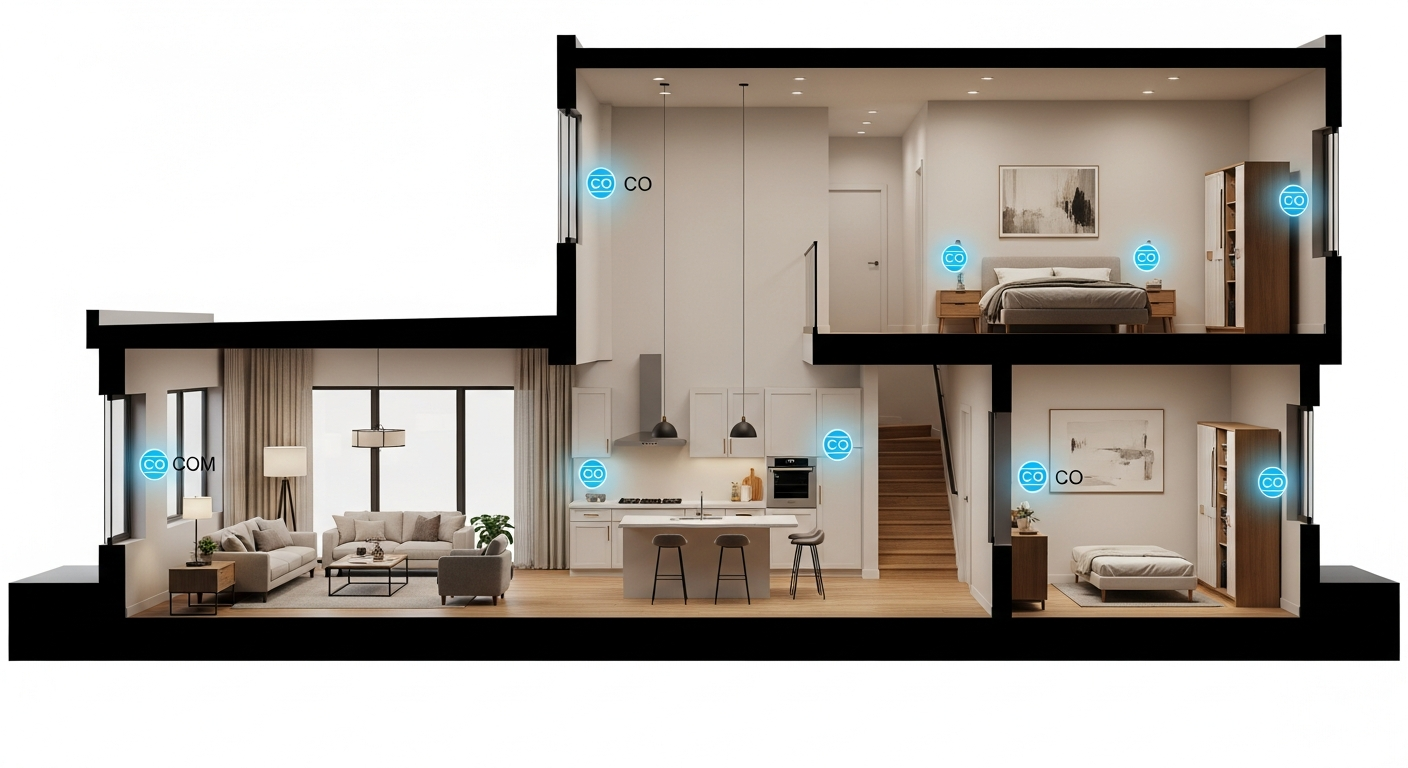
Most people buy a carbon monoxide detector and install it wherever a nail was already in the wall or wherever the nearest outlet happens to be. That logic works for picture frames. It doesn't work for life-safety equipment. Carbon monoxide detector placement determines how quickly the device responds to rising CO — and whether it detects a problem in time to act. An alarm on the far side of the house from your bedroom may not warn you during nighttime exposure, when you're asleep and your body is most vulnerable to CO buildup. An alarm installed directly next to a gas stove will generate false readings during normal cooking. A unit mounted on the ceiling in a room with complex air circulation may miss a slow buildup that stays below it until it reaches your sleeping level. Every one of these mistakes is common, and none of them are obvious from the packaging. This guide covers exactly where to place a CO detector in every room, at what height, and how many you actually need. How Does a Carbon Monoxide Detector Work? A Clear Explanation
Why Placement Determines How Early You're Warned
Carbon monoxide is nearly identical in density to air — its molecular weight of 28 g/mol sits between nitrogen at 28 and oxygen at 32. Unlike smoke, which rises because combustion gases are hot and buoyant, CO distributes through a space at roughly the same rate as the surrounding air. It does not pool at the floor or concentrate at the ceiling; it mixes into the room's air volume over time. This matters for placement because it means detector height is less critical than proximity to sleeping areas and fuel-burning appliances. A detector placed across a large open-plan room from the CO source will eventually read the same concentration as one placed closer — but it will detect it later, because CO has to diffuse through a larger air volume before reaching the sensor. In a sleeping area, placement within 10 to 15 feet of the bed is the single most important factor — CO exposure during sleep is the highest-risk scenario because you cannot smell CO and will not wake from its effects until symptoms are already severe. Response time matters most when you're unconscious and can't feel the warning signs. Takeaway: CO distributes through air like air itself — proximity to where you sleep and to combustion sources determines how early your detector gives you a warning.
Room-by-Room Placement Guide
Bedroom: Place the detector within 10–15 feet of the bed at outlet height or mid-wall. This is the highest-priority placement in any home — most CO fatalities occur during sleep because the victim never regains consciousness. If you have multiple bedrooms, each occupied sleeping area needs its own detector. A single hallway unit does not adequately cover a closed bedroom at the far end of the floor. Living room and common areas: Place at outlet height or mid-wall on an interior wall. Avoid placing it within five feet of a gas fireplace or combustion appliance — brief normal operation produces CO spikes that can trigger false alarms without indicating a real safety problem. Kitchen: Do not place a CO detector directly next to the stove. Natural gas combustion during cooking produces small amounts of CO, and a detector within five feet of the burners will alarm from normal use. If the kitchen opens to a living area, one unit covering both spaces is usually sufficient — positioned toward the living area side. Attached garage entry: Place a detector inside the living area near the interior door to the garage. Vehicles produce significant CO while warming up, and the door between garage and living space is a common migration point for buildup, especially in winter when engines idle longer. The attached garage is one of the most common and underprotected CO entry points in American homes — a door gap is all it takes for dangerous concentrations to build overnight. Carbon Monoxide in Cars: Garage Risks and How to Stay Safe Takeaway: every sleeping area needs its own detector and the attached garage door is a critical zone that most homeowners never address.
How High Should a CO Detector Be?
This question generates more confusion than any other aspect of CO detector placement, largely because smoke detector rules — place high, smoke rises — are incorrectly applied to CO. Because CO is approximately the same density as air, it does not concentrate at the ceiling or pool at the floor. It disperses through the room's air volume relatively uniformly. This means outlet height, typically 12 to 18 inches from the floor, is a completely valid placement for a CO detector. Mid-wall at four to five feet is also effective. Ceiling mounting is acceptable but provides no detection advantage and can make the unit harder to read or reposition. The practical implication is significant for plug-in detectors specifically. A plug-in CO detector that draws power directly from a wall outlet is installed at exactly the right height automatically, and it eliminates battery management — the most common cause of undetected detector failure in alarm-only units. The AirShield plugs into any standard outlet at the ideal detection height and displays a live CO reading from the first second of operation — no mounting hardware, no battery schedule, no guesswork about whether it's still working. Takeaway: CO is near-neutral in air density, so outlet height and mid-wall are both fully effective — the ceiling-only rule applies to smoke detectors, not CO detectors.
How Many CO Detectors Do You Actually Need?
The minimum standard across most fire safety codes is one CO detector per sleeping level of the home. That baseline is a legal floor, not a safety recommendation. A large home with multiple bedrooms on one floor, a gas furnace in the basement, and an attached garage has several distinct CO risk zones that one detector per level cannot adequately cover. A more complete approach: one detector in or immediately outside each occupied sleeping area, one near any fuel-burning appliance — furnace room, boiler room, water heater closet — and one near the entry from an attached garage. For a typical two-story home with a basement, that works out to three to five detectors. For a smaller apartment with one sleeping area and a gas stove, two is usually sufficient — one in the sleeping area and one in the living area near the kitchen. The National Fire Protection Association recommends a CO detector on every level of the home including the basement, and in or near every sleeping area — a standard the majority of US households do not currently meet. Running out of detectors is far more common than having too many. Carbon Monoxide Detectors in Rental Properties: What Landlords Are Required to Do Takeaway: the legal minimum of one per sleeping level is a starting point — complete coverage means a detector in each sleeping area, near each fuel-burning appliance, and at the garage entry.
Practical Application: Your Room-by-Room Placement Checklist
Follow this sequence when placing or repositioning CO detectors throughout your home:
- Start with every sleeping area — before anything else, confirm there is a working detector within 10–15 feet of every bed; this is the highest-priority zone and the most common gap
- For plug-in detectors, choose the outlet closest to the sleeping position — not the most convenient outlet near the door or dresser
- Keep all detectors at least 5 feet from any gas stove, gas fireplace, or combustion appliance — brief normal operation at close range produces CO that triggers false readings
- Place a detector inside the living area near every interior garage door — CO from idling vehicles migrates through door gaps faster than most homeowners expect Carbon Monoxide in Your Garage Is Entering Your Home — Here Is How to Stop It
- In basement or utility areas with a furnace, boiler, or water heater, place a detector in the room or just outside it — these are the most common origin of slow residential CO leaks
- Avoid humid areas like bathrooms and locations near exterior vents — humidity can interfere with electrochemical sensor accuracy over time
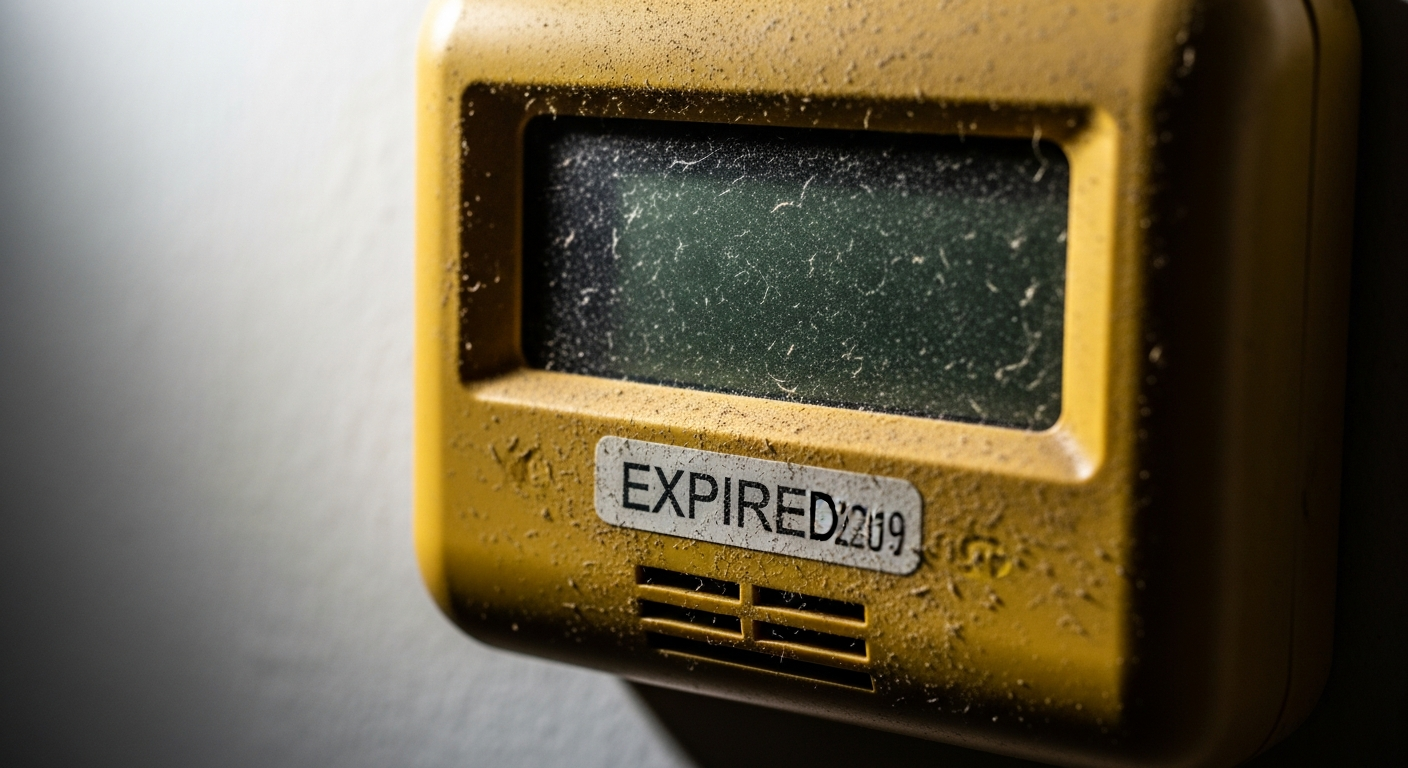
- Check your detector's manufacture date: electrochemical sensors expire on a fixed chemical timeline, typically five to seven years — an expired unit may appear functional while no longer reading accurately Carbon Monoxide Detector Not Working? Here's How to Tell — and What to Do
- For any hotel, Airbnb, or vacation rental, treat the outlet closest to your bed as the correct placement every time — you have no information about the age or condition of any installed detector in the space Carbon Monoxide Detector for Travel: Your Hotel Safety Protocol
Carbon monoxide detector placement is the difference between an alarm that gives you time to act and one that responds too slowly, or not at all. Sleeping areas first, at outlet height, at least five feet from gas appliances, with additional units near the garage entry and any fuel-burning equipment — that is the complete framework. The AirShield™ 3-in-1 Portable Carbon Monoxide Detector is designed for exactly this: plug it into any outlet anywhere in the home, and it begins displaying live CO, methane, and propane readings immediately. No mounting hardware, no battery replacement schedule, no uncertainty about whether it's still working after three years on the shelf. Place it where it matters and it shows you the number in real time. Visit airshield.store to get yours today.
Frequently Asked Questions
Protect Your Home with AirShield™
The only portable CO detector that shows you real-time PPM readings on a live OLED display. Electrochemical sensor, multi-gas detection, UL listed.
Check Availability →
Loading comments...