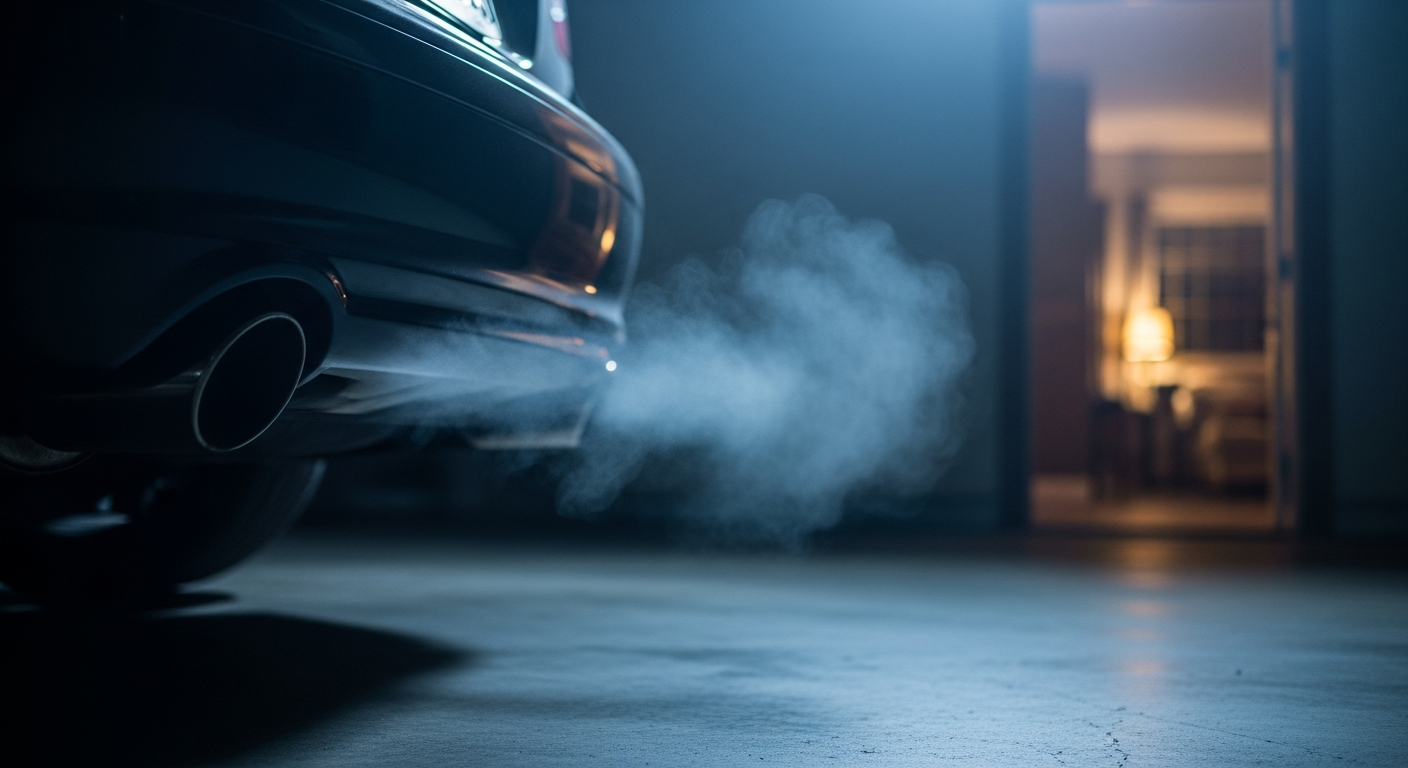
Carbon monoxide kills more than 400 Americans every year in unintentional non-fire poisonings, and a significant share of those incidents share one feature: a running car in an attached or enclosed garage. The vehicle does not need to be malfunctioning. It does not need to be old. A new, well-maintained car running for ten minutes in a closed two-car garage produces enough carbon monoxide to reach concentrations that cause headache and cognitive impairment in healthy adults. The gas does not stay in the garage — it migrates through shared wall cavities, door gaps, HVAC ductwork, and foundation penetrations into the living space, often while the household is asleep. Carbon monoxide in cars is one of the most preventable residential CO hazards and one of the least understood, because the situations that create it feel routine. This article covers how car engines produce CO even when functioning correctly, why the attached garage multiplies that risk dramatically, which three habits drive most incidents, and what real-time monitoring looks like for any home with a connected garage. Carbon Monoxide in Your Garage Is Entering Your Home — Here Is How to Stop It
How Cars Produce Carbon Monoxide Even When Running Correctly
Internal combustion engines produce carbon monoxide as a byproduct of incomplete fuel combustion. When a hydrocarbon fuel does not receive adequate oxygen during the combustion cycle, the reaction produces CO instead of CO₂. This happens in every gasoline and diesel engine to some degree — not as a sign of mechanical failure, but as a fundamental characteristic of how the chemistry works under real operating conditions, even in a vehicle that passed its last emissions inspection. Modern catalytic converters are engineered to convert CO in exhaust gases into CO₂ before they exit the tailpipe, and they perform this conversion effectively once at operating temperature. In the first 90 seconds of a cold start, before the catalytic converter warms to its activation threshold, a modern vehicle's CO output is substantially higher than during normal highway driving — producing concentrations that accumulate quickly in a small enclosed space. That brief warm-up interval is precisely when most residential garage CO incidents begin, because it corresponds exactly to how cars are used in attached garages on cold mornings. Hybrid vehicles running their gasoline engine at low speeds or under light load produce CO at rates comparable to conventional engines in the same conditions. Electric vehicles produce no combustion exhaust, though their battery systems present separate ventilation concerns during certain charging scenarios distinct from CO. Takeaway: every internal combustion vehicle produces elevated CO during the first two minutes of a cold start — the interval that corresponds most closely to how cars are operated in attached garages.
Why Your Attached Garage Amplifies the Risk
An enclosed garage concentrates carbon monoxide faster than almost any other residential space. The combination of limited air volume, a high-output combustion source, and minimal natural ventilation means concentrations climb from zero to dangerous levels in minutes. Research from the National Institute of Standards and Technology documented that CO concentrations in a standard single-car garage can reach 500 PPM — nearly five times the OSHA permissible exposure ceiling — within three to five minutes of one running vehicle. Studies have found that CO from a vehicle running in an attached garage can migrate into the home in concentrations sufficient to cause symptoms within 15 to 30 minutes, even with the connecting door closed. The migration pathways are rarely visible: shared stud wall cavities, gaps around electrical and plumbing penetrations, HVAC supply and return ductwork passing through the garage ceiling, and door weather stripping that compresses and loses its seal over years of use. People who warm their cars in cold weather encounter this risk routinely. Accidental exposure follows the same pattern: remote start systems that activate the engine before the garage door opens, engines left running while unloading cargo, vehicles idled while an owner steps back inside to grab something — each scenario produces the same CO accumulation in the same connected space. Carbon Monoxide PPM Levels Explained: What's Safe, What's Dangerous Takeaway: an attached garage creates a direct CO migration pathway into the living space that operates regardless of whether the connecting door is open or closed.
The Three Habits That Drive Most Residential Car CO Incidents
Three normalized behaviors account for a disproportionate share of residential car CO incidents — and each feels safe precisely because it usually ends before harm occurs. Warming up the car before driving is the most widespread habit in cold climates. Carbureted engines from earlier decades genuinely required warm-up time to run efficiently. Modern fuel-injected engines do not — they reach operating temperature more efficiently under light driving load than idling stationary in a garage. A car running in a closed garage for five minutes produces CO concentrations that cause headache and early cognitive impairment in healthy adults. Ten minutes pushes concentrations into a range associated with cardiovascular stress. Partial door opening is dangerous specifically because it resembles a solution. Many people believe a garage door open six to twelve inches provides adequate ventilation for a running vehicle. It does not — the airflow through a narrow gap is insufficient to prevent CO accumulation, and wind direction determines whether the partial opening draws fresh air in or allows exhaust to recirculate inward. The most dangerous habit — and the one that appears most consistently in CPSC and NTSB fatality reports — is leaving the car running for what feels like a brief errand inside and becoming distracted. A task expected to take one minute extends to five, then ten. The car continues running. Concentrations climb. By the time the person returns, CO has migrated into the adjacent living space. Carbon Monoxide Survivor Stories: The Pattern That Repeats Takeaway: the habits that most often produce dangerous car CO exposure are not signs of negligence — they are routines that feel safe because they rarely produce visible consequences before they become serious.
Carbon Monoxide Exposure Inside Moving Vehicles
The garage scenario accounts for the majority of residential car CO incidents, but CO exposure inside a moving vehicle is documented and underreported. Three situations account for most cases. The most clinically significant is an exhaust system leak. A cracked exhaust manifold, failing flex pipe, or damaged muffler allows CO to escape before it exits the tailpipe — and at highway speeds, the negative pressure differential created by forward motion can draw exhaust gases into the passenger compartment through firewall gaps or HVAC fresh-air intakes. Have the exhaust system inspected annually, with attention to flexible joints and the manifold-to-converter connection. Signs of a Carbon Monoxide Leak in Your House — and How to Confirm It The second is following heavy vehicles in slow urban traffic with the climate system set to recirculate. CO concentrations in congested traffic can approach 30–40 PPM in certain road and wind configurations — low enough that most people attribute any resulting fatigue or headache to air quality or stress rather than CO exposure. The third, and least intuitive, is the open rear hatch scenario: CO from a car's own tailpipe can reenter through open rear hatches, tailgate glass in station wagons, and cargo windows in SUVs, because the pressure differential created by forward vehicle motion draws air inward from the rear rather than outward. This mechanism has produced documented CO poisoning incidents specifically in children and pets riding in rear cargo areas. Takeaway: exhaust leaks, heavy traffic with recirculation mode engaged, and open rear hatches are the three primary in-vehicle CO exposure pathways — each preventable with inspection and specific habit changes.
Practical Application: Carbon Monoxide Safety Protocol for Attached Garages
Run through this before the next cold morning — not after an alarm sounds:
- Never run a vehicle in a closed or partially closed garage — open the door fully before starting the engine, regardless of how briefly you plan to run it
- Treat remote start systems as a specific risk: they activate the engine before the garage door is opened; disable remote start for garage use or configure it to confirm the door is fully open first
- Install a CO detector at the entry point between your garage and home — the door between the garage and the kitchen or mudroom is where CO migrates first, and a detector there provides the earliest possible warning for the living space
- Run a CO detector with a live PPM display in the room immediately adjacent to your garage; check the reading after any period of vehicle operation, particularly in cold weather when windows are closed Carbon Monoxide in Your Garage Is Entering Your Home — Here Is How to Stop It
- Have your vehicle's exhaust system inspected annually, focusing on flex pipe joints, manifold connections, and the underbody exhaust path nearest to the passenger compartment
- Never leave a car running unattended in an attached garage — even with the door fully open, distraction is the documented precursor to the majority of fatal car CO incidents
- If a CO detector reads above 9 PPM in the home after garage vehicle use, ventilate immediately and identify the source — sustained readings above 9 PPM are not normal background even in a home adjacent to an active garage
- If a CO alarm activates inside the home after garage vehicle use, treat it as an active emergency: evacuate, leave doors open, call 911 from outside, and do not re-enter until emergency services clear the space Carbon Monoxide Alarm Going Off? Here Is Exactly What to Do
Carbon monoxide from cars in attached garages is among the most preventable residential CO hazards — and among the most consistently overlooked, because the habits that create it feel ordinary. A well-maintained car in a closed garage for ten minutes generates the same CO exposure risk as a malfunctioning appliance. The difference is that people expect the appliance to be dangerous and the morning routine to be safe. Fatalities remind us how quickly CO reaches lethal levels in a vehicle — including in parked cars where occupants fall asleep with an engine running. 2 St. Paul Teens Dead from Carbon Monoxide in a Parked Car — August 2026 A CO detector with a live PPM display at the garage-to-home connection point gives you the data to know the difference in real time — not after symptoms have started, not when a threshold alarm finally sounds, but in the minutes when the concentration is still a number you can act on. The AirShield™ 3-in-1 Portable Carbon Monoxide Detector plugs into any outlet, displays live CO readings on an OLED screen, and requires no installation — place it between your garage and living space before the next cold morning. Visit airshield.store to order today.
Frequently Asked Questions
Protect Your Home with AirShield™
The only portable CO detector that shows you real-time PPM readings on a live OLED display. Electrochemical sensor, multi-gas detection, UL listed.
Check Availability →
Loading comments...