
Your attached garage may be one of the most dangerous rooms in your home — and you probably spend very little time thinking about it as a CO risk. A vehicle left idling for two minutes produces enough carbon monoxide to fill an attached garage to lethal concentrations within minutes, and that CO does not stay in the garage. It migrates through door gaps, HVAC duct penetrations, wall outlets, and plumbing access points into the living space. Research published by the Department of Energy found that even a properly sealed attached garage can allow air infiltration of 10 to 25 cubic feet per minute under normal house pressure differentials — enough to introduce significant CO concentrations when a combustion source is active. The tragedy is that most CO incidents involving garages happen to people who were not running the vehicle intentionally to create a hazard. They were warming it up on a cold morning, running it briefly to move it, or forgot a piece of lawn equipment was still running. This article explains exactly how carbon monoxide in a garage becomes a household CO event and what to do about it.
Why Attached Garages Are a Unique Hazard
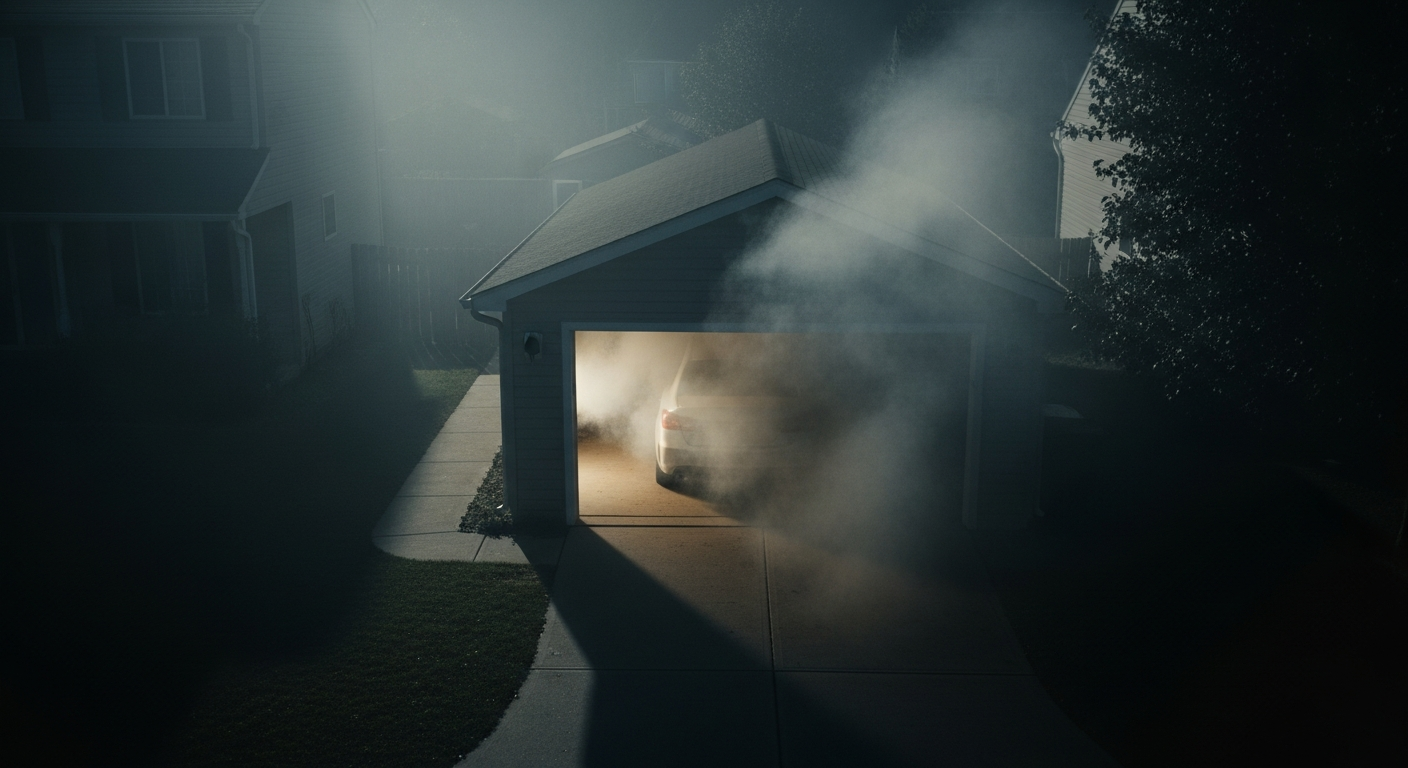
Detached garages allow CO to dissipate through gaps in the structure — most are not airtight, and the CO source is physically separated from the living space. Attached garages are different. They share at least one wall with the home and typically have a door — often with an inadequate seal — that creates a direct pathway for CO migration. Modern homes are built tighter than older construction, which compounds the problem: the negative pressure created by bathroom exhaust fans, range hoods, and the HVAC system actively pulls air from the garage into the living space as makeup air. Running a vehicle in an attached garage for as little as one minute can produce CO concentrations in adjacent rooms that exceed the OSHA permissible exposure limit for an eight-hour workday. Warming up a cold-weather vehicle — a practice that most modern fuel-injected engines don't even require — is the single most common trigger of garage-related residential CO events. Takeaway: the attached garage is a direct CO delivery system to your sleeping areas.
Sources of CO in the Garage Beyond Vehicles
Automobiles get most of the attention in garage CO discussions, but they are not the only combustion sources that create carbon monoxide risk in a garage environment. Gas-powered lawn equipment — lawn mowers, leaf blowers, pressure washers, and generators — produces extremely high CO concentrations when operated in enclosed or semi-enclosed spaces. A standard gasoline lawn mower running in a closed garage can produce CO concentrations equivalent to 100 idling automobiles. Natural gas water heaters installed in attached garages with inadequate combustion air create chronic low-level CO exposure that builds over hours of normal operation. The garage itself serves as a CO accumulation zone that the rest of the house then draws from through infiltration pathways. Even gas-powered tools stored in the garage that were recently operated and are still cooling emit residual CO. Takeaway: anything that burns fuel in or near your garage is a potential CO contributor, not just the vehicle.
How CO Travels From the Garage to Your Bedroom
The pathways by which CO moves from an attached garage into the living space are numerous and often invisible. The interior door between the garage and home is the most obvious — even a solid-core door with a good seal will allow CO infiltration during high-concentration events. More concerning are the hidden pathways: HVAC ducts that pass through or are located in the garage, electrical outlets on shared walls (a single standard outlet has enough gap around its wiring to allow measurable air flow), plumbing penetrations, and any structural gaps created during renovation. Combustion appliances like the home's furnace or water heater create negative pressure inside the living space as they draw combustion air — when the interior of the house is at negative pressure relative to the garage, any CO in the garage will flow toward the house through every available pathway. This is why CO incidents from garage sources often affect bedrooms at the far end of the house, not just rooms adjacent to the garage. Takeaway: a CO event that originates in the garage will reliably travel throughout the home.
Detection and Prevention: What Actually Works
The most important protective measure for an attached garage is a CO detector installed at the door between the garage and the living space — on the living space side, at breathing height, with a live PPM display. This gives you a real-time reading of what air is entering your home from the garage direction. Beyond detection, the prevention measures that make a meaningful difference are: installing a solid weatherstripped door between the garage and home (hollow-core doors offer minimal CO resistance), ensuring the door seal is intact at the threshold and all four sides, never warming up a vehicle inside the garage even briefly, never running gasoline-powered equipment inside the garage regardless of how open the door is, and relocating any gas appliance currently in the garage to a location with dedicated outdoor combustion air. If your HVAC return is located in the garage or the ducts pass through it, have an HVAC technician seal those penetrations. Takeaway: detection at the entry point combined with sealed pathways eliminates the garage-to-bedroom CO pipeline.
Practical Application: Securing Your Garage CO Pathway
- Install a CO detector with a live PPM display on the living space side of the garage-to-home door
- Check the door seal: run your hand along the edges while the garage door is closed — any airflow indicates a gap
- Never idle a vehicle in the attached garage, even with the garage door open — exhaust enters faster than it exits
- Never operate gasoline-powered equipment indoors, including in a garage with the door open
- Have your HVAC system inspected for duct penetrations through garage walls and ceiling
- If your water heater is in the garage, verify it has adequate combustion air supply per local code and that its exhaust vent is sealed and undamaged
- Consider a portable CO detector Plug-In Carbon Monoxide Detectors: Who Needs One and What to Look For to monitor the garage itself during periods of equipment use
- Use the CO Detector Placement Guide for exact mounting location and height guidance for the garage-to-house wall and every other area in your home
- Educate every household member: the garage-to-home CO pathway is invisible and acts quickly at high concentrations
Carbon monoxide in a garage is not a theoretical risk — it is one of the most consistently documented causes of residential CO events in the United States. The gap between the garage and the living space is often measured in fractions of an inch, but CO does not need much space to travel. A detector that shows you the live CO concentration entering your home from that direction is the most direct tool for catching a garage-sourced CO event before it becomes a medical emergency.
Protect Your Home with AirShield™
The only portable CO detector that shows you real-time PPM readings on a live OLED display. Electrochemical sensor, multi-gas detection, UL listed.
Check Availability →


Loading comments...