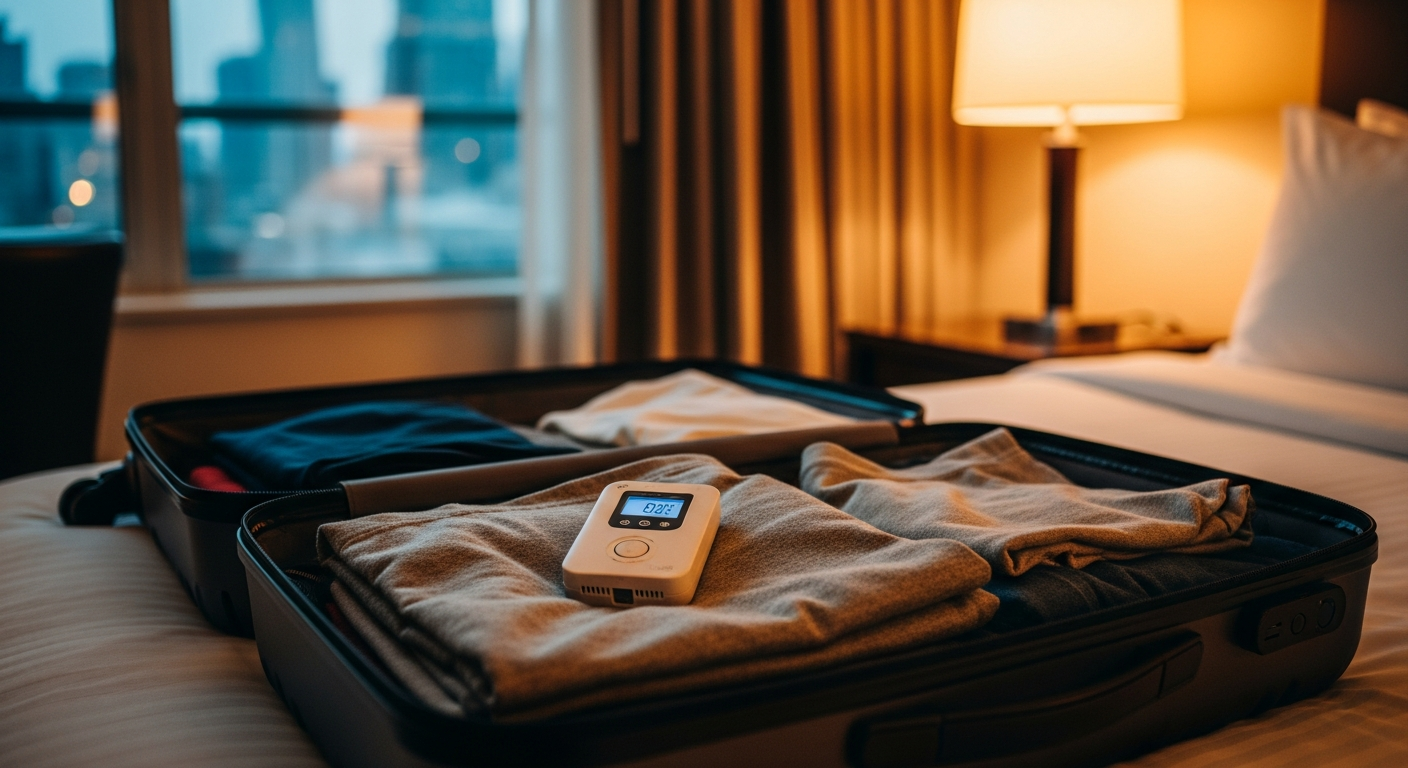
A portable carbon monoxide detector for travel is a compact, plug-in device that gives you an independent live CO reading in any hotel room, vacation rental, or Airbnb — without depending on the property's maintenance history. You check into a hotel room and run the standard assessment — working lock, functional remote, no obvious damage. The one thing you probably don't check is the CO detector on the wall, if there is one. Most travelers assume that the detector installed by the property is working. What they don't know is that it may have been installed three years ago by a maintenance contractor, that its electrochemical sensor may have expired last year, that its battery may be running on reserve capacity, or that the state where the hotel sits has no law requiring CO detectors in hotels at all. A carbon monoxide detector for travel is not a niche product for unusually cautious travelers — it's the logical response to a simple, persistent problem: you have no visibility into the CO safety infrastructure of any space where you sleep away from home, and the consequences of it failing are severe. This article covers why hotels and rentals carry higher CO risk than your home, what features your travel detector needs, how to use it correctly on every check-in, and what the readings mean. Carbon Monoxide Poisoning Symptoms: Signs & What to Do
Why Hotels and Vacation Rentals Carry Higher CO Risk Than Your Home
Your home has a CO history you understand. You know when the furnace was last serviced, when you replaced the detector, and roughly how old the water heater is. Hotels and vacation rentals offer none of that transparency. The HVAC systems, gas boilers, and water heaters in a hotel serve dozens of rooms and run continuously. Combustion equipment operating without interruption accumulates wear differently than residential systems that cycle seasonally. A cracked heat exchanger in a hotel boiler can elevate CO levels across multiple rooms before anyone identifies the source — and because hotel rooms don't have operable windows in many newer buildings, occupants can't ventilate. Research has documented that a meaningful portion of Airbnb and VRBO listings either lack CO detectors entirely or use units past their sensor expiration date — a structural safety gap that affects millions of stays annually. Beyond equipment age, the physical design of hotel rooms creates CO risk that homes don't have: they're often interior spaces with no operable windows, shared HVAC infrastructure that can carry CO from one unit to another, and guests who cycle through and never report sub-alarm readings because they don't know what normal looks like. The detector installed by the property may be functioning, but it may be alarm-only — calibrated to respond only after 70 PPM has been present for four hours. A reading of 45 PPM that builds slowly overnight will never trigger it. Carbon Monoxide Detector False Alarm: What's Causing It and What to Do Takeaway: the CO safety infrastructure of hotels and rentals is invisible to guests, may be expired, and may not respond to the slower low-level exposures that still cause harm.
What to Look for in a Carbon Monoxide Detector for Travel
Not every CO detector travels well, and the features that define a good home detector are not always the right features for a travel detector. Four specifications matter most for travel use. First: plug-in design with universal voltage. A detector that plugs directly into any wall outlet eliminates battery failure — the most common failure mode for portable safety devices that sit unused between trips. Universal voltage (100–240V) means the same detector works in North America, Europe, Asia, and Australia with only a physical plug adapter. Second: electrochemical sensor. This is the technology used in professional CO meters and provides accurate readings across the range of temperatures and humidity levels typical of hotel rooms worldwide. Third: live PPM display. In an unfamiliar space, you need to see a number, not wait for an alarm. A travel CO detector with a live display shows you 12 PPM within minutes of arrival — giving you the data to ventilate before anyone develops a headache. Fourth: multi-gas detection. Vacation rentals may use propane appliances, gas fireplaces, or LP heating. A detector that monitors CO, methane, and propane together gives you a complete picture of the combustion gas environment of any space. Takeaway: plug-in universal voltage, electrochemical sensor, live PPM display, and multi-gas detection are the four features that define a travel CO detector providing real protection. Portable Carbon Monoxide Detector: 5 Features That Actually Matter
The Check-In Protocol That Maximizes Your Protection
Most travelers who bring a CO detector don't use it correctly — and placement mistakes significantly reduce its protective value. CO concentration in a room is not uniform. It rises from sources, accumulates near the floor in some scenarios, and can reach dangerous levels in one area while the rest of the room reads close to normal. A detector plugged into the wall outlet on the far side of the room from your bed, especially near the bathroom or HVAC return, may not register a buildup near your sleeping position until concentrations there are already elevated. The most protective placement is within 10 feet of where you'll sleep at outlet height — not at the top of the wall, not across the room, as close to your pillow position as the nearest outlet allows. Follow this sequence on every check-in: plug in immediately after entering the room, position it nearest to your bed, and watch the display for two minutes. A reading of 0–4 PPM is normal background. Five to nine PPM sustained warrants opening a window and monitoring for another five minutes. Ten to 34 PPM calls for immediate ventilation, a conversation with the front desk, and a request for a different room. Above 35 PPM is an evacuation event — leave immediately, leave doors open behind you, call emergency services from outside. Carbon Monoxide Alarm Going Off? Here Is Exactly What to Do Takeaway: where you place the detector in the room matters as much as whether you brought it — 10 feet from your sleeping position at outlet height is the correct placement every time.
International Travel and Universal Voltage — What Most Buyers Get Wrong
International travel introduces a CO detector variable that domestic travelers don't encounter: voltage. A standard US CO detector operates on 110V current. Most of Europe, Asia, the UK, and Australia run on 220–240V. A plug adapter changes the physical connector; it does not change the voltage. Running a 110V-only device on 220V power will damage or destroy it on first use. A voltage transformer changes the voltage but adds weight and bulk that eliminates the portability benefit. A universal voltage CO detector (100–240V) is the only travel detector that genuinely works worldwide — it requires nothing beyond a physical plug adapter matching the local outlet shape. The same convenience that makes modern laptop power supplies and phone chargers work globally applies here. Beyond voltage, fuel types vary by region. In many parts of Europe, Latin America, and Southeast Asia, propane and liquefied petroleum gas are more common cooking and heating fuels than natural gas. In those environments, a CO-only detector misses part of the combustion gas risk profile. Multi-gas detection covering CO, methane, and propane provides complete coverage regardless of what's flowing through local appliances. Takeaway: for international travel, universal voltage and multi-gas detection are not optional upgrades — they are the baseline specifications for a detector that works everywhere you actually go.
Practical Application: Building Your Travel CO Safety Kit
These habits make the difference between a CO detector that travels in your bag and one that actually protects you:
- Carry it in your personal item or carry-on, not checked luggage — plug-in CO detectors without lithium batteries are permitted on commercial flights; keeping it accessible means you use it every trip
- For international travel, pack a universal plug adapter set — a universal voltage detector handles the electricity automatically; the adapter is the only accessory you need Portable Carbon Monoxide Detector: What It Is, Who Needs One, and How to Choose
- Plug in within five minutes of arriving at any new room — before you unpack, before windows are opened or closed, before the HVAC adjusts to the new occupancy level
- Place it within 10 feet of where you'll sleep at outlet height — the closest outlet to your pillow is the right placement, not the most convenient outlet near the door
- Watch the display for two minutes and note the baseline — if the reading is climbing rather than settling at or near 0, open the window immediately and monitor
- Normal on arrival: 0–4 PPM. Above 9 PPM sustained with no obvious cause: ventilate and request a different room. Above 35 PPM: evacuate and call emergency services
- Photograph any elevated reading before you leave the room — documentation is useful for the property, for Airbnb or VRBO reporting, and for any medical follow-up if symptoms developed
- Replace the unit every five to seven years — electrochemical sensors expire on a fixed chemical timeline regardless of how often you travel or how the device looks externally Carbon Monoxide Detector Not Working? Here's How to Tell — and What to Do
A carbon monoxide detector for travel is not a product for unusually cautious travelers — it's the correct response to the fact that you cannot verify the maintenance history of any CO detector installed in a hotel room, vacation rental, or RV, and you cannot know whether it's still working. The AirShield™ 3-in-1 Portable Carbon Monoxide Detector is the answer to that problem: plug-in, universal voltage, electrochemical sensor, live OLED display covering CO, methane, and propane simultaneously. It's compact enough to fit in a toiletry bag, works in any outlet from New York to Tokyo, and shows you a live reading within seconds of plugging in. Don't wait for an alarm to tell you whether the room is safe. Visit airshield.store and make it part of your travel kit today.
Frequently Asked Questions
Protect Your Home with AirShield™
The only portable CO detector that shows you real-time PPM readings on a live OLED display. Electrochemical sensor, multi-gas detection, UL listed.
Check Availability →
Loading comments...