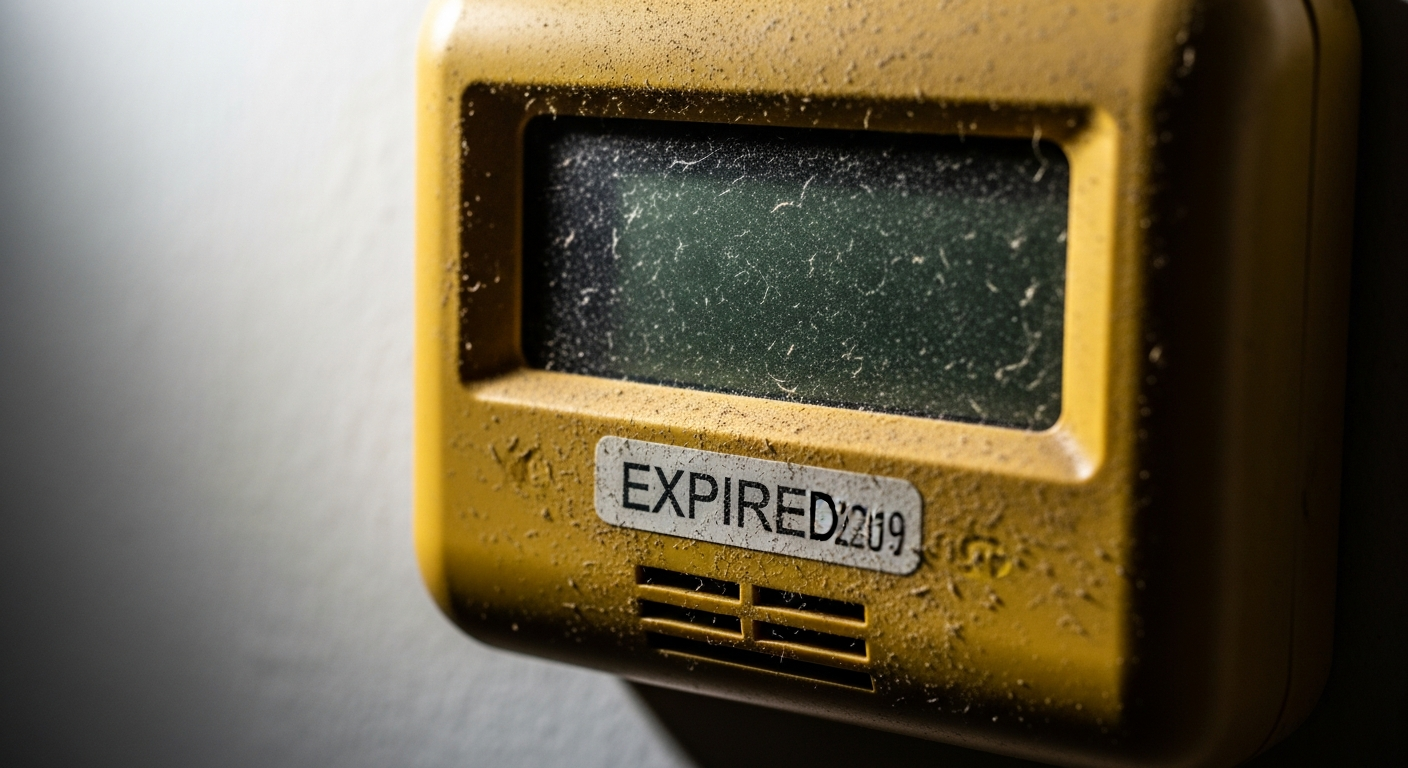
There is a quiet safety failure hiding in tens of millions of American homes right now. It looks like protection. It passes every test you run on it. The button beeps, the unit flashes, everything appears to be working. And if carbon monoxide enters that house tonight, it may not make a sound. CO detectors expire. Not in a theoretical way — in a specific, documented, well-understood chemical way. The electrochemical sensor inside every standard CO detector is a small chemical cell that reacts to CO molecules and generates an electrical signal. That cell has a finite lifespan. It dries out. It oxidizes. It loses sensitivity. After 5 to 7 years, it may no longer respond accurately to dangerous CO concentrations — and it will give you no indication that it can't. July is the peak month for home sales in the United States. Right now, hundreds of thousands of Americans are moving into homes with existing CO detectors whose age and history they know nothing about. This is what you need to know before you trust yours. What Causes Carbon Monoxide in a House? 7 Hidden Sources
The Chemistry Behind CO Detector Expiration
Most CO detectors use an electrochemical sensor — a small cell filled with a chemical electrolyte solution that reacts with CO molecules and produces a tiny electrical current. That current is what triggers the alarm. The problem is chemical: electrolyte solutions evaporate and oxidize over time. As the cell dries, it becomes less reactive. As it oxidizes, it loses sensitivity at the low-concentration range that matters most for early warning. The alarm threshold — the concentration at which the detector triggers — effectively rises as the sensor degrades. A detector that once alarmed at 70 ppm may no longer trigger reliably at 100 ppm after six years. This degradation is gradual and invisible. There is no indicator light for sensor degrading. There is no self-diagnostic that tells you the sensitivity has shifted. The detector continues to appear fully functional because, from the circuit board's perspective, it is. The test button on a CO detector tests the alarm circuit, not the sensor — a detector can pass the test button and still be unable to detect carbon monoxide. Manufacturers know this. Every reputable CO detector manufacturer lists a replacement interval — typically 5 to 7 years — on the unit itself, usually printed on a label on the back or bottom of the housing. The manufacturer is disclosing the chemistry. The question is whether anyone reads it. Portable Carbon Monoxide Detector: Battery or Plug-In? Takeaway: CO sensor degradation is a chemical certainty — every electrochemical sensor has a lifespan, and it ends silently and without visible warning.
The Test Button Won't Save You
Every CO detector has a test button. Push it and the alarm sounds. Most people interpret this as proof the detector works. It is not. The test button activates the detector's auditory circuit — the buzzer, the LED, the digital display. It confirms the device can make noise. It does not expose the electrochemical sensor to CO molecules. It does not measure whether the sensor can still detect gas. It tells you one thing: the alarm hardware is functional. A CO detector with a completely dead sensor will pass the test button check every time, right up until the night it fails to alarm and you don't wake up. This is not a design flaw — it's a design limitation that manufacturers disclose clearly in their manuals. The confusion arises because consumers reasonably assume that a test tests the thing that matters. In the CO detector market, that assumption is wrong — and it is responsible for homes relying on expired detectors for years after their sensors have degraded past the point of reliable detection. Some newer detector models include a calibration gas test port. If yours doesn't — and most don't — the only valid check on sensor function is knowing the manufacture date and replacing the unit when it reaches its stated service life. Why Is Carbon Monoxide Dangerous? The Science Explained Takeaway: Passing the test button is not a test of CO detection ability — it is a test of the buzzer, and every expired detector in America passes it.
Finding the Date That's Hiding on Your Detector
Every CO detector manufactured by a reputable brand has a manufacture date printed on it somewhere. It is almost always on the back or bottom of the housing, often in small type next to a model or serial number field. This date is the starting gun on the sensor's lifespan. Add 5 to 7 years — check your specific model's documentation for the stated interval, as it varies — and you have the date after which the detector should no longer be trusted. Flip your detector over right now. If the manufacture date is 2018 or earlier, the unit is operating past the industry-standard replacement window for most manufacturers. If the date is partially worn or illegible, the safest assumption is to replace it. Several things complicate this check in practice. Some older units have manufacture dates encoded in serial numbers rather than printed as a calendar date — a serial beginning with a two-digit year code means that is the manufacture year. Rental units and hotel-installed detectors are notoriously difficult to date; property managers often don't track replacement cycles. In a home sale, the CO detector may have been installed by a previous owner with no disclosure of age — it's not something buyers are typically told to check, and it's not required on most disclosure forms. Hotel Carbon Monoxide: Why You Should Bring Your Own Detector Takeaway: The manufacture date on the back of your detector is the only honest performance data you have — check it today.
Why July Is the Month This Becomes Most Dangerous
July is the peak month for residential home closings in the United States. Hundreds of thousands of buyers move into homes this month with CO detectors they did not install and know nothing about. In the typical home sale, the CO detector is treated like a smoke alarm — present, compliant, presumably functional. Buyers don't ask about the age. Inspectors note presence but rarely note the manufacture date. Real estate disclosure forms in most states don't require CO detector age disclosure, only that one exists. A new homeowner who moves in during July and discovers an existing CO detector is almost certain to assume it works. It may have been installed during a 2015 renovation. That detector is now more than a decade old, and its sensor has been past its replacement window for years. The same dynamic plays out in vacation rentals, Airbnb properties, extended-stay hotels, and any rental unit where the detector was installed years ago and maintenance is informal. Renters and short-term guests have essentially no way to assess the age of an installed CO detector and no legal mechanism in most states to require disclosure. Carbon Monoxide in Vacation Rentals: What Travelers Must Know Takeaway: The highest-risk moment for inheriting an expired detector is a home purchase or rental — exactly what July brings for millions of Americans.
Check Yours in the Next 10 Minutes
- Go to every CO detector in your home and flip it over
- Find the manufacture date — usually on the back or bottom label, look for MFD, Date, or a coded serial number
- If the date is 2018 or earlier, the unit is at or past the replacement window for most manufacturers
- If you cannot find a date, replace the unit — the absence of a readable date on a detector you did not install is itself a red flag
- Confirm the replacement interval for your specific model — check the manual or the manufacturer's website
- When you replace, choose a unit that displays a live PPM reading — a detector that only shows OK or Alarm gives you no data between zero and emergency
- If you're buying or renting a home this month, add CO detector manufacture date to your pre-move-in checklist
- If the detector is in a vacation rental or Airbnb, treat it as unverified — a portable detector with a live PPM display gives you independent measurement you can trust
A CO detector that doesn't work is not neutral. It is actively dangerous — it creates the belief that you're protected when you are not. That is worse than having no detector at all, because a home with no detector at least knows its own gap. The manufacture date on the back of that unit is the only honest signal you have. Everything else — the test button, the display, the annual battery swap — tells you nothing about whether the sensor can still do its job. If you're moving into a new home this July, or renting a property you didn't furnish, bring your own detector with a live PPM display. The AirShield™ 3-in-1 Portable Carbon Monoxide Detector uses an electrochemical sensor rated for 10 years — the longest standard available in portable detectors — and shows the actual live ppm reading the moment you plug it in. That number is the only data that tells you whether the air in that home is safe. Visit airshield.store.
Frequently Asked Questions
Sources & References
- CPSC: Carbon Monoxide Information Center — CPSC guidance on CO detector maintenance and replacement.
- NFPA 720: Standard for CO Detection and Warning Equipment — NFPA standard covering CO detector installation, service life, and maintenance requirements.
- UL 2034: Standard for Single and Multiple Station Carbon Monoxide Alarms — UL standard governing performance requirements and service life for residential CO alarms.
Protect Your Home with AirShield™
The only portable CO detector that shows you real-time PPM readings on a live OLED display. Electrochemical sensor, multi-gas detection, UL listed.
Check Availability →
Loading comments...