When a hurricane hits, people prepare for the obvious threats — flooding, wind damage, falling trees. What most households don't prepare for is what happens in the days after the storm: the power goes out, the generator comes on, and carbon monoxide builds silently in every room. During hurricane season, carbon monoxide poisoning kills more people in the affected region than the storm's wind and rain in many individual events. The CDC documented multiple post-hurricane periods where CO deaths in a single week exceeded all direct storm fatalities in that state. Hurricane season officially opens June 1 — and with it comes the generator risk that most safety conversations skip entirely. This post covers why CO becomes so dangerous after a hurricane, exactly why standard alarms respond too slowly to protect you, and the specific prep steps that can prevent a generator-related CO death in your household this season. Generator Carbon Monoxide: Why It Kills and How to Stay Safe
CO Is the Leading Cause of Post-Hurricane Deaths — Not the Storm
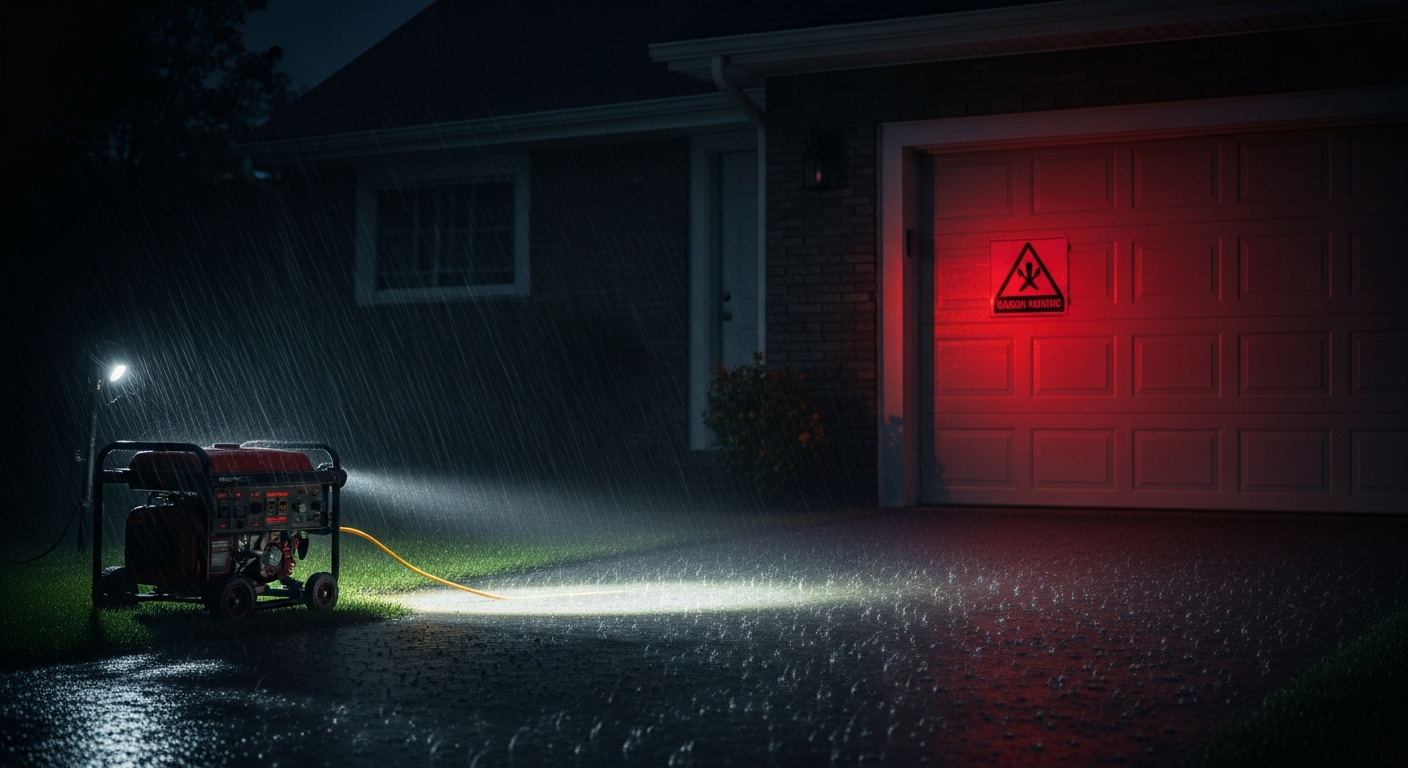
Carbon monoxide poisoning kills more Americans after hurricanes than the storms themselves — primarily from generators and fuel-burning appliances used indoors without adequate ventilation. After Hurricane Irma made landfall in Florida in 2017, at least 14 people died from CO poisoning in the week that followed — the majority tied directly to improper generator use. After Hurricane Harvey in Texas the same year, CO poisoning accounted for a significant share of post-storm emergency room visits. The pattern repeats every major hurricane season: the storm kills people during landfall, and the generator kills people in the week after. The core reason is physics. A portable generator running at full load produces carbon monoxide at a rate that can raise an attached garage from 0 PPM to a fatal concentration in under 10 minutes if the garage door is closed, and in under 30 minutes with the door partially open. Generators are not designed to be run near living spaces — they are construction and industrial tools adapted for emergency home use, and they produce CO volumes that dwarf anything a residential appliance emits. When millions of households in a hurricane zone start these machines simultaneously, the resulting CO poisoning incidents are predictable, preventable, and still happen every year. Takeaway: CO poisoning is a direct, predictable consequence of post-hurricane generator use — and it kills more people in many storm events than the storm itself. Carbon Monoxide Poisoning Symptoms: Signs & What to Do
Why Generators Kill Even When People Try to Be Careful
Most generator owners know they're not supposed to run the machine indoors. The problem is that 'indoors' is understood too narrowly. A generator in an attached garage with the door open is running indoors by any meaningful CO standard — CO enters the living space through the connecting door, through shared wall penetrations, and through the HVAC return air system. A generator running on a covered back porch 10 feet from an open window pushes CO directly into that room when the wind is calm. A generator running at the side of the house 15 feet from a ground-floor window — the distance that many households assume is safe — can still produce hazardous concentrations in the rooms nearest the exhaust, depending on wind direction and building tightness. The CPSC recommends a minimum of 20 feet from any opening in the structure — and specifies that the generator exhaust must point away from the house, not merely be placed at a distance. In practice, during a post-hurricane power outage with limited outdoor space, standing water, and a family that needs to run a refrigerator and a few fans, that standard is difficult to maintain. The result is that careful, well-meaning generator owners still end up with CO migrating into their homes. Takeaway: the standard ‘don’t run it indoors’ guidance creates false confidence — CO travels through attached spaces, HVAC systems, and open windows at distances most people consider safe. Carbon Monoxide in Your Garage Is Entering Your Home — Here Is How to Stop It
Your Standard CO Alarm Won't Protect You Fast Enough
Residential CO alarms in the United States are required to comply with UL 2034. That standard sets alarm thresholds at 70 PPM for 4 hours, 150 PPM for 50 minutes, or 400 PPM for just 4 minutes. Those thresholds were designed to ensure an alarm responds before a healthy adult develops severe acute poisoning symptoms from brief, high-concentration exposures. They were not designed for the post-hurricane generator scenario, where CO can climb rapidly and where the people inside — exhausted from storm prep, sleeping after a long day, or dealing with heat in a closed-up house — may not be alert enough to notice early symptoms. At 400 PPM, a standard UL 2034 alarm has 4 minutes to trigger — but at the same concentration, a person at rest begins experiencing severe headache and dizziness within 1–2 hours, and children and elderly individuals are affected faster. A CO detector with a live numeric display changes the equation. Instead of waiting for an alarm threshold to be crossed, you see the actual PPM reading: 8 PPM at baseline, rising to 22 PPM as the generator starts, climbing to 45 PPM when the wind shifts. That trend line tells you to adjust placement before the concentration reaches the danger zone — not after. Carbon Monoxide PPM Levels Explained: What's Safe, What's Dangerous Takeaway: UL 2034 alarm thresholds are calibrated for acute scenarios, not for the slow CO climb that a generator in a semi-enclosed space produces over hours of runtime.
The Generator Isn't the Only Post-Hurricane CO Source
Generators account for the majority of post-hurricane CO deaths, but the hours and days after a major storm introduce several other CO sources that households underestimate. Charcoal grills are the most dangerous: people bring them indoors or into garages during rain to cook meals during the outage, not realizing that charcoal combustion produces extremely high CO concentrations. A charcoal grill in a closed garage can raise CO to fatal levels in 30 minutes. Propane camp stoves used indoors for cooking are similarly hazardous — designed for ventilated outdoor use, they produce enough CO in an enclosed kitchen to cause poisoning within an hour of continuous use. Gas lanterns, especially older-style mantle lanterns, emit CO during combustion and should never be used in bedrooms or sleeping areas during a power outage. In post-hurricane conditions, when multiple CO sources are active simultaneously — generator plus grill, or camp stove plus gas lantern — concentrations inside a home can rise to dangerous levels far faster than any single source would produce alone. The combination effect is what makes the post-hurricane period so particularly dangerous from a CO perspective. Takeaway: after a hurricane, assume every fuel-burning appliance brought indoors or into an attached space is a CO source — the cumulative effect of multiple sources is more dangerous than any single one.
Hurricane CO Safety: What to Do Before the First Outage
Prepare now, before June 1, while you still have power and time to think clearly:
- Place a CO detector with a live numeric display in the room closest to your generator's likely position — this gives you real-time data on migration before concentrations reach alarm thresholds Plug-In Carbon Monoxide Detectors: Who Needs One and What to Look For
- Measure 20 feet from every window, door, and vent on your house and mark where your generator can legally run — do this now so you're not estimating distances in the dark during an outage
- Check the exhaust direction: the generator exhaust pipe must point away from your home, not parallel to the wall — even 20 feet of distance is undermined if the exhaust blows toward an opening
- Stock battery-powered lighting and a propane camp stove you plan to use outdoors only — eliminating indoor cooking needs reduces the temptation to bring a grill or stove inside during rain
- Never run a generator, grill, camp stove, or gas lantern in a bedroom — people asleep cannot detect early CO symptoms and do not wake up to alarms until concentrations are severe
- Run your generator no more than necessary: every hour of runtime is an hour of CO production; prioritize the refrigerator and medical equipment over non-essential appliances to minimize total runtime
- If your CO detector reads above 9 PPM sustained, move the generator further away or shut it down and ventilate — do not wait for an alarm to sound Carbon Monoxide PPM Levels Explained: What's Safe, What's Dangerous
- Know the symptoms: headache, fatigue, nausea, and confusion that appear during or after generator use are CO poisoning until proven otherwise — get everyone outside and call 911
Hurricane season opens June 1, and for millions of households in the Gulf Coast, Atlantic Seaboard, and Caribbean, the first major outage is a matter of when — not if. The generator that keeps your food cold and your family comfortable is also the most concentrated source of carbon monoxide in any residential setting. The difference between a close call and a fatality is often the difference between an alarm-only detector and one that shows you the actual number. The AirShield™ 3-in-1 Portable Carbon Monoxide Detector displays live CO, methane, and propane readings on its OLED screen at all times — 0 PPM to dangerous, in real time, not just when a threshold is crossed. It plugs into any outlet, runs for up to 10 years without battery replacement, and travels wherever you need protection. Before the first storm of the season, visit airshield.store and put a live-reading detector in your hurricane kit.
Frequently Asked Questions
Sources & References
- CPSC: Generators and Carbon Monoxide Poisoning — CPSC data on generator-related CO poisoning incidents and deaths
- CDC: Hurricane Preparedness — Carbon Monoxide Poisoning — CDC guidance on CO risks during and after hurricanes
- EPA: Generators and Air Quality — EPA documentation on CO emissions from portable generators
Protect Your Home with AirShield™
The only portable CO detector that shows you real-time PPM readings on a live OLED display. Electrochemical sensor, multi-gas detection, UL listed.
Check Availability →


Loading comments...