Children's bedrooms need their own carbon monoxide detectors — not just a unit in the hallway. NFPA 720 explicitly recommends CO detection inside each sleeping area, and pediatric data shows children accumulate dangerous CO levels significantly faster than adults due to higher respiratory rates. A hallway detector with a closed bedroom door between it and your sleeping child is not adequate protection. This post explains exactly why kids are more vulnerable to CO, where detectors should go in a child's room, and what type of detector actually provides real-time confirmation that it is working — not just waiting to alarm.
Why Are Children More Vulnerable to Carbon Monoxide Than Adults?
Carbon monoxide binds to hemoglobin with roughly 240 times the affinity of oxygen, forming carboxyhemoglobin (COHb) that prevents blood from delivering oxygen to organs. The faster you breathe, the faster COHb accumulates. Children breathe 20–40 times per minute — toddlers at the higher end — compared to an adult's 12–20 breaths per minute. This means a toddler can reach a COHb level of 20% (associated with confusion and possible loss of consciousness) in roughly half the time it takes an adult in the same room. The New England Journal of Medicine has published clinical data confirming that pediatric patients consistently present with higher COHb levels than adults found in the same incident location, controlling for exposure duration. The CPSC estimates that over 100,000 Americans visit emergency rooms annually due to CO poisoning, with children under 5 disproportionately represented in severe-outcome cases. This is not because children are in more dangerous situations — it is because their physiology concentrates the danger faster. The additional complication is symptom misidentification. CO poisoning symptoms in children — vomiting, headache, lethargy — are clinically indistinguishable from gastroenteritis. Emergency physicians report that pediatric CO cases are frequently delayed by 12–24 hours because parents assume a stomach bug, not a gas leak. Carbon Monoxide Poisoning While Sleeping: The Real Risk Takeaway: Children's faster respiratory rates cause CO to accumulate to dangerous levels in roughly half the time it takes adults in the same environment — making bedroom-level detection non-negotiable.
Does a Hallway CO Detector Actually Protect a Child's Bedroom?
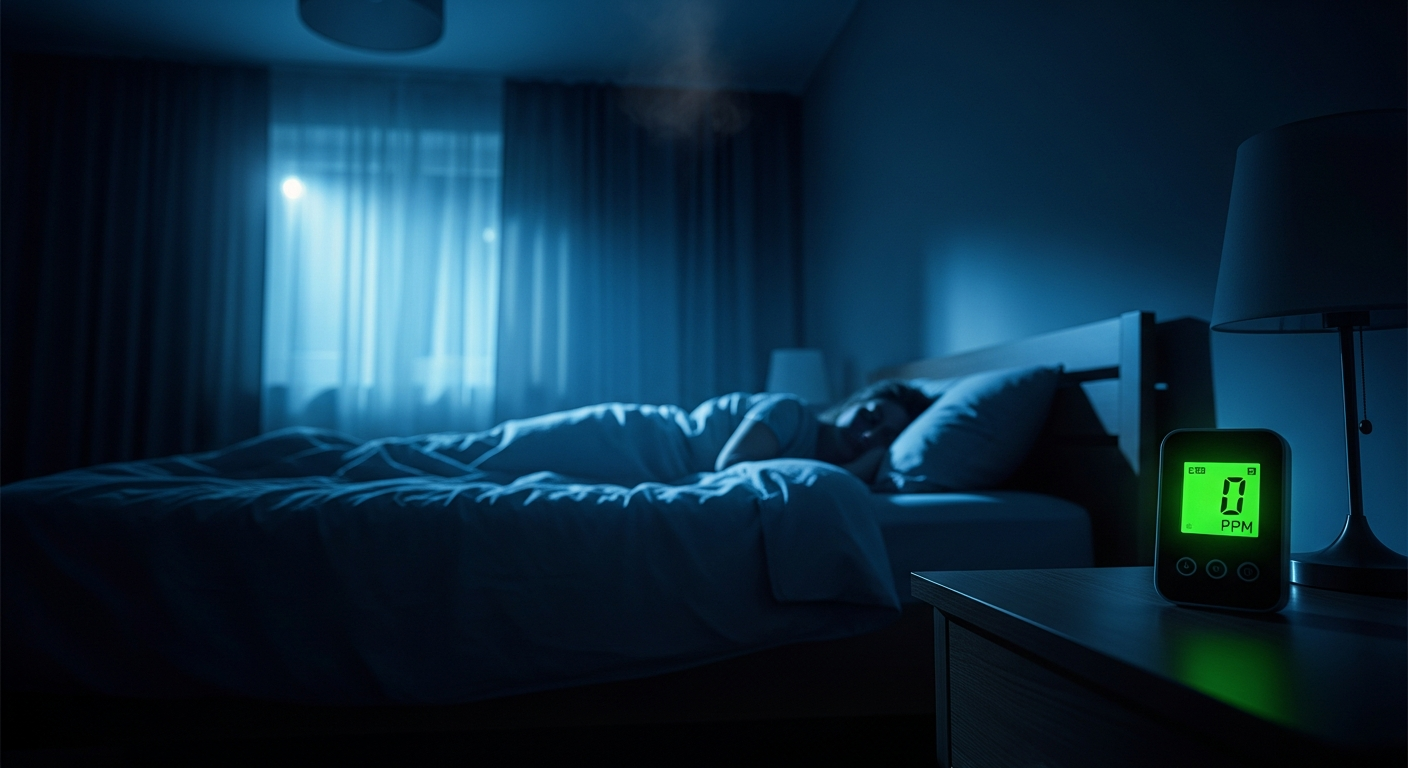
The short answer is: not reliably, especially at night. NFPA 720 — the U.S. standard for CO detection systems — specifically recommends detectors both outside sleeping areas (hallways) and inside sleeping areas. The reason is straightforward physics combined with human behavior: bedroom doors are frequently closed at night, and a closed door creates a meaningful barrier to CO migration from hallway to bedroom and vice versa. In a closed bedroom scenario, CO can rise to 100–150 ppm inside the room before enough gas migrates under the door to trigger a hallway detector set to alarm at 70 ppm. By that time, a child sleeping in the room has been exposed to sub-alarm but still harmful concentrations for potentially 30–60 minutes. The 70 PPM Standard Was Designed to Alarm Late — Here's Why That's a Problem NIOSH data on CO incidents confirms that many victims are found in rooms distant from the only installed detector, which had not yet alarmed. CPSC explicitly states that every sleeping area should have a CO detector — not just outside it — and recommends one on each level of the home plus each sleeping zone. For a typical three-bedroom home, that means four or more detectors, not one or two. Most families dramatically underprotect their children by following minimum code rather than best-practice guidance. The practical implication is clear: the hallway detector is a backstop, not a primary protection system for children sleeping behind closed doors at night. Takeaway: A closed bedroom door delays hallway CO alarm notification by 30–60 critical minutes — children's bedrooms require dedicated detectors inside the room.
How Should You Set Up CO Detection for a Child's Bedroom?
- Place a dedicated detector inside the child's bedroom, not just outside the door — NFPA 720 and CPSC both support this as best practice for sleeping areas
- Mount or plug in the detector at 3–5 feet height — CO distributes evenly in air, so mid-wall placement near the bed captures the breathing zone accurately
- Choose a unit with a live PPM display so you can do a quick visual check during nighttime room checks without waking the child or waiting for an alarm
- Prioritize plug-in detectors in children's rooms to eliminate battery-failure risk — dead batteries are the number one documented cause of CO detector failures during incidents per CPSC
- Test the detector monthly using the test button and verify the sensor is within its rated lifespan — electrochemical sensors degrade after 5–7 years and must be replaced How Long Do Carbon Monoxide Detectors Last? When to Replace Yours
- Ensure interconnected alarms if your home supports it — when one unit detects CO, all units sound, giving you maximum warning time to reach a child in a distant bedroom
- Keep a CO detector at any secondary location your child regularly sleeps — grandparent's home, vacation rental, or hotel room Carbon Monoxide in Airbnbs and Vacation Rentals: What Every Summer Traveler Needs to Know
The distance between your child's sleeping face and the nearest CO detector may be the most consequential measurement in your home. If it is a hallway unit behind a closed door, that gap could cost 30–60 minutes of warning time you cannot afford. The AirShield™ 3-in-1 Portable Carbon Monoxide Detector was designed for exactly this gap: a compact plug-in unit powered by universal 100–240V that displays live CO, methane, and propane PPM on an OLED screen, so you can read the sensor status at a glance during any nighttime check. UL listed, built on an electrochemical sensor with a Smart M8 Chip, and portable enough to follow your child to every room they sleep in — at home or away. See it and order at airshield.store.
Frequently Asked Questions
Sources & References
- CDC — Carbon Monoxide Poisoning Prevention — CDC guidelines on CO detector placement and at-risk populations including children
- NFPA 720 — Standard specifying CO detector placement requirements including outside and inside sleeping areas
- American Academy of Pediatrics — Pediatric guidance on environmental hazards in the home including CO exposure in children
- CPSC — Carbon Monoxide Questions and Answers — CPSC guidance on number and placement of CO detectors per sleeping area
- NIOSH — Carbon Monoxide Hazards — NIOSH data on CO concentration thresholds and vulnerable populations
- New England Journal of Medicine — CO Poisoning in Children — Clinical data on pediatric carboxyhemoglobin accumulation rates versus adults
Protect Your Home with AirShield™
The only portable CO detector that shows you real-time PPM readings on a live OLED display. Electrochemical sensor, multi-gas detection, UL listed.
Check Availability →
Loading comments...