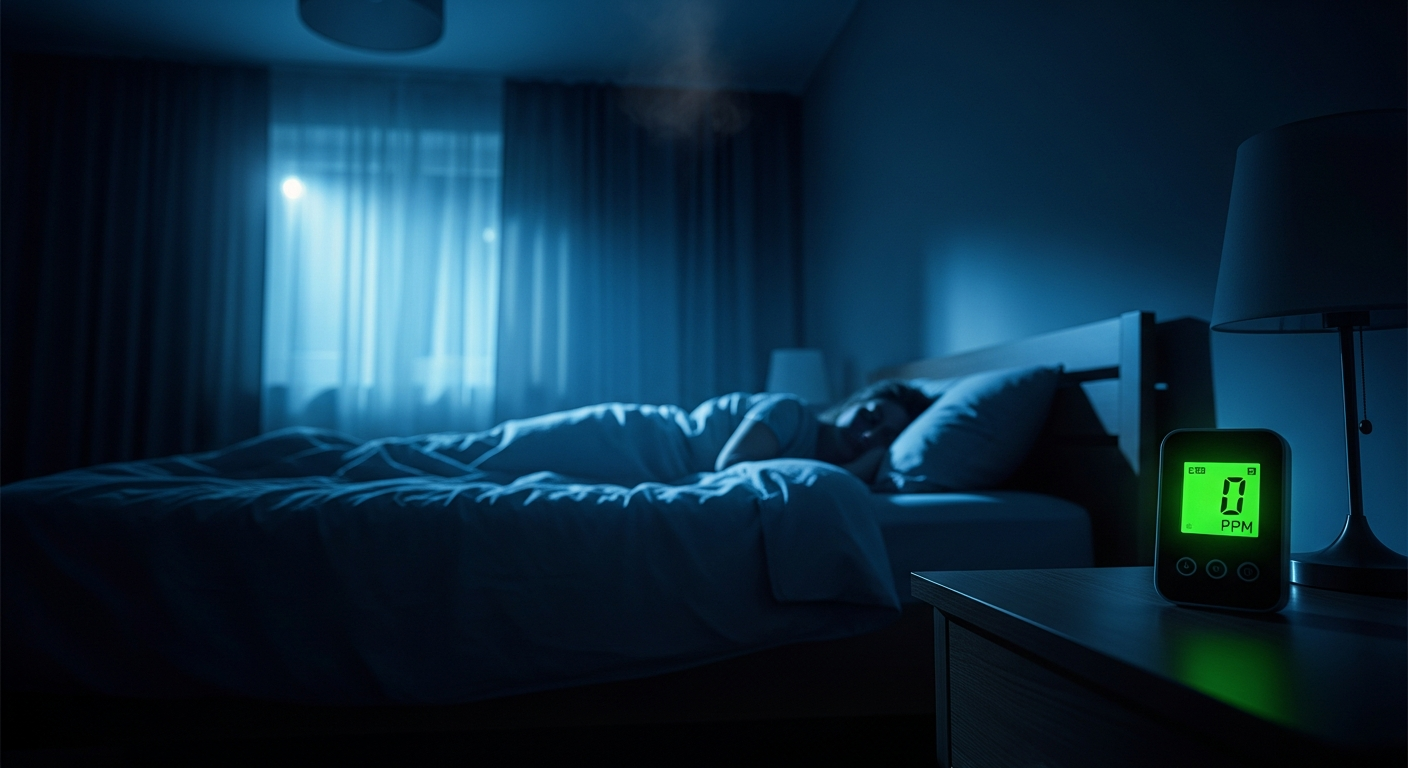
Carbon monoxide poisoning while sleeping is responsible for the majority of CO-related fatalities in the United States every year. The reason is direct: while you sleep, you cannot recognize the early symptoms of CO exposure — the headache, nausea, and dizziness that would prompt you to act when awake pass completely unnoticed, and by the time concentrations reach the threshold that triggers a standard alarm, the buildup may already be incapacitating. The CDC estimates approximately 430 Americans die each year from unintentional, non-fire CO poisoning, and CPSC data shows a disproportionate share of those deaths occur between midnight and 6 a.m. This guide explains the specific mechanisms that make nighttime CO exposure uniquely lethal, where to place your detector, what low-level CO does to your sleep quality even without a poisoning event, and what to do if your alarm sounds at 2 a.m.
Why Carbon Monoxide Is More Dangerous at Night Than During the Day
The danger of CO poisoning while sleeping comes down to one factor: you cannot recognize and respond to its early warning symptoms when unconscious. During waking hours, a rising CO level produces a progressive headache, nausea, and fatigue that most people would eventually connect to their environment — symptoms that can prompt ventilation, evacuation, or a call for help. Asleep, none of those recognition pathways are active. Carbon monoxide binds to hemoglobin in the blood — forming carboxyhemoglobin — and progressively reduces oxygen delivery to the brain and heart. At around 35 PPM over several hours, cognitive function and reaction time degrade measurably. At 70–150 PPM, a sleeping person may never regain full consciousness before concentrations climb further. A CPSC review of non-fire CO fatalities found that more than 60% occurred in bedrooms or other sleeping areas — confirming that being asleep during CO buildup is the single most predictive factor in fatal outcomes, more than appliance type, building age, or CO source. Even standard UL 2034 CO alarms provide limited nighttime protection. They are not required to sound until CO reaches 70 PPM sustained over 4 hours or 150 PPM over 50 minutes — thresholds calibrated to reduce nuisance alarms, not to catch slow-building nighttime exposure in sleeping occupants. Takeaway: sleep removes the self-rescue window that makes daytime CO survivable — nighttime protection depends entirely on your detector catching the buildup before concentrations become incapacitating.
The Morning Symptoms of CO Poisoning Most People Misattribute
The medical literature documents a pattern called CO poisoning morning syndrome: occupants wake with a dull frontal headache, nausea, and unusual grogginess that resolves after 30–60 minutes outside. These same people typically attribute the symptoms to poor sleep, dehydration, allergies, or the early stages of a cold — until the pattern repeats, or concentrations spike during a single severe event. Research published in the Annals of Emergency Medicine estimates that 20,000 to 30,000 cases of CO poisoning per year are misdiagnosed as flu, viral illness, or migraine in emergency settings — with overnight exposure presenting as morning symptoms accounting for a significant share. Key features that distinguish CO poisoning from ordinary morning grogginess: The headache is frontal and worsens indoors. If you wake with a headache that improves after you have been outside for an hour, that improvement is diagnostic. Flu headaches do not respond to location change. Multiple people are affected simultaneously. If two or more household members wake with the same symptoms on the same morning, that pattern is a strong CO indicator. Viral illness spreads over days; CO exposure affects everyone in the space at once. Pets show symptoms first. Birds and small mammals are more sensitive to CO than humans. A lethargic bird, a dog unwilling to rise, or a cat seeking outdoor air alongside your headache is a combination that warrants immediate evacuation. Carbon Monoxide Poisoning Symptoms: Signs & What to Do Takeaway: morning symptoms that improve outdoors and affect multiple people simultaneously are a CO red flag — the location response is the diagnostic signal, not the severity.
Where to Place Your CO Detector for Maximum Protection While Sleeping
NFPA 720 requires at least one CO detector in the immediate vicinity of each sleeping area — within 15 feet of each bedroom door. In most homes, this means one detector in the hallway serving bedrooms on each floor. This placement catches CO migrating toward sleeping occupants before concentrations in the bedrooms themselves reach dangerous levels. For stronger protection, a detector inside each sleeping room outperforms hallway-only placement. A closed bedroom door measurably slows CO migration — concentrations can build inside a room with a closed door and a local CO source (gas fireplace, connected HVAC zone, attached garage wall) before the hallway detector responds. The most effective nighttime placement is a CO detector with a live PPM display positioned within 10 feet of your sleeping position, at outlet height — close enough that the display and alarm can reach you before concentrations in the room become incapacitating. For apartments: shared mechanical systems — boilers, underground parking, adjacent unit appliances — are not under your control. A detector inside your bedroom is the only protection layer you can rely on independently of building management. For hotel rooms and vacation rentals: the same logic applies. Plug your portable CO detector within 10 feet of where you will sleep. The detector near the room's entrance door — if one exists at all — is positioned to protect the hallway, not your pillow. Carbon Monoxide Detector for Travel: Your Hotel Safety Protocol Takeaway: bedroom-specific placement, not hallway-only, is the standard that matches the actual risk — the room where you sleep is where CO needs to be measured.
What Low-Level CO Does to Your Sleep Quality Before Any Alarm Sounds
Below the threshold that triggers standard CO alarms — the 1–35 PPM range common in homes with gas appliances, aging furnaces, or attached garages — carbon monoxide has a measurable effect on sleep architecture that most people attribute to other causes entirely. Occupational exposure studies have documented that sustained CO at 15–35 PPM over several hours produces increased sleep latency, reduced slow-wave and REM sleep duration, higher frequency of nighttime arousals, and elevated morning fatigue ratings independent of total sleep time. A furnace operating slightly outside spec, a gas range in a poorly ventilated kitchen, or an attached garage wall that doesn't fully seal can produce CO levels that chronically degrade sleep quality — with no alarm ever sounding and no single incident severe enough to prompt investigation. This is the exposure band that alarm-only detectors are engineered to ignore. Standard CO alarms do not trigger in the 1–35 PPM range regardless of duration, by design. A detector with a live PPM display — showing 22 PPM at 2 a.m. in the bedroom — provides the only way to identify this pattern, connect it to a specific appliance or ventilation deficiency, and address it before it becomes an acute event. Night after night of 20–30 PPM in the bedroom is not a crisis that triggers an alarm. It is a chronic appliance problem that shows up as years of bad sleep. Low-Level Carbon Monoxide Exposure: The Silent Risk Your Alarm Never Triggers Takeaway: the 1–35 PPM band invisible to standard alarms is measurably affecting sleep quality in more homes than anyone would guess — only a live-display CO detector reveals it.
What to Do If Your CO Alarm Sounds While You Are Sleeping
A CO alarm at night requires one response: immediate evacuation. Not investigation. Not pressing the silence button. Not cracking a window to see if the reading drops.
- Wake every person in the household immediately — assign someone to check each bedroom; do not assume everyone heard the alarm
- Get outside without stopping to investigate the source, collect belongings, or reset the alarm — leave doors open as you go
- Call 911 from outside — emergency responders carry meters that measure actual CO concentrations and can identify the source before re-entry is safe
- Do not re-enter for any reason until emergency services give explicit clearance — the instinct to grab your phone, check the pets, or silence the alarm has contributed to CO fatalities
- Account for all household members and pets at your outdoor meeting point
- If using a live-display CO detector: a reading above 35 PPM warrants the same response as an audible alarm — evacuate and call 911, do not wait for the threshold alarm to sound Carbon Monoxide Alarm Going Off? Here Is Exactly What to Do
Carbon monoxide poisoning while sleeping kills because sleep takes away the one resource that makes CO survivable: the awareness to act. The headache builds, the air thickens, concentrations climb — and none of it penetrates the sleeping person until it is past the point of self-rescue. The solution is not just having a CO detector in the house — it is placing a detector where you sleep, showing you the number before your eyes close. The AirShield™ 3-in-1 Portable Carbon Monoxide Detector displays live CO PPM on an OLED screen the moment it is plugged in, at the bedside, in the bedroom, or in a hotel room 1,000 miles from home. You see what is in the air before you fall asleep. Visit airshield.store to get yours.
Frequently Asked Questions
Sources & References
- CDC: Carbon Monoxide Poisoning Prevention — CDC overview of CO poisoning incidence, mortality, and prevention — approximately 430 Americans die annually from non-fire CO poisoning
- CPSC: Non-Fire CO Poisoning Deaths Annual Report — Annual CPSC data showing nighttime hours (midnight–6 a.m.) account for a disproportionate share of CO fatalities
- NIOSH: CO Immediately Dangerous to Life or Health — NIOSH IDLH threshold for carbon monoxide: 1,200 PPM; occupational ceiling: 35 PPM (8-hour TWA)
- NFPA 720: Standard for CO Detection in Dwelling Units — NFPA 720 placement standard requiring CO detectors in the immediate vicinity of sleeping areas
- Annals of Emergency Medicine: CO Poisoning Misdiagnosis — Study estimating 20,000–30,000 cases of CO poisoning per year are misdiagnosed as flu, viral illness, or migraine
Protect Your Home with AirShield™
The only portable CO detector that shows you real-time PPM readings on a live OLED display. Electrochemical sensor, multi-gas detection, UL listed.
Check Availability →
Loading comments...