In February 2025, three young Massachusetts women — Wafae El-Arar, 26; Kaoutar Naqqad, 23; and Imane Mallah, 24 — died of carbon monoxide poisoning in their suite at a beach resort in Belize. One month later, in March 2025, Miller Gardner, the 14-year-old son of former New York Yankees player Brett Gardner, was found dead in a Costa Rica hotel room. The cause: carbon monoxide from the building's systems. One month after that, a double fatality at a motel in Eureka. These are not anomalies. Between 1989 and 2018, at least 183 documented CO incidents in U.S. hotels injured over 1,600 people and killed 49. No federal law requires CO detectors in any of these properties. This summer, millions of travelers will sleep in hotel rooms, resort suites, and vacation rentals with no CO protection at all. Here's what you need to know. July 4th Carbon Monoxide Danger: Grills and Generators
The Regulatory Gap That Puts Travelers at Risk
When you check into a hotel in the United States, you have every reason to assume that room meets basic safety standards. For most hazards — fire, electrical, structural — that assumption is largely accurate. For carbon monoxide, it is not. There is no federal requirement for CO detectors in hotels, motels, or vacation rentals. The patchwork of state laws is startling: only 14 states require CO detectors in hotels and motels. The other 36 states — plus Washington D.C. — have no such mandate. Short-term rental platforms like Airbnb require hosts to disclose whether CO detectors are present. They do not require that detectors actually exist, that they work, or that they have been tested. Verification is self-reported. Resort and hotel chains often install CO detectors voluntarily, but "often" is not "always," and detector placement, maintenance, and functionality are not federally audited. The families of victims of multiple high-profile hotel CO deaths have publicly questioned why no federal agency tracks CO poisoning incidents in hospitality settings — a data gap that makes the true scope of the problem unknowable. What Causes Carbon Monoxide in a House? 7 Hidden Sources Takeaway: The absence of a CO alarm in your hotel room says nothing about whether CO is present. The regulatory framework simply does not require one.
Where CO Comes From in Hotels and Resorts
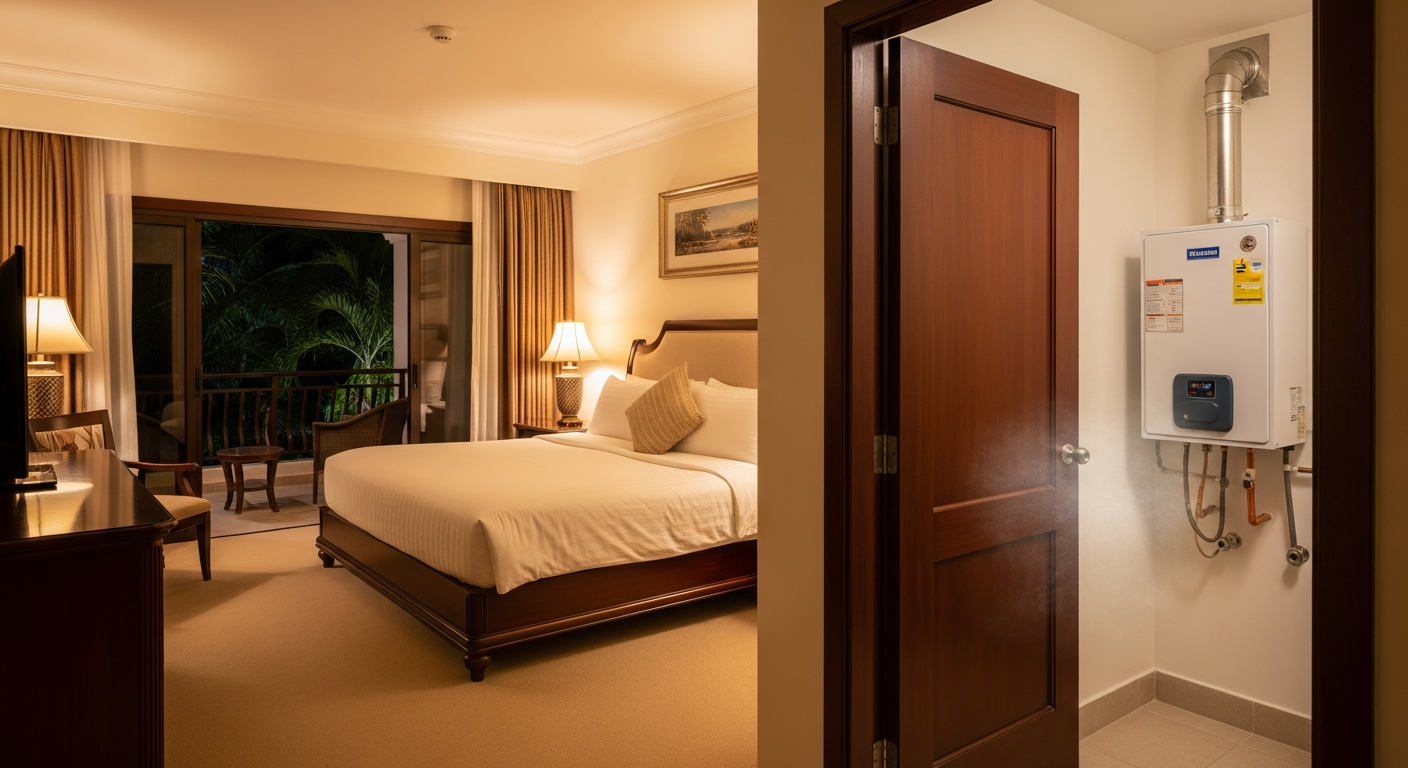
Hotel CO incidents are not random. They cluster around specific equipment categories found in the mechanical infrastructure of most hospitality properties. **Pool and spa heaters** are the most commonly cited source in documented hotel CO incidents. Gas-fired pool heaters produce high CO output. When vents are blocked — by debris, animal nesting, poor maintenance, or improper installation — exhaust back-drafts into mechanical rooms that share walls or HVAC systems with guest rooms. **Gas water heaters and boilers** follow the same failure pattern. In older properties, venting systems corrode, develop leaks, or lose their draw. CO enters utility corridors and migrates into adjacent rooms through penetrations, shared HVAC systems, and gaps under doors. **Portable generators** used during power outages have caused multiple hotel CO deaths. When a property loses power and staff deploys a generator indoors or in a parking structure adjacent to guest rooms, CO migrates rapidly. **Gas-fired laundry equipment** in basement or ground-floor utility rooms has been cited in incidents involving guest rooms directly above. The common thread in nearly every documented hotel CO incident is that affected guests had no idea anything was wrong — because CO is invisible, odorless, and tasteless, and standard room amenities include no way to detect it. Low-Level Carbon Monoxide Exposure: The Silent Risk Your Alarm Never Triggers Takeaway: Hotel CO almost always comes from back-of-house mechanical equipment — sources guests never see and properties often fail to maintain.
Why Hotel CO Deaths Happen During Sleep
The timing of hotel CO fatalities is not random. An overwhelming majority occur overnight, while guests are sleeping. This is not a coincidence — it is a predictable outcome of how CO poisoning interacts with sleep. During sleep, the body's gas exchange rate drops. You breathe more shallowly and more slowly. CO accumulates in your bloodstream at a slower rate, which sounds like a safety buffer — but it is the opposite. Slower accumulation means the poisoning progresses further before symptoms become severe enough to wake you. The body's normal response to CO — confusion, impaired judgment, weakened muscles — is effectively masked by the state of sleep. By the time CO concentrations reach the threshold where a sleeping person might naturally rouse, the carboxyhemoglobin saturation is often already high enough to prevent them from getting up. This is why the documented CO deaths in hotels share a common feature: the victim did not call for help. The 14-year-old in Costa Rica. The three women in Belize. None of them raised an alarm. They lost consciousness before the situation was recognizable to them as an emergency. At moderate CO concentrations, the transition from sleep to unconsciousness can occur without any waking period in between — the poisoning outpaces the body's ability to rouse itself. Should a CO Detector Be in Your Bedroom? Yes. Here's Why Takeaway: Hotel CO deaths happen at night because CO poisoning and sleep have the same symptom: you stop moving. The combination is catastrophic without a detector.
What to Do Before You Sleep in Any Rental or Hotel Room
- Bring a portable CO detector — plug it in immediately upon check-in and let it run; a live PPM reading tells you what the air contains before you sleep in it
- Look for a CO detector in the room — check smoke detectors (some are combination units) and look near the floor, where CO detectors are optimally placed
- If no detector is present, ask management — properties in regulated states are legally required to provide one; in unregulated states, at minimum you know the room's status
- Locate the mechanical room nearest your room — pool equipment, boilers, and laundry rooms are the highest-risk adjacencies
- Note the home-away symptom pattern — if you wake with a headache that fades after you step outside, take it seriously and request a different room
- If multiple guests in the same area report similar symptoms, alert management and leave the building; contact emergency services
- On travel to international destinations, research local CO detector laws — many popular destinations (Mexico, Caribbean, Central America) have no requirements whatsoever
The AirShield™ 3-in-1 Portable Carbon Monoxide Detector is designed for exactly this situation. Compact enough to pack in a carry-on, compatible with any standard outlet worldwide (100–240V with international adapters included), it shows a live CO PPM reading from the moment it's plugged in. Check in. Plug in. Know the number before you close your eyes. That's the layer of protection no hotel is legally required to provide you — but you can provide yourself. Visit airshield.store.
Frequently Asked Questions
Sources & References
- CDC: Carbon Monoxide in Hotels and Motels — CDC NIOSH data on documented CO incidents in hotel and motel settings, 1989–2018.
- Journal of Environmental Health: Hotel CO Poisoning Study — Peer-reviewed study documenting 183 CO incidents in U.S. hotels resulting in 49 deaths and 1,600+ injuries.
- CPSC: CO Safety in Lodging Properties — CPSC guidance on CO detector requirements and lodging property hazard identification.
Protect Your Home with AirShield™
The only portable CO detector that shows you real-time PPM readings on a live OLED display. Electrochemical sensor, multi-gas detection, UL listed.
Check Availability →
Loading comments...