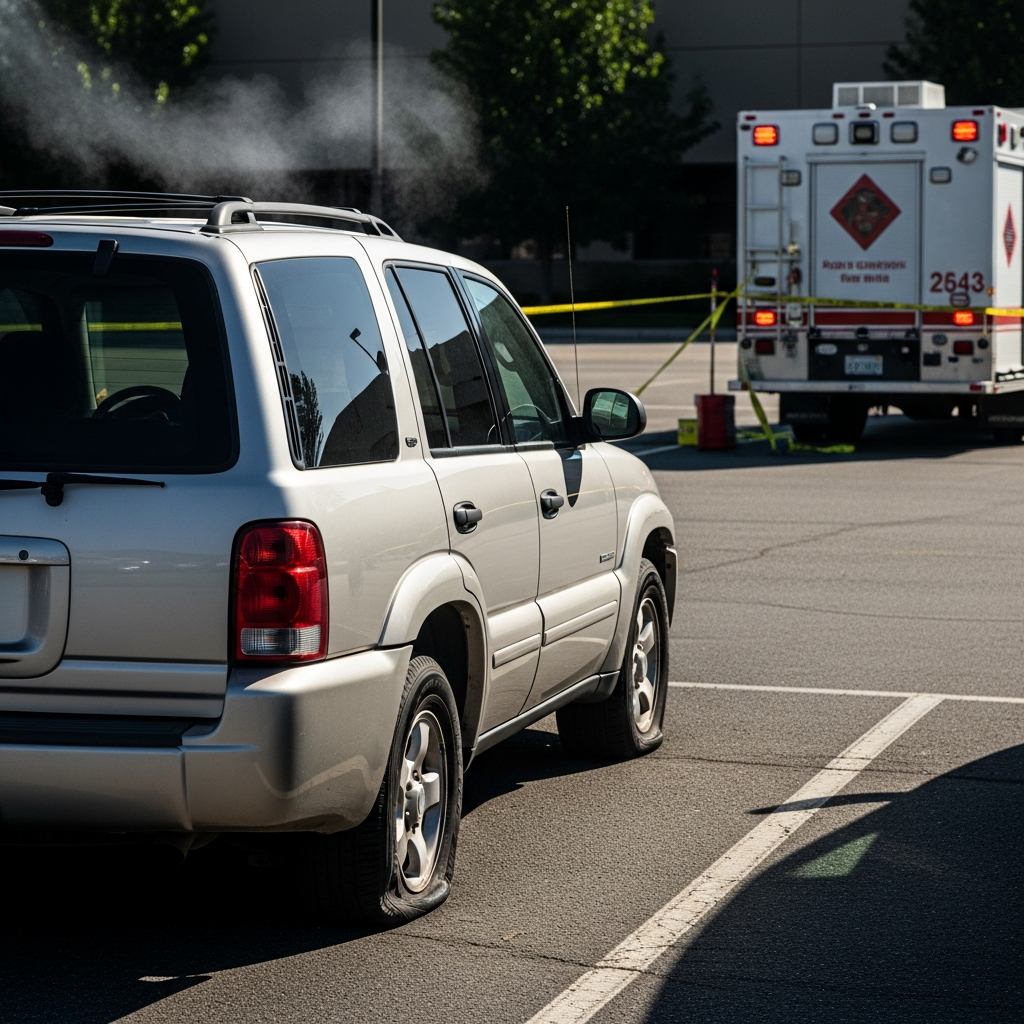
At approximately 11 a.m. on July 15, 2026, five members of a family were found unresponsive in a parked Ford Explorer in a Toledo, Ohio parking lot. The vehicle had pulled over with a flat tire. The engine was running. Three family members — a grandmother and two grandchildren — did not survive. Two children were hospitalized in critical condition. Carbon monoxide poisoning in a car is a risk most people associate with a closed garage. The Toledo incident shows why that mental model is dangerously incomplete. Carbon Monoxide Poisoning Symptoms: What to Know Before It's Too Late
What Happened in Toledo on July 15, 2026
The family had pulled into an open parking lot after their Ford Explorer suffered a flat tire. Stranded in summer heat, they stayed inside the running vehicle with the air conditioning on while waiting for help. When the son arrived to assist, he found his family unresponsive inside. Toledo Mayor Wade Kapszukiewicz confirmed the investigation: officers started the vehicle in a controlled setting with a CO meter inside the cabin and recorded a high spike of carbon monoxide in the passenger compartment. Investigators confirmed that running the vehicle in its specific exhaust configuration produced measurable, dangerous carbon monoxide inside the sealed passenger cabin — in an open parking lot, in daylight, on a clear summer day. Ford Explorers had been the subject of a previous six-year federal investigation by NHTSA into exhaust odors entering passenger cabins. That investigation closed without a recall — but the documented pattern of exhaust intrusion, and now the Toledo fatalities, make clear that cabin CO accumulation in idling vehicles is a real and underacknowledged risk. Portable Carbon Monoxide Detector: What It Is, Who Needs One, and How to Choose Takeaway: The Toledo incident was not caused by a closed garage or a running engine in a sealed space — it was caused by exhaust leaking into a running vehicle parked in the open, a risk most vehicle owners have never considered.
How Carbon Monoxide Gets Into a Parked Vehicle's Cabin
Most people understand why CO builds up in a closed garage. Fewer understand why CO can accumulate inside a vehicle parked in an open lot. The mechanics are specific to how vehicle HVAC systems manage air intake. The fresh-air intake for most vehicle HVAC systems is located near the base of the windshield or in the cowl area. In many SUV configurations, the recirculating air draw also pulls from rear compartment gaps. In Ford Explorers, the documented issue involved exhaust from components near the rear of the vehicle seeping into the cabin through structural gaps and HVAC intake paths. When the engine is idling and exhaust pools at the rear of the vehicle, the HVAC system's intake can draw that CO-containing air directly into the passenger cabin — even with all windows closed and the AC running on recirculate. Rear-heavy SUV configurations are particularly susceptible: the passenger compartment extends to the rear bumper without a sealed trunk wall, meaning exhaust that collects at the rear can enter through tailgate seams, floor gaps, or rear HVAC intake paths. This structural characteristic applies to any SUV or wagon with a compromised seal between the exhaust path and the rear cabin area. What Causes Carbon Monoxide in a House? 7 Hidden Sources Takeaway: Vehicle HVAC systems and structural seams can draw exhaust CO into the passenger cabin while the car is parked in an open area — making any idling vehicle with exhaust seal issues a potential CO source.
Why Summer Increases In-Vehicle CO Risk
Cold weather gets most of the attention in CO safety warnings, but summer creates its own set of in-vehicle CO conditions. In hot weather, people are more likely to sit in idling vehicles with the AC running for extended periods — at rest stops, in parking lots, waiting for appointments, or in situations like the Toledo family's, stranded and waiting for help. Heat also affects CO behavior inside a vehicle differently than cold. Warm air circulates more actively, and HVAC systems running at high demand pull more air through recirculation paths. A vehicle that might show a modest PPM reading in mild weather can show higher readings on a hot day with the AC running at maximum. The assumption that a vehicle is safe to idle in because the windows are cracked or the AC is set to fresh-air mode is not always accurate — fresh-air mode on a vehicle with a rear-exhaust seal issue draws in the air that is pooling near the exhaust. The fundamental safety gap here is that no production vehicle comes with a CO sensor in the cabin as standard equipment. A car dashboard shows speed, fuel, and engine temperature — it does not show the concentration of gas actively displacing oxygen in the air your family is breathing. Takeaway: Idling in a parked vehicle is a routine summer behavior, and for any vehicle with exhaust seal degradation, that idle produces CO accumulation in the cabin without any dashboard warning.
What the Toledo Case Means for Your Own Vehicle
Unless you have had your exhaust system inspected recently by a mechanic who specifically tested for cabin CO intrusion, you do not know whether your vehicle has a seal issue. Most vehicles do not — but exhaust seal degradation is real, it occurs gradually, and it often produces no odor or other sensory warning. Ford Explorers are not the only vehicles with a documented history of cabin CO concerns. Any vehicle with age-related degradation of rear floor seams, a compromised exhaust gasket, or an aftermarket exhaust modification has some elevated risk. The Toledo case is the consequence of that risk going undetected. The only reliable way to detect CO in a vehicle cabin is a portable CO monitor with a live numerical display — not a threshold alarm, but a device that shows the actual concentration so you can see a 15 PPM reading rise to 30 before anyone becomes symptomatic. For families — especially those with elderly members, young children, or passengers who may be slower to recognize CO symptoms — a portable detector placed in the vehicle during extended idling periods costs almost nothing and changes the outcome of a rare but catastrophic event. Carbon Monoxide Poisoning Symptoms: Signs & What to Do Takeaway: Exhaust seal degradation happens silently and gradually — a portable CO monitor in your vehicle is the only instrument that tells you when idling has made the cabin unsafe before someone loses consciousness.
What to Do If You Are Stranded in a Vehicle
- If you must wait in a stranded vehicle in hot weather, open at least two windows on opposite sides of the vehicle to create airflow, not just recirculation
- Do not rely on AC 'fresh air' mode if your vehicle has any exhaust odor history — the fresh-air intake may be drawing from near the exhaust
- If you notice any exhaust smell inside the vehicle, turn off the engine immediately and exit
- A portable CO detector on the rear seat or dash will show you live CO levels — if it climbs above 10 PPM while idling, turn off the engine and get out
- Call for help and wait outside the vehicle rather than sitting inside a running car for an extended period when stranded
- Have your exhaust system inspected annually, specifically asking the mechanic to check for signs of cabin CO intrusion
- If any passenger reports headache, dizziness, or nausea during or after extended vehicle idling, treat it as a possible CO exposure event and seek fresh air immediately
- Never leave children or elderly passengers asleep in an idling vehicle unattended — they may not wake before CO levels cause incapacitation
The Toledo family had no way of knowing their Explorer's cabin was filling with carbon monoxide while they waited for help in that parking lot. A portable CO detector on the back seat would have shown the concentration climbing in real time — giving them the information to get out before anyone lost consciousness. The AirShield™ 3-in-1 Portable CO Detector is compact enough to carry in a glove box or center console and shows a live PPM reading the moment it is plugged in. It works at home and travels with you wherever idling for extended periods becomes unavoidable. Visit airshield.store.
Frequently Asked Questions
Sources & References
- 13ABC: Toledo mayor — Three dead, two children hospitalized in carbon monoxide incident — Local news report on the Toledo Ford Explorer CO incident, July 15, 2026.
- NHTSA: Ford Explorer Exhaust Odor Investigation — NHTSA federal investigation into exhaust odor complaints in Ford Explorers.
- CDC: Carbon Monoxide Poisoning from Motor Vehicles — CDC guidance on vehicle-related CO poisoning.
- CPSC: Carbon Monoxide Safety Information — CPSC CO safety resources including vehicle-related risks.
Protect Your Home with AirShield™
The only portable CO detector that shows you real-time PPM readings on a live OLED display. Electrochemical sensor, multi-gas detection, UL listed.
Check Availability →
Loading comments...