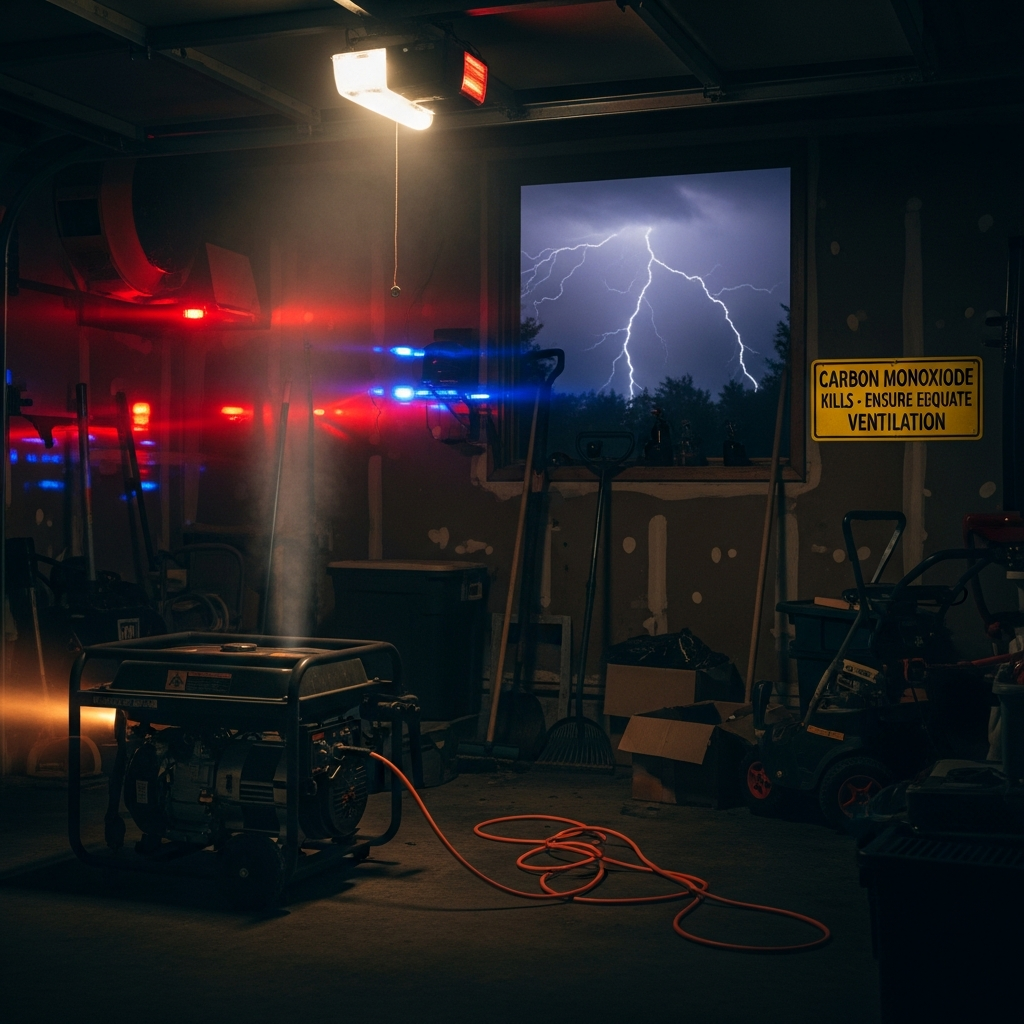
On July 4, 2026, three children in Wayne County, Michigan were killed by carbon monoxide poisoning from generators run indoors during a power outage. In each case, the generator was in an enclosed space — a garage, a basement — while the family sheltered through a storm that had knocked out power to more than 305,000 Michigan customers. This was not a freak accident. It was a sequence of understandable decisions, each one individually reasonable, that together became lethal. Understanding that sequence is the only way to prevent the next one. What Causes Carbon Monoxide in a House? 7 Hidden Sources
What Happened in Wayne County on July 4, 2026
Severe storms through Metro Detroit on the July 4th weekend cut power across hundreds of thousands of homes. Families responded the way families do: they found ways to keep essential systems running. In Sumpter Township, two girls aged 8 and 12 were found unresponsive on the morning of July 4th with a gas-powered generator running in the attached garage. In Melvindale, a 16-year-old boy was found alone in a basement with a generator running nearby. All three died. Emergency responders found no mechanical failures and no structural defects — just enclosed spaces, running generators, and the physics of carbon monoxide accumulation. Carbon monoxide from a single gas generator can reach fatal concentrations in a two-car garage in under an hour, and in a basement in minutes. Wayne County police described the deaths as "a stark reminder of the dangers of carbon monoxide" and urged residents never to run generators indoors under any circumstances. Portable Carbon Monoxide Detector: What It Is, Who Needs One, and How to Choose Takeaway: The July 4th Wayne County deaths resulted from generators placed in enclosed spaces during a storm outage — a scenario that repeats every time severe weather drives families to improvise their power solutions indoors.
Why Generators Produce So Much Carbon Monoxide
A portable gasoline generator is a small internal combustion engine. It burns fuel to produce electricity and, like any combustion process, produces carbon monoxide as a byproduct. What makes generators especially dangerous compared to cars or furnaces is the volume of CO they produce relative to their size. A typical 5,500-watt portable generator produces CO at a rate many times greater than a car engine at idle. In the time it takes to run an extension cord into the house, a generator in an attached garage can raise CO concentrations in adjacent rooms above NIOSH's immediately dangerous to life threshold — without the people inside having any sensory warning. CO is colorless, odorless, and tasteless — you cannot smell it, you cannot see the fumes, and your body's first response to mild exposure (drowsiness, mild headache) is easily confused with falling asleep during a stressful power outage. This is the core danger: the physiological cues that are supposed to prompt self-preservation come too late, after the exposure has already reached levels that impair judgment and prevent escape. Carbon Monoxide Poisoning Symptoms: What to Know Before It's Too Late Takeaway: Portable generators produce CO at extraordinary rates that an open garage door cannot dilute — and the early symptoms of poisoning are indistinguishable from normal fatigue during a stressful outage.
The July 4th CO Risk No One Talks About
July 4th creates a specific combination of circumstances that makes carbon monoxide a particular threat. Summer storms knock out power during holiday weekends, sending families scrambling for generators they may not have used since the previous storm season. The machines come out of storage, get fueled, and get placed wherever is convenient — which is almost never 20 feet from the house. Holiday weekends also mean gatherings: more people are home, children are present, the house may be unusually full. A generator that might otherwise be placed outside gets moved to a covered porch, a carport, or a shed — all of which can funnel exhaust into the building. Gasoline-powered generators are the leading cause of non-fire carbon monoxide fatalities in the United States, responsible for an average of 70 deaths per year — with a spike every time a major storm causes widespread power outages. The July 4th weekend 2026 is not unusual; it is a documented version of a pattern that repeats every hurricane season, every winter storm, and every summer severe weather outbreak. Carbon Monoxide Detector Laws by State (2025): Is Your Home Compliant? Takeaway: Storm-related power outages reliably produce generator CO incidents because they create time pressure, dark conditions, and the impulse to prioritize convenience over placement distance.
Where a Generator Can Run Safely — and Where It Will Kill You
The CPSC rule is absolute: generators must run outdoors, at least 20 feet from any window, door, or vent. Not in the garage. Not in the garage with the door open. Not in a covered porch. Not in a basement with a window cracked. Not under an awning attached to the house. Outdoors, 20 feet away, exhaust pointed away from the building. This rule feels extreme during a stressful power outage in the dark, and that gap between the rule and instinct is exactly where people die. The convenience choices — running the cord under the garage door to avoid opening windows, placing the generator near the wall to keep the extension cord short — are the choices that kill. A generator placed 10 feet from a side window produces CO concentrations inside the house that are indistinguishable from having the generator indoors. If you cannot place your generator 20 feet from the structure, you cannot safely run that generator during that storm. The alternative is not a dead generator; it is candles, flashlights, and a cooler of ice until the power returns. Takeaway: Any generator placement that prioritizes convenience over distance — garage, porch, shed, or carport — puts CO inside the living space at potentially lethal concentrations.
How to Survive a Storm Outage Without Risking CO Poisoning
- Place the generator 20+ feet from every door, window, and vent — measure the distance, do not estimate it
- Never run a generator in a garage, even with the door fully open — CO migrates through gaps into the house regardless
- Install a CO detector with a live PPM display in every sleeping area before storm season begins, not during the outage
- Do not rely only on the UL 2034 alarm threshold — a display showing 30 or 40 PPM is a warning to shut the generator down before the alarm sounds
- Run extension cords under doors or through windows — do not move the generator inside to shorten the cord
- Pre-plan your generator placement in daylight before a storm hits, so you are not making location decisions in the dark under pressure
- If anyone in the house develops headache, nausea, or dizziness, move everyone outside immediately, call 911, and do not return until the building is cleared
- Consider a battery backup for essential devices — these produce zero CO and require no placement considerations
The three children who died in Wayne County on July 4th, 2026, did not have a CO detector near where they slept. The AirShield™ 3-in-1 Portable CO Detector shows the live CO level on an OLED display — not just an alarm when the threshold trips, but the actual PPM count — so you can see a level climbing to 20, 40, or 60 and shut the generator down before anyone loses consciousness. One detector in the room where your family sleeps during the outage is the only tool that gives you advance warning before the situation becomes irreversible. Visit airshield.store.
Frequently Asked Questions
Sources & References
- WILX: 3 children die of suspected carbon monoxide poisoning in Wayne County — Local news report on the Sumpter Township and Melvindale incidents.
- ClickOnDetroit: Wayne County children die from carbon monoxide poisoning after generator used during power outage — Detailed reporting on July 4, 2026 generator incidents.
- CPSC: Generator Carbon Monoxide Safety — CPSC generator CO safety guidance including distance requirements.
- CDC: Carbon Monoxide Poisoning Prevention — CDC guidance on CO sources, symptoms, and prevention.
Protect Your Home with AirShield™
The only portable CO detector that shows you real-time PPM readings on a live OLED display. Electrochemical sensor, multi-gas detection, UL listed.
Check Availability →
Loading comments...