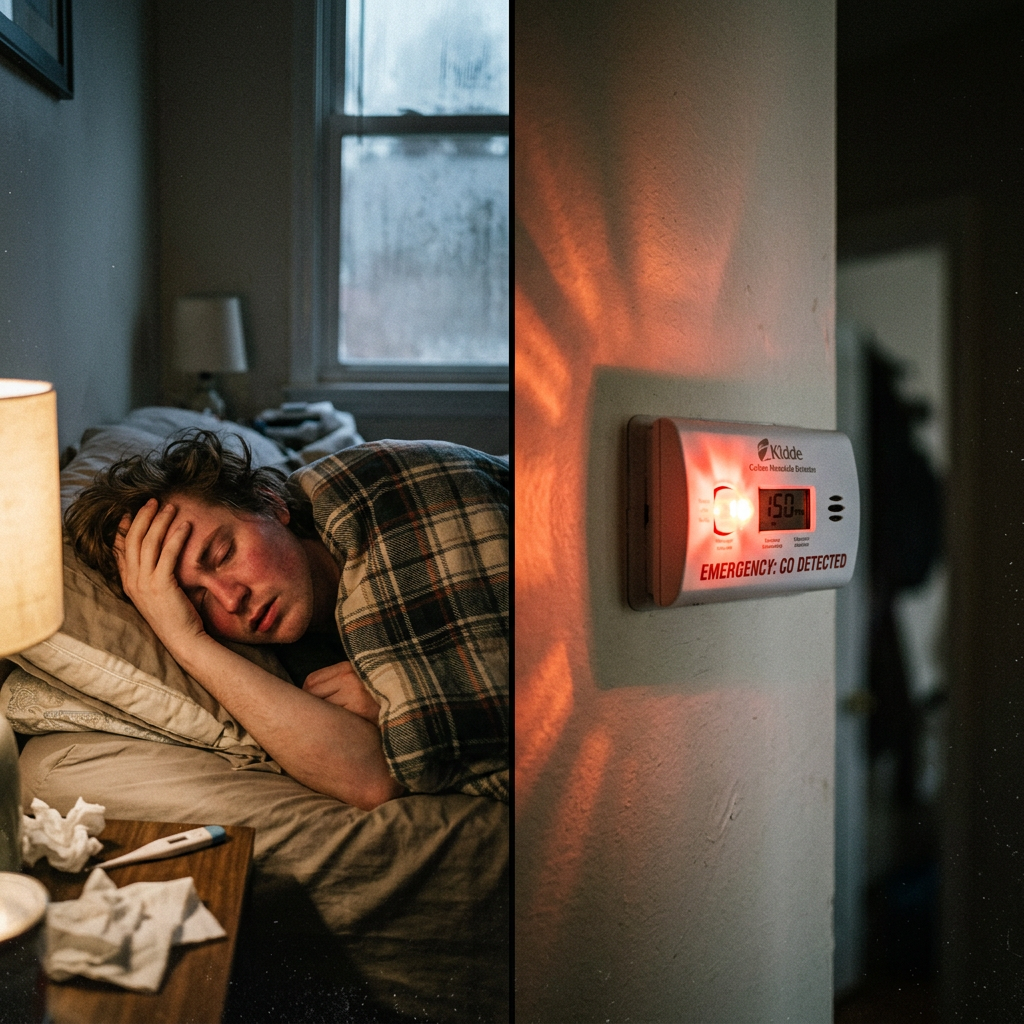
Every autumn, as furnaces switch on for the first time after months of dormancy, emergency rooms across the country see a predictable increase in patients presenting with headache, nausea, fatigue, and dizziness. Most of these cases are logged as influenza. Some are influenza. Some are carbon monoxide poisoning. The patients sent home with flu advice and a recommendation to rest — and told to return if symptoms worsen — sometimes do get worse. Some don't make it back to the ER. The CO source that produced their symptoms continues operating in their home while they sleep off what they believe is a viral illness. The flu misidentification window is one of the most dangerous phenomena in CO poisoning, and it is not a fringe problem. Published research in emergency medicine literature has documented repeatedly that CO exposure is a routine misdiagnosis. The symptoms overlap is not superficial — it is complete. Carbon Monoxide Poisoning Symptoms: What to Know Before It's Too Late
Why CO and Flu Produce Clinically Identical Symptoms
Carbon monoxide causes harm by binding to hemoglobin and displacing oxygen — the blood continues circulating, the lungs continue working, but the cells throughout the body receive progressively less oxygen than they need. The brain and heart, as the highest oxygen consumers, feel this first. The result, at the moderate exposures typical of a slow residential leak — 50 to 150 PPM — is a recognizable cluster: throbbing headache (the brain hypoxic and inflamed), nausea (the gut responding to systemic hypoxia and vagal response), fatigue (muscles and organs under-oxygenated), and a general sense of malaise. This symptom cluster — headache, nausea, fatigue, dizziness — is also the standard clinical presentation of influenza, gastroenteritis, and most common viral illnesses that send people to urgent care. The overlap is not a coincidence or a quirk. Both conditions are producing the same cellular stress — reduced energy availability, inflammatory response, and vascular dilation — through different mechanisms. From the inside, both feel the same. From the outside, both look the same. Without a specific test or a CO reading, there is nothing in the symptom profile alone that separates them. Carbon Monoxide Poisoning Treatment: What Happens, What Helps, and What Does Not Takeaway: CO poisoning and influenza produce identical symptoms through different mechanisms — the overlap is physiologically genuine, not superficial, which is why misdiagnosis is systematic rather than rare.
What the Clinical Literature Says About How Often This Happens
Studies published in emergency medicine literature, including research in the Annals of Emergency Medicine and similar peer-reviewed journals, have consistently found that CO poisoning is substantially underdiagnosed in clinical settings. One frequently cited analysis estimated that tens of thousands of CO poisoning cases annually are misclassified as viral illness or migraine — cases that resolve when the patient incidentally leaves the contaminated environment and are never identified as CO exposure. The structural reason for this is straightforward: emergency departments do not routinely order carboxyhemoglobin blood tests for patients presenting with headache or flu-like symptoms unless CO exposure is already suspected. But patients who are unaware they've been exposed to CO don't tell the ER they might have been. The test never gets ordered. The discharge diagnosis is viral syndrome. The medical literature refers to this gap as the "CO misdiagnosis window" — the period between the onset of symptoms and either correct diagnosis or serious escalation, during which patients return to the contaminated environment and continue accumulating exposure. Seasonal patterns confirm this. CO poisoning incidents spike in winter — correlating with furnace activation, generator use, and reduced ventilation — at exactly the same time influenza season peaks. The two conditions peak together, which means the diagnostic confusion is highest precisely when CO incidents are most frequent. Winter Carbon Monoxide Poisoning: Why Cold Weather Is CO's Deadliest Season Takeaway: clinical studies consistently show CO is misclassified as viral illness in substantial numbers — because the test that distinguishes them is not routine, and patients don't know to ask for it.
The Clues That Separate CO from the Flu
Since symptoms alone cannot distinguish CO exposure from viral illness, the separating information is context and pattern. Several clues reliably point toward CO rather than flu — not individually conclusive, but collectively diagnostic: **Location-dependence**: This is the most reliable signal. CO symptoms are produced by a source in a specific space. They improve when the person leaves — often within 30 to 60 minutes of breathing fresh air — and return when they go back inside. Flu symptoms persist regardless of location. **Household clustering without fever**: If multiple people in the same building feel unwell simultaneously, and none of them have an elevated temperature, flu is a less likely explanation. Influenza spreads person-to-person over days. CO exposes everyone in the space simultaneously. Pets showing unusual lethargy add significant weight — they share the same air but are not susceptible to flu transmission. **Seasonal appliance correlation**: Symptoms beginning on the same day a furnace ran for the first time this season, a generator was used, or a gas heater was lit for the first time are temporally linked to a combustion event that strongly suggests CO. The pattern of a headache that builds indoors, resolves outdoors, and returns indoors is effectively a clinical CO test that requires no laboratory equipment — and yet it is the pattern most consistently described by survivors who were initially told they had the flu. Takeaway: location-dependence, simultaneous household illness without fever, and temporal correlation with a combustion event are the three strongest signals that differentiate CO exposure from a viral illness. Signs of a Carbon Monoxide Leak in Your House — and How to Confirm It
What to Do If You Suspect CO Instead of Flu
- Leave the building immediately — do not wait to test the hypothesis indoors; fresh air is both the treatment and the diagnostic test
- Note whether symptoms improve within 30 to 60 minutes of going outside — improvement is a strong signal of CO rather than flu
- Call 911 from outside — emergency responders carry calibrated CO meters and can measure the concentration inside
- Do not re-enter until responders have identified and cleared the source
- If you go to an ER with flu-like symptoms during heating season, explicitly mention that CO poisoning is a possibility and ask about a carboxyhemoglobin blood test
- Check your CO detector's manufacture date — if it's more than 5 years old, the sensor may be degraded enough to not alarm on a moderate leak
- Have fuel-burning appliances (furnace, boiler, water heater) inspected before the first use each season — a combustion problem left from last year gets worse, not better, with time
- A CO detector with a live PPM display tells you the actual concentration — not just whether it crossed an alarm threshold — which is the difference between confirming a source and guessing
The flu that gets better when you go outside is not the flu. The headache that builds every evening at home and disappears on your morning commute is not a tension headache. The household where everyone is off and the dog is sleeping more than usual is not suffering a coincidental viral cluster. These are patterns that a CO detector would resolve in seconds. The AirShield™ 3-in-1 Portable Carbon Monoxide Detector shows the live PPM reading in the air around you — at home, in a hotel, wherever you are. If the number is climbing while your head is pounding, you have an answer before any alarm is required to trigger. Visit airshield.store.
Frequently Asked Questions
Sources & References
- CDC: Carbon Monoxide Poisoning — Frequently Asked Questions — CDC guidance on CO symptoms, misdiagnosis risk, and at-risk populations.
- EPA: Carbon Monoxide's Impact on Indoor Air Quality — EPA data on CO health effects and the exposure-symptom relationship.
- CPSC: Carbon Monoxide Information Center — CPSC data on CO poisoning incidence, misdiagnosis, and prevention.
- Annals of Emergency Medicine: CO Misdiagnosis Studies — Published emergency medicine research on CO poisoning misdiagnosis frequency.
Protect Your Home with AirShield™
The only portable CO detector that shows you real-time PPM readings on a live OLED display. Electrochemical sensor, multi-gas detection, UL listed.
Check Availability →
Loading comments...