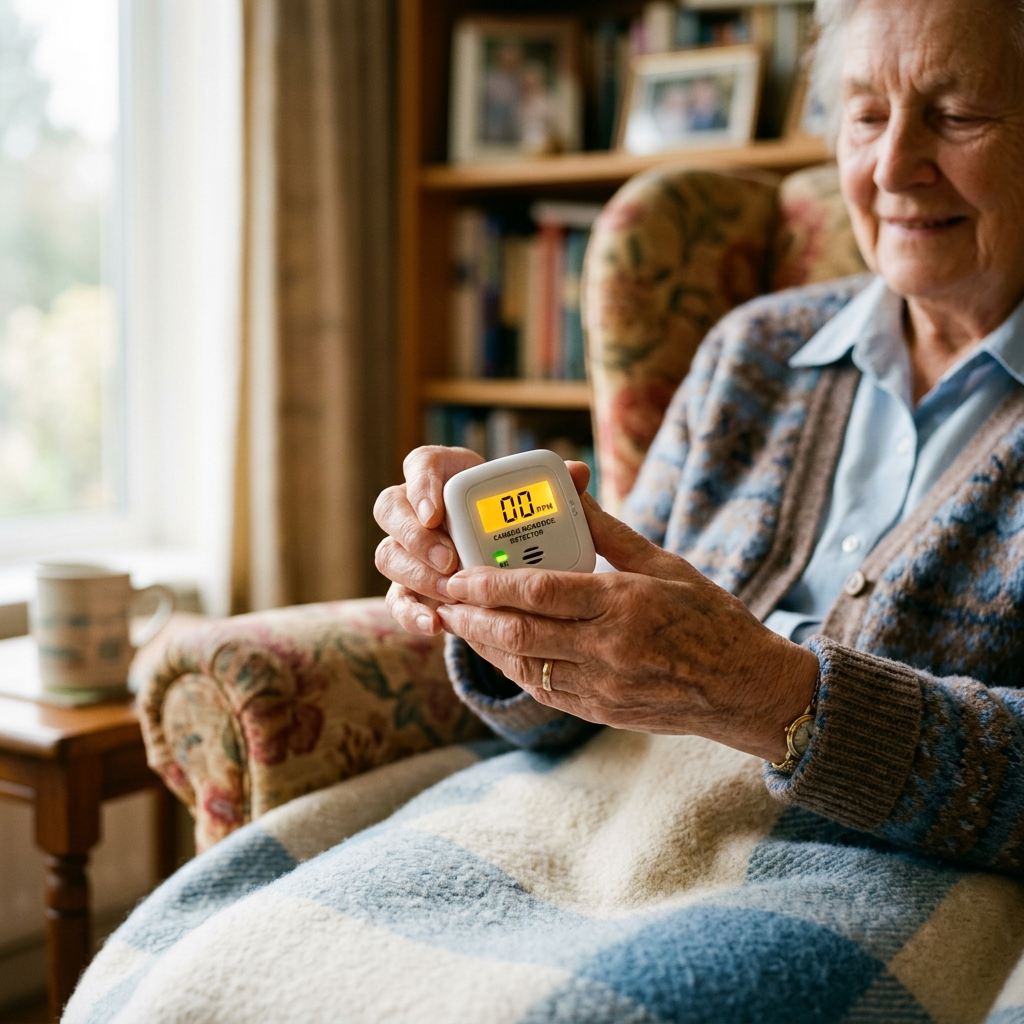
Carbon monoxide kills more adults over 65 than any other age group outside of infancy. The CPSC's own data consistently shows elderly adults accounting for a disproportionate share of non-fire CO fatalities — not because they encounter more CO than younger adults, but because their bodies and their circumstances give them less margin when they do. If you're choosing a carbon monoxide detector for an elderly parent or grandparent — or helping an older adult choose one for themselves — the features that matter are different from what the average buyer needs. Volume, portability, and the ability to see a live reading matter more than smart home connectivity. Here's what actually protects an older adult from CO poisoning. Why Is Carbon Monoxide Dangerous? The Science Explained
Why Seniors Are the Highest-Risk Group
The elevated CO risk for adults over 65 is not a single factor — it's several that compound each other. Cardiovascular disease, which is significantly more prevalent in older adults, lowers the threshold at which CO causes serious harm. Carbon monoxide works by binding to hemoglobin and blocking oxygen delivery to the heart and brain. A healthy heart with full cardiac reserve can tolerate a degree of impaired oxygen delivery. A heart already managing coronary artery disease, arrhythmia, or heart failure has less margin — the same CO concentration that produces a headache in a 35-year-old can trigger a cardiac event in a 70-year-old with existing heart disease. This means the alarm threshold defined by UL 2034 — which is based on health effects in a healthy adult — provides less margin for an older adult whose baseline is already closer to that threshold. Seniors also tend to sleep more deeply than younger adults and are less likely to wake to a standard audible alarm. Those living alone have no backup — no spouse or housemate who might wake first, notice symptoms, or call for help. Carbon Monoxide Poisoning While Sleeping: The Real Risk Takeaway: seniors face elevated CO risk because cardiovascular disease lowers their safety margin, deeper sleep reduces alarm response, and living alone removes the backup that catches events before they become emergencies.
Why Standard Alarm-Only Detectors Aren't Enough
A standard UL 2034 alarm is calibrated around a specific assumption: a conscious adult who hears an alarm, understands what it means, and can evacuate efficiently. For a deeply sleeping 72-year-old with mild hearing loss, each of those assumptions is weaker. The legally required alarm volume under UL 2034 is 85 dB at 10 feet. That's roughly the volume of a lawnmower. It's adequate in many situations. For a senior sleeping in a bedroom at the end of a hallway, with the door closed and some degree of age-related hearing reduction, it may not be enough to wake them before exposure is significant. Beyond alarm volume, the binary nature of alarm-only detectors removes the one piece of information that would change how a senior — or a caregiver checking in — responds. A reading of 18 PPM rising slowly is a very different situation from a reading of 18 PPM that has been stable for two hours, and an alarm-only detector treats both identically: silence. For an elderly parent living alone, a detector with a live PPM display means a family member stopping by in the morning can glance at a number and know immediately whether the air is clean. Carbon Monoxide Detectors That Show PPM: Why a Number Matters More Than an Alarm Takeaway: alarm-only detectors assume a response that elderly adults — particularly those sleeping deeply, living alone, or with hearing loss — may not be able to execute, and withholds the information that would let caregivers monitor proactively.
The Travel Risk Most Families Don't Think About
Seniors travel — to visit children and grandchildren, to spend winters in warmer states, to stay in hotels and vacation rentals for extended periods. And CO risk doesn't stay at home. Hotels and short-term rentals are not federally required to have working CO detectors in every room. In states with requirements, enforcement is inconsistent. The battery-operated units in many commercial spaces may be expired, low-battery, or simply non-functional. A senior checking into a hotel room has no practical way to verify the air is safe. Portable CO detectors — ones that plug directly into any outlet and work immediately — solve this problem entirely. A portable detector travels in a carry-on or suitcase, plugs into the hotel room the moment the door opens, and confirms within seconds whether the air is clean or not. For elderly travelers who may spend weeks in a single vacation rental or assisted living facility, the lack of a portable CO detector is the same as trusting that a stranger maintained their safety equipment correctly. This matters especially for seniors visiting family in homes with gas appliances, attached garages, or older HVAC systems — environments where their hosts may have become habituated to conditions that a fresh occupant's detector would flag. Carbon Monoxide Detector for Travel: Your Hotel Safety Protocol Takeaway: seniors who travel carry their elevated CO risk with them — and a portable CO detector is the only way to verify safety in spaces they don't control.
What to Look for When Choosing a CO Detector for an Elderly Parent
- Loud alarm — look for at least 85 dB, positioned where the senior sleeps (bedroom, not hallway)
- Live PPM display — so caregivers and family members can see actual CO levels at a glance, not just an alarm state
- Electrochemical sensor — required for accurate PPM readings and lower false-alarm rates; semiconductor sensors produce more false alarms, which teaches seniors to ignore alarms
- Portable, plug-in design — no battery changes required, works immediately in any room or hotel, travels anywhere
- UL 2034 certification — confirms the device meets U.S. minimum safety standards
- Simple setup — one plug, no app required, no pairing process; complexity is a barrier for older adults who should be able to deploy the device themselves
- Place one in the bedroom — CO exposure during sleep is the most dangerous scenario; a hallway detector may not protect a sleeping occupant in time
The right CO detector for an elderly parent is one they will actually have with them, that will actually wake them if something happens, and that gives the people who care for them the information they need to monitor proactively. That combination — portability, volume, and a live display — is not a premium feature set. It's the minimum that actually protects an older adult. The AirShield™ 3-in-1 Portable Carbon Monoxide Detector plugs into any outlet, displays live CO PPM on an OLED screen, sounds an 85 dB alarm, and works instantly — at home, in a hotel, at a family member's house. UL 2034 certified. Compact enough to slip into a travel bag. Visit airshield.store.
Frequently Asked Questions
Sources & References
- CDC: Carbon Monoxide Poisoning — CDC guidance on CO symptoms and at-risk populations including older adults.
- CPSC: Carbon Monoxide Information Center — CPSC data on CO fatality demographics, including elevated risk for adults 65+.
- NFPA: Carbon Monoxide Safety — NFPA guidance on CO detector placement and vulnerable populations.
Protect Your Home with AirShield™
The only portable CO detector that shows you real-time PPM readings on a live OLED display. Electrochemical sensor, multi-gas detection, UL listed.
Check Availability →
Loading comments...