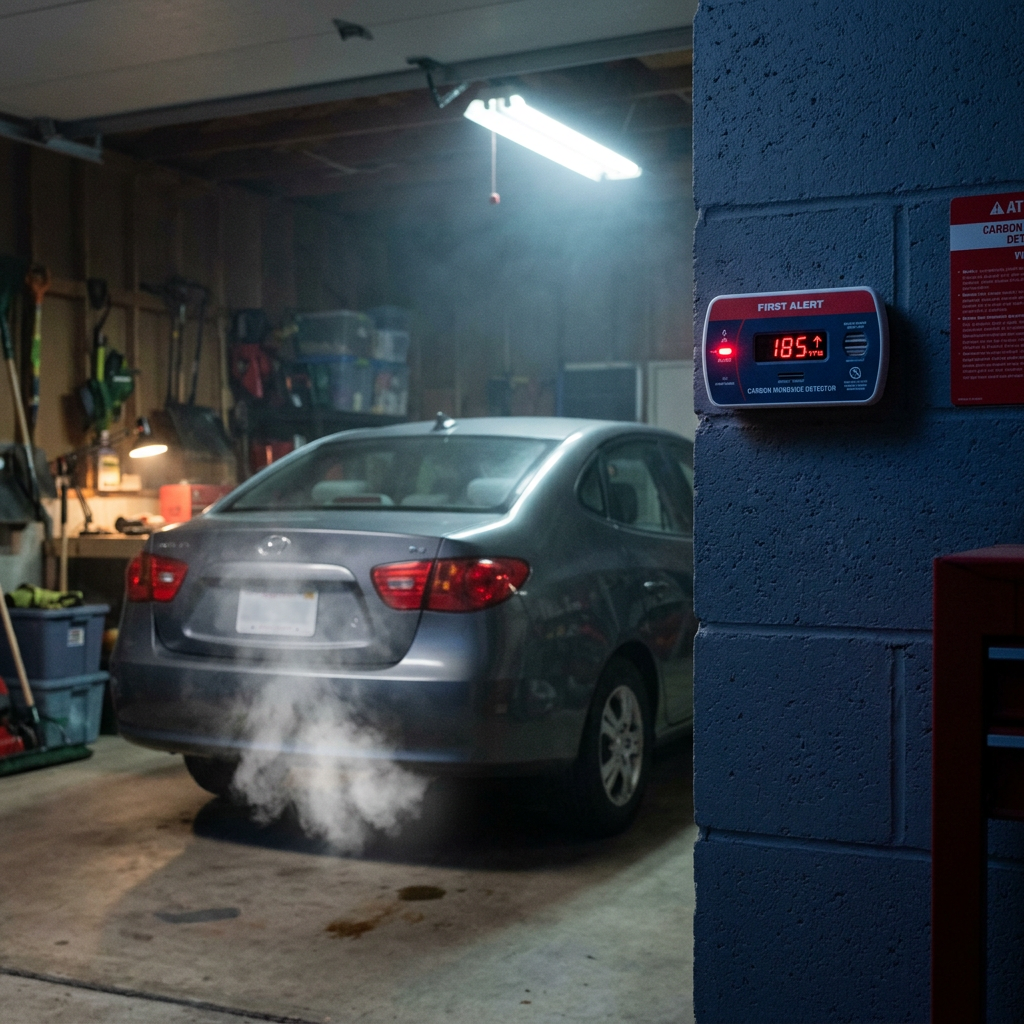
The attached garage is the residential location most likely to produce a fatal CO concentration quickly. A closed garage with a running vehicle is an industrial-scale CO source — not a slow leak from a furnace, but a high-volume acute emission that can build from 0 to immediately dangerous in under three minutes. Despite this, garages are the least protected CO zone in most homes. The average household has one CO detector placed on the main floor or in a bedroom hallway. The garage has none. The door between the garage and the house — usually a hollow-core interior door with visible gaps at the threshold and sides — provides negligible resistance to CO migration. The physics: CO (molecular weight 28) is almost exactly the same density as air (molecular weight 29). It does not pool at the floor or rise to the ceiling — it mixes uniformly throughout the space. CO produced in the garage distributes into the garage air column and migrates into the adjacent living space through every available gap simultaneously. Car Running in Closed Garage: How Long Until It's Dangerous? A CO detector in the garage is the only way to catch this event before concentrations in your bedroom reach harmful levels.
The PPM Math: How Fast Does a Garage Fill With CO?
The numbers are stark. Published EPA and California Air Resources Board vehicle emissions data establish the following for a typical gasoline passenger vehicle: **Cold-start exhaust concentration:** 30,000–80,000 PPM of CO during the first 30–60 seconds. This is not the garage air concentration — this is the exhaust stream itself. **Garage air concentration (2-car attached garage, 20×20×8 ft = 3,200 cubic feet):** - At 1 minute of idling: approximately 200–400 PPM (above the OSHA 8-hour PEL of 50 PPM) - At 2 minutes: approximately 500–1,000 PPM (approaching OSHA's 1,200 PPM immediately dangerous ceiling) - At 5 minutes: 1,200–2,500 PPM (immediately dangerous to life and health regardless of exposure duration) The UL 2034 residential CO alarm is calibrated for chronic slow leaks: it alarms at 70 PPM if sustained for 60–240 minutes, or at 150 PPM within 10–50 minutes. A vehicle in a closed garage will exceed the 150 PPM threshold within 60–90 seconds of engine start — faster than the alarm's time-weighted response window. You may not hear the alarm before concentrations reach dangerous levels. This is why NFPA and safety organizations universally state: never idle a vehicle in an attached garage, even with the garage door open. The risk is too fast for a residential alarm to provide adequate warning in all cases. Takeaway: your garage CO detector is not a substitute for the rule 'always open the garage door before starting a vehicle' — it is a backup that catches leaks from appliances, residual idling, and slow infiltration from an adjacent attached structure. Carbon Monoxide in Cars: Garage Risks and How to Stay Safe
The One Placement Mistake That Makes Garage Detectors Useless
The most common garage CO detector installation error is placing the unit directly above or adjacent to the vehicle's tailpipe position — often near the front of the garage where cars park, or on the ceiling directly above the parking bay. This placement seems logical (CO is produced there, detect it there) but fails for two reasons: **1. Acute peak vs. ambient mix:** A detector placed directly in the tailpipe exhaust stream will register extremely high momentary readings every time a car starts. This triggers nuisance alarms and trains occupants to dismiss CO alerts as false positives. After several false alarms, the detector's battery gets removed or the unit gets relocated — defeating its purpose entirely. **2. Migration, not source:** The relevant CO you're trying to detect in a garage isn't the peak tailpipe concentration — it's the ambient concentration that has mixed throughout the garage and is beginning to migrate through the door into the house. This ambient concentration is best measured away from the direct exhaust source. The correct placement: 4–5 feet above the floor, on the wall opposite the primary parking position, ideally near the door that connects the garage to the living space. This placement measures the mixed ambient CO that has distributed throughout the garage and is at risk of infiltrating your home. If your garage has a door to the house, also place a detector on the living-space side of that door — especially if the door has visible gap at the threshold. CO will flow through that gap before you can see or smell it. Carbon Monoxide Detector Placement: Exactly Where to Put Yours
Temperature and Sensor Performance in Unheated Garages
Electrochemical CO sensors — the type in all high-quality residential CO detectors — operate optimally between approximately 40°F and 100°F. Below 40°F, the electrochemical reaction that detects CO slows down, reducing sensitivity. A detector in an unheated garage in Minnesota or Montana in January may be operating in conditions that meaningfully reduce its response speed and detection threshold. For heated garages or garages in mild climates, standard residential CO detectors (Kidde, First Alert, AirShield) perform correctly year-round. For unheated garages in cold climates: check the operating temperature range in the product specifications. Look for detectors rated to 32°F (0°C) minimum operating temperature. If your garage routinely drops below freezing, either: - Place the detector just inside the door to the house (where it will be within the home's temperature range while still detecting migrating CO), or - Use a detector specifically rated for low-temperature environments Some manufacturers offer commercial or industrial CO detectors (UL 2075) rated to lower temperatures, though these are generally not needed for standard attached garages in most of the contiguous US.
What to Buy for a Garage CO Detector
For an attached garage: any UL 2034 listed electrochemical CO detector within the temperature operating range for your climate. Specific recommendations: **If the garage is heated or in a mild climate:** Any plug-in residential CO detector functions correctly. The AirShield 3-in-1 is useful because its live OLED PPM display shows ambient CO levels whenever you're in the garage — you see 12 PPM on a Tuesday afternoon and know the furnace is producing small amounts of CO even without an alarm triggering. That's actionable information a threshold-only detector can't provide. **If the garage is unheated in a cold climate:** Look for a unit rated to 32°F or lower. Alternatively, place a standard residential detector just inside the interior door to the house — it remains at room temperature and detects CO migrating from the garage. **For the living-space side of the garage door:** This is the highest-priority placement if you currently have zero CO coverage in your garage area. A detector here catches CO after it has migrated through the door — later than a garage-side detector, but still early enough to alert occupants before dangerous concentrations reach sleeping areas. The combination of one detector in the garage (ambient-mix position on the wall opposite the car) plus one on the living-space side of the door to the house gives you two warning points — the only reliable way to protect both the garage and the adjacent living space simultaneously. AirShield's portable plug-in design makes it practical for both locations without any permanent installation required. Visit airshield.store.
Frequently Asked Questions
Sources & References
- EPA: Carbon Monoxide and Indoor Air Quality — EPA data on CO production from combustion sources including vehicles.
- OSHA: Carbon Monoxide Hazards — OSHA CO exposure limits including the 50 PPM PEL and 1,200 PPM IDLH ceiling.
- NFPA 720: CO Detection and Warning Equipment Installation — NFPA placement guidance including attached garage requirements.
- CPSC: Garage Carbon Monoxide Safety — CPSC guidance on CO risks from attached garages and vehicle exhaust.
- California Air Resources Board: Vehicle Emissions Data — CARB published data on cold-start CO emissions from gasoline vehicles.
Protect Your Home with AirShield™
The only portable CO detector that shows you real-time PPM readings on a live OLED display. Electrochemical sensor, multi-gas detection, UL listed.
Check Availability →
Loading comments...