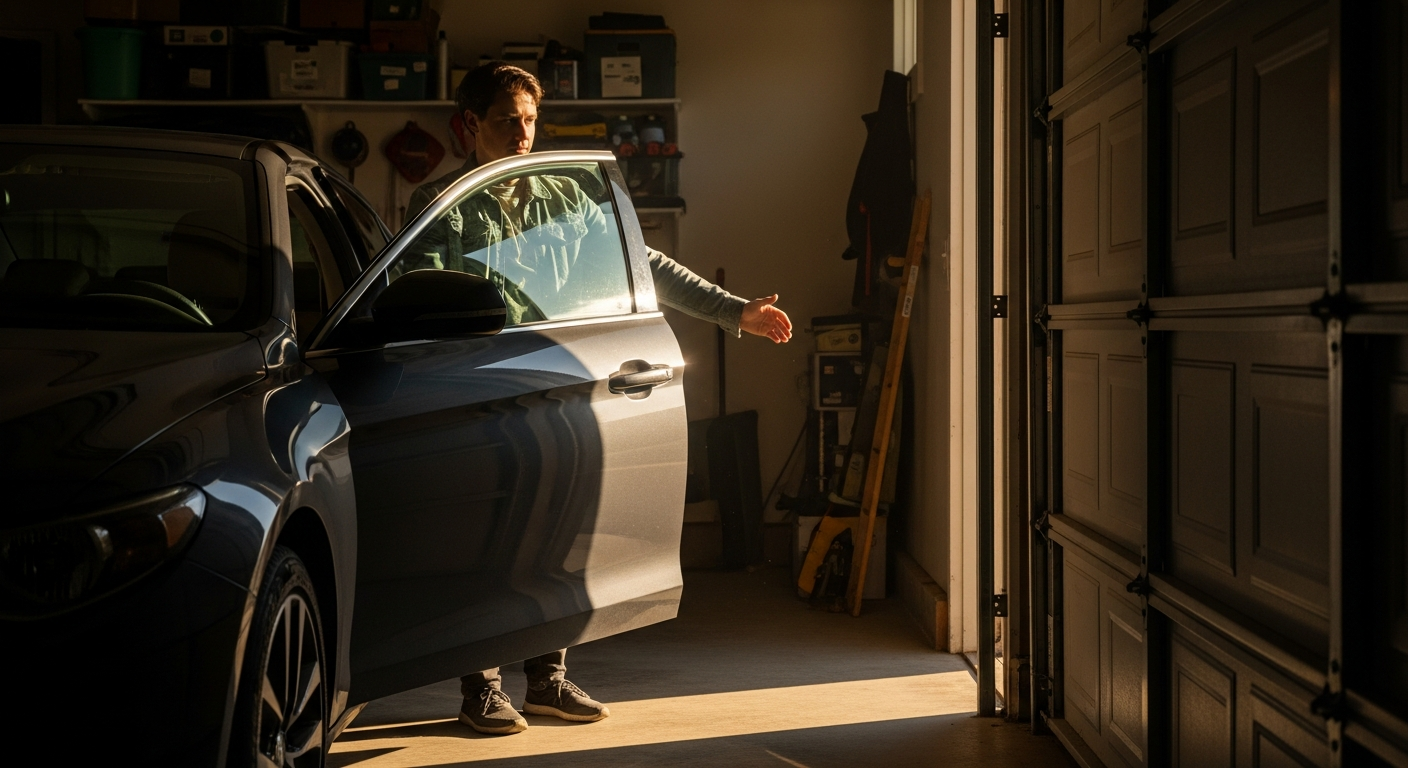
Almost half a million people have searched this exact question on Quora. That tells you something — people sense the danger but don't know the timeline. Here it is: a car idling in a closed two-car garage can hit dangerous CO levels in under 10 minutes. It can hit lethal levels in 30. And you won't smell it coming. This is true for modern cars too — not just old ones. And it's true even if you're not sitting in the garage. CO sneaks through the door into your home. This article gives you the exact minute-by-minute breakdown, explains why modern cars still cause this, and tells you what to do if you have an attached garage. Should a CO Detector Be in Your Bedroom? Yes. Here's Why
Minute by Minute: How Fast CO Builds in a Closed Garage
Here is what actually happens when a car idles in a closed two-car garage: - **Within 90 seconds** — CO begins climbing above safe levels - **3 to 5 minutes** — CO reaches 200 PPM. At this level, headaches start after an hour or two of breathing it. - **8 to 10 minutes** — CO hits 400 to 500 PPM. Dizziness, nausea, and confusion begin. Most people still think it's a headache. - **15 to 20 minutes** — CO passes 800 PPM. Convulsions can happen within 45 minutes at this level. - **30 minutes** — CO can exceed 1,600 PPM. At this level, symptoms hit within 20 minutes. Death within one hour. A typical two-car garage holds 1,500 to 3,000 cubic feet of air. Your car's exhaust fills it faster than it vents. That's the whole problem. A car in a closed two-car garage can reach CO levels that cause death within one hour — in just 30 minutes of idling. Can Carbon Monoxide Seep Through Walls? What You Need to Know Takeaway: The timeline is far faster than most people guess. By the time you feel confused or dizzy, you may already be too impaired to get yourself out.
Does My Modern Car Still Produce Enough CO to Be Dangerous?
Yes. This is one of the most common myths about garage CO risk. Modern cars with catalytic converters make far less CO than older vehicles. An older carbureted engine put out about 7% CO in its exhaust. A modern car puts out about 0.5%. That sounds like a huge improvement — and on the open road, it is. But in a closed garage, you're not on the open road. That 0.5% CO goes into a sealed box. A 1,500 cubic foot garage exposed to 0.5% CO exhaust will still reach dangerous ambient levels in minutes. A 2015 study in the Journal of Forensic Sciences confirmed CO deaths from vehicles less than five years old in closed garages. Modern cars still cause this. Keyless ignitions make it worse — they're easier to accidentally leave running. Catalytic converters save lives on the highway. They don't change the math in a closed garage. Generator Carbon Monoxide: Why It Kills and How to Stay Safe Takeaway: Your new car, your hybrid, your fuel-efficient SUV — all of them produce enough CO to reach lethal levels in a closed garage in under 30 minutes.
What CO Does to Your Body in a Garage
CO works by grabbing onto your red blood cells before oxygen can. It binds to hemoglobin about 230 times more tightly than oxygen does. Once it latches on, that blood cell can't carry oxygen anymore. Here's how it feels as it gets worse: **50–100 PPM**: Mild headache. You think you're tired. **200 PPM**: The headache gets worse. Dizziness starts. You might think you're getting sick. **400 PPM**: Nausea. Weak muscles. You want to sit down or lie down. **800 PPM**: Convulsions possible within 45 minutes. You may lose the ability to stand up. The cruelest part? CO impairs your judgment before it knocks you out. You feel unwell but can't think clearly enough to connect it to your surroundings. CO takes away the ability to recognize you're being poisoned — at exactly the moment you most need to recognize it. Carbon Monoxide Poisoning Symptoms: What to Know Before It's Too Late Takeaway: The body's CO warning system is terrible. Symptoms look like a bad day. By the time you know something is wrong, you may not be able to fix it.
Attached Garages: CO That Follows You Inside
Most people imagine the risk of garage CO as: person in car, car running, bad outcome. The more common story is quieter than that. You start the car. You go back inside. You don't think twice about it. But CO doesn't stay in the garage. It seeps through gaps around the interior door. It moves through shared wall cavities. It gets pulled into your home through HVAC return vents. Research shows that a 10-minute warm-up in a closed garage can raise CO levels in adjacent rooms to 200–300 PPM. That's above the level where headaches and cognitive problems begin. And you're in the kitchen having breakfast, not in the garage. You don't connect the headache to the car. In homes with attached garages, a brief car warm-up is one of the most common — and most invisible — causes of indoor CO exposure. Carbon Monoxide Cases Are Up 50% in 2026: The Data Every Homeowner Needs to See This is a bigger risk in winter. Cold weather makes people more likely to warm up a car. Cold weather also seals homes tighter, which means less natural air exchange. Both things together make the CO worse. Takeaway: The attached garage door between your car and your kitchen is not airtight — CO crosses it, often without anyone noticing.
What to Do If You Have an Attached Garage
- Never warm up a car in the garage — even with the outer door fully open, CO still migrates toward the interior door
- Seal the interior door: use weatherstripping and a door sweep; the door itself should be solid-core and self-closing
- Don't idle in the garage for any reason — not to take a phone call, not for 'just a minute,' not in any season
- If your garage is under or beside a bedroom, treat it as your highest-priority CO risk zone
- Get a CO detector with a live PPM display and place it at the garage-entry side of your home — so you see the number, not just an alarm
- If a detector reads above 35 PPM for more than a few minutes, find the source — don't write it off as a false alarm
The attached garage causes more residential CO deaths than any other single source in the U.S., according to CPSC data. Most of those deaths are preventable. You don't need a technician. You just need to stop warming up cars in enclosed spaces — and to have a detector that tells you what's actually in your air before the symptoms decide for you. The AirShield™ CO detector shows live PPM readings every minute of every day, so the number changes on screen before you feel a thing.
Frequently Asked Questions
Sources & References
- CPSC: Carbon Monoxide Information Center — National CO death and hospitalization data, including residential and garage exposure statistics.
- OSHA: Carbon Monoxide Hazards — OSHA occupational exposure limits and physiological effects by PPM concentration.
- Journal of Forensic Sciences: Modern Vehicle CO Fatalities — 2015 study confirming CO-related deaths from modern vehicles in closed residential garages.
Protect Your Home with AirShield™
The only portable CO detector that shows you real-time PPM readings on a live OLED display. Electrochemical sensor, multi-gas detection, UL listed.
Check Availability →
Loading comments...