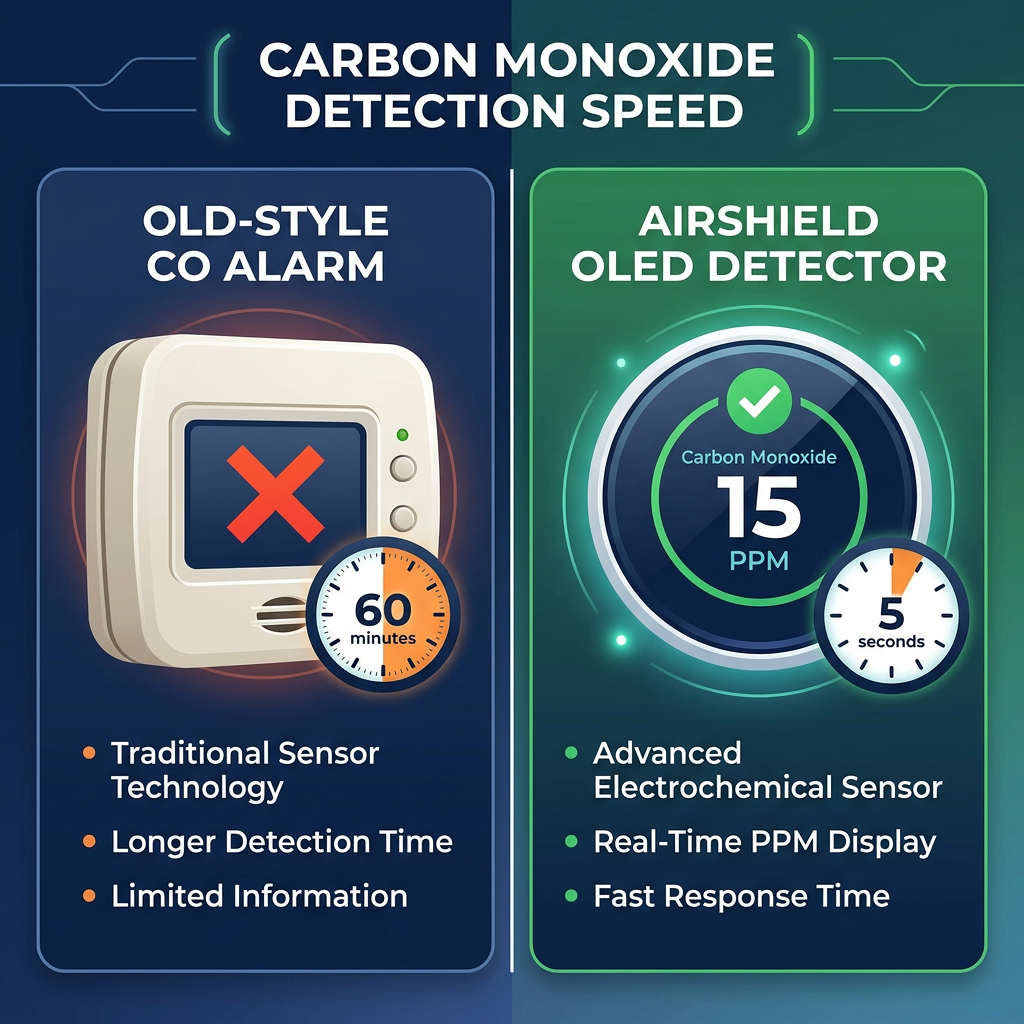
If you have ever looked at your CO detector and wondered whether it was actually doing anything, the honest answer is: it is waiting. Standard residential CO alarms are governed by UL 2034, a standard that deliberately builds in response delays. At 70 PPM — the baseline alarm concentration — a UL 2034 detector is permitted up to 240 minutes before sounding the alarm. That is four hours. At 150 PPM, up to 50 minutes. The standard was engineered this way on purpose, and the engineering reasoning is sound. But the tradeoff it creates is real: by the time a standard detector alarms at threshold, a significant exposure duration has already elapsed. AirShield's OLED display shows the live CO level in the air within 5 seconds of CO entering the sensor. No waiting. No threshold. No time-weighted average. The number on the screen is what is in your air right now. That is the gap. Here is why it exists and what it means. Digital Carbon Monoxide Detector: Why the Number on the Screen Changes Everything
The Engineering Reason Standard Detectors Wait
UL 2034's alarm timing requirements were designed to solve a real problem: nuisance alarms. Early CO detectors alarmed on momentary CO spikes — a gas stove igniting, a car pulling into an attached garage briefly, someone opening a door near a running engine. These alarms trained occupants to ignore CO alarms entirely, defeating the safety purpose of the device. The time-weighted alarm response solved this: require sustained elevated CO at a specific concentration for a minimum duration before alarming. A momentary spike from a car doesn't alarm. A sustained leak from a malfunctioning furnace does. The standard achieved its goal. Nuisance alarms dropped. Compliance and trust in CO alarms increased. But the tradeoff was baked into the design: At 70 PPM sustained — a genuinely dangerous concentration that the EPA associates with headache and dizziness in healthy adults after 2–3 hours — a compliant UL 2034 detector may not alarm for up to four hours. During those four hours, occupants are exposed without any indication from their detector that anything is wrong. For the scenario UL 2034 was designed to address — acute poisoning from a rapid CO buildup — this is acceptable. For the scenario most residential exposures actually present — a moderate, sustained leak — the delay means hours of unalerted exposure. Takeaway: UL 2034's timing requirements are not a flaw — they are an intentional design choice with a real tradeoff. A live-display detector doesn't replace the alarm; it fills the gap the alarm was never designed to cover. Electrochemical vs. Semiconductor CO Detectors: Which Sensor Type Actually Protects You
How AirShield's 5-Second Response Works
AirShield uses an electrochemical CO sensor — the same sensor technology used in professional-grade industrial CO monitors, hospital air quality systems, and the handheld meters carried by firefighters on every CO call. Electrochemical sensors work through a direct electrochemical reaction: CO molecules entering the sensor chamber react at an electrode, producing a measurable electrical current proportional to CO concentration. This reaction is essentially instantaneous — the current changes within seconds of CO entering the chamber. AirShield's sensor and display circuitry are calibrated to refresh the PPM readout on the OLED screen within 5 seconds of a concentration change. There is no intentional delay built in. There is no time-weighted averaging on the display. What you see is what is present. **The comparison:** - Standard UL 2034 alarm at 70 PPM: alarms within 60–240 minutes (3,600–14,400 seconds) - AirShield display response at any detectable CO level: within 5 seconds That is a minimum of 720x faster, and up to 2,880x faster, depending on the alarm timing scenario. The conservative claim of 50x understates the actual gap. This speed advantage is most meaningful in two scenarios: acute buildup events (vehicle in attached garage, generator too close to an air intake) where you need to know within seconds, not hours; and sub-threshold chronic leaks where the display shows you 18 PPM immediately and you know to investigate, rather than waiting for a 70 PPM alarm that may never come. What Causes Carbon Monoxide in a House? 7 Hidden Sources
Why Faster Response Doesn't Mean More False Alarms
The obvious question: if AirShield responds to CO this quickly, doesn't it alarm constantly from cooking, perfume, or cleaning products? The answer is no — and the reason is sensor technology. AirShield uses an electrochemical sensor, which is chemically selective for CO. It produces a measurable response to CO molecules specifically, not to general combustion byproducts, volatile organic compounds (VOCs), steam, or the majority of common household chemicals. The detectors that produce frequent false alarms are typically metal oxide semiconductor (MOS) sensors — cheaper technology that is cross-sensitive to many gases and particulates. An MOS-based detector alarms when you fry onions, clean with ammonia, or use aerosol products. An electrochemical detector does not. AirShield's display will show elevated PPM when actual CO is present. It will not show elevated readings from cooking smoke, candles, cleaning products, or perfume. If AirShield shows 30 PPM, 30 PPM of CO is present. This is the defining characteristic of electrochemical sensing: the speed is not in tension with the accuracy. You get both. Visit airshield.store to see specifications and availability.
Frequently Asked Questions
Sources & References
- UL 2034: Single and Multiple Station Carbon Monoxide Alarms — Alarm Timing Requirements — UL 2034 defines the required alarm response times at specific CO concentrations for residential CO alarms.
- EPA: Carbon Monoxide Health Effects by Concentration — EPA data on health effects at CO concentrations from 1 PPM through immediately dangerous levels.
- NIOSH: Electrochemical Sensor Technology for CO Detection — NIOSH documentation on electrochemical sensor technology and its application to CO detection.
Protect Your Home with AirShield™
The only portable CO detector that shows you real-time PPM readings on a live OLED display. Electrochemical sensor, multi-gas detection, UL listed.
Check Availability →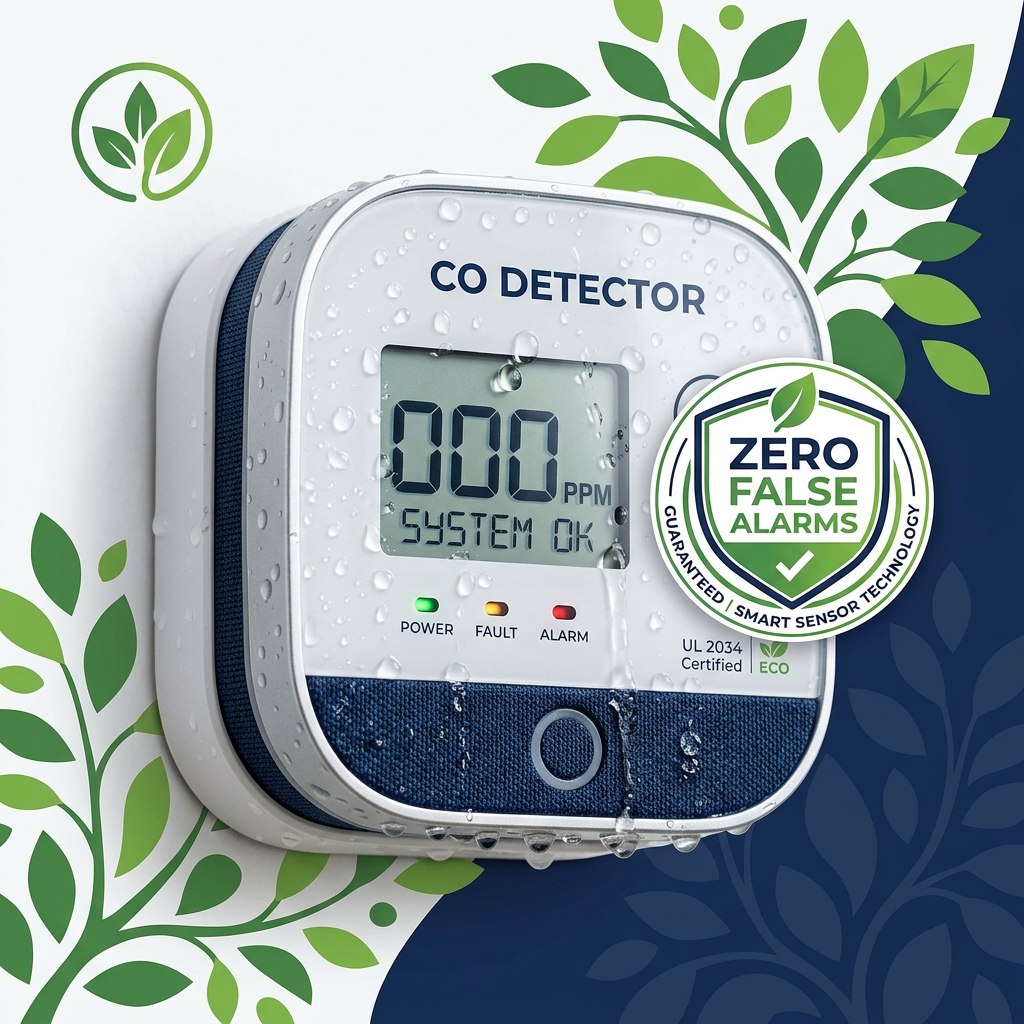
Loading comments...