Most consumer CO detectors are designed to a single specification: alarm at the right CO threshold. That is a reasonable minimum. It is also the entirety of most manufacturers' design ambition. AirShield was built to a higher set of requirements: survive real-world environments without degrading, minimize its environmental footprint across its entire lifecycle, and never interrupt your sleep or your day with an alarm that means nothing. Three design choices define how AirShield differs from the typical plug-in detector. Portable Carbon Monoxide Detector: 5 Features That Actually Matter
The Bio Splash-Resistant OLED Screen
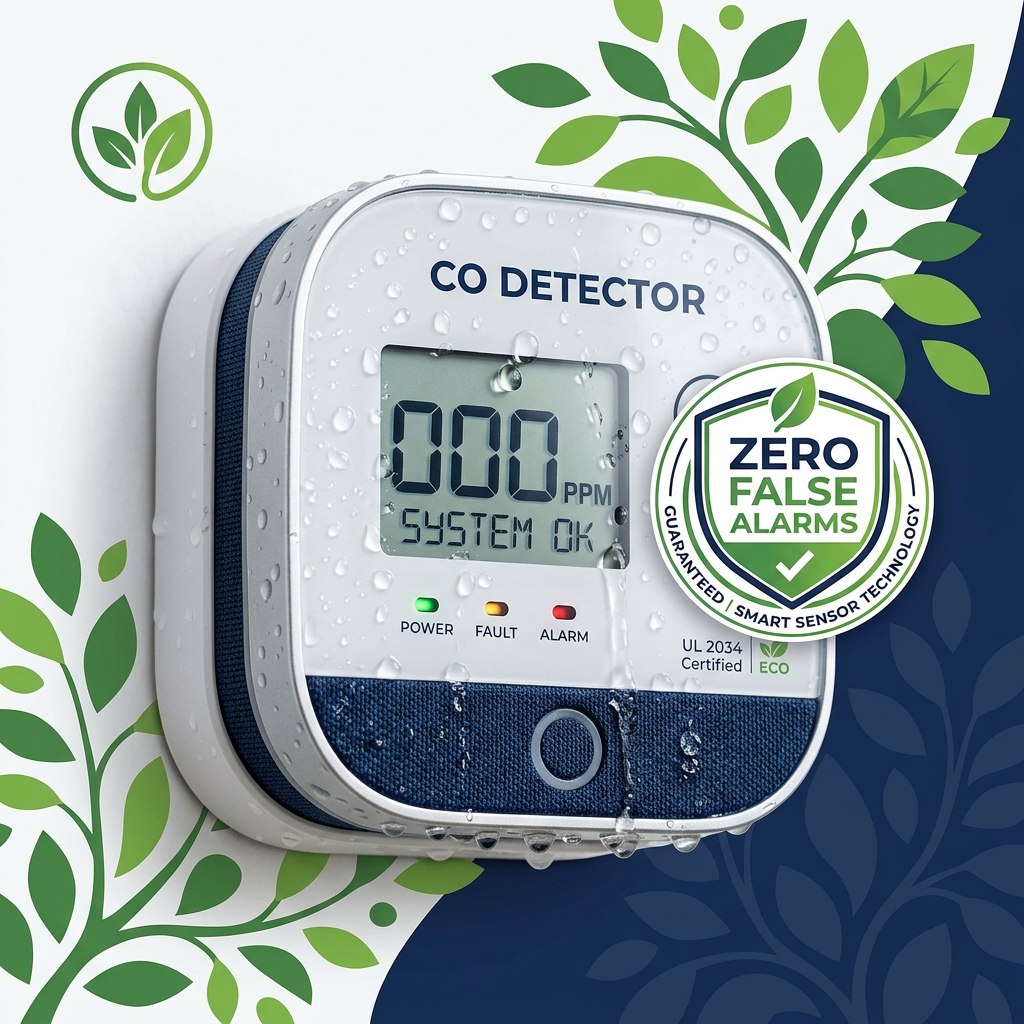
The AirShield OLED display is the most information-dense component on the device — and historically the most vulnerable. Standard OLED panels are sensitive to moisture. Humidity, steam, water droplets from cleaning, and biological moisture from proximity to a shower or kitchen sink all degrade an unprotected OLED display over months of exposure. This is not a theoretical concern. CO detectors are placed near bedrooms (proximity to bathroom humidity), in kitchens (cooking steam and moisture), and in basements (ambient humidity). A detector with an unprotected display placed in any of these locations will show display degradation — dark spots, uneven brightness, or complete panel failure — within 1–3 years. AirShield's OLED display is protected by a bio splash-resistant layer — a hydrophobic protective coating applied directly to the screen surface. This coating: - Repels water droplets, steam, and cleaning solution mist from the display surface - Prevents moisture infiltration at the screen edge-housing junction - Maintains display clarity and brightness in high-humidity environments - Allows the display surface to be wiped clean without abrading the underlying OLED panel The result is a display that looks as clear at year five as it did at year one — in the environments where CO detectors are actually used, not laboratory conditions. Takeaway: the bio splash-resistant layer is not a luxury feature — it is the reason the display you depend on for live CO readings is still readable at the end of the detector's operational lifespan.
Eco-Friendly by Design: Why Plug-In Matters Beyond Convenience
The choice to build AirShield as a plug-in detector rather than a battery-operated unit was made for usability reasons — a plug-in detector never goes dead at 3 AM because a battery drained. But the environmental case for plug-in design is equally strong. **Battery waste:** A standard battery-operated CO detector consumes 2–4 AA batteries per year, replaced when the low-battery chirp becomes annoying enough to act on. Over a 5–7 year detector lifespan, that is 10–28 AA batteries per unit deposited in household waste streams. Multiplied across the roughly 45 million CO detectors sold in the US annually, battery-operated CO detection generates tens of millions of disposable batteries per year in landfill waste. AirShield produces zero battery waste across its entire operational life. Plug it in once. It runs continuously on standard AC power without ever consuming or discarding a battery. **Sensor materials:** AirShield's electrochemical CO sensor cell contains no mercury and no cadmium — heavy metals present in some older sensor technologies that create disposal and contamination concerns at end of life. The sensor chemistry is designed for safe disposal through standard e-waste recycling streams. **Housing and packaging:** AirShield's housing uses materials selected for recyclability. Product packaging is designed to minimize non-recyclable components — no foam inserts, minimal plastic wrap, cardboard shipping materials that go directly into curbside recycling. Takeaway: the eco-friendly design of AirShield is not a marketing position — it is a set of specific engineering choices (plug-in power, sensor chemistry, housing materials, packaging) that reduce environmental impact at every stage of the product lifecycle. How Accurate Are Portable Carbon Monoxide Detectors?
Why AirShield Never False Alarms
The CO detector false alarm is one of the most reliable ways to destroy user trust in home safety equipment. A detector that alarms when you make stir-fry, when you use cleaning spray, when someone lights a candle — and never when CO is actually present — trains every person in the household to ignore alarms entirely. When the detector finally encounters real CO, no one acts. AirShield does not false alarm. This is not a design goal or a performance aspiration — it is a direct consequence of the electrochemical sensor technology at the core of the device. Electrochemical CO sensors work through a highly selective electrochemical reaction: the sensor cell reacts to carbon monoxide molecules specifically, generating a current proportional to CO concentration. The chemistry of this reaction is specific to CO. Cooking smoke contains particulates and combustion byproducts but not significant CO — no reaction, no alarm. Cleaning products contain VOCs — no reaction, no alarm. Perfume, aerosol hairspray, paint fumes — no reaction, no alarm. Contrast this with MOS (metal oxide semiconductor) sensors — the technology in most budget CO detectors under $30. MOS sensors respond to a broad range of gases and particulates. They alarm from cooking, from cleaning products, from humidity changes, from cigarette smoke. They are the source of the 'CO alarm going off for no reason' searches that flood Google every winter. With AirShield's electrochemical sensor: if the alarm sounds, CO is present. No exceptions, no explanations, no pressing reset and hoping it was nothing. The alarm is information, not noise. When it sounds, you leave. The live display adds a second layer of confidence: before any alarm, you can see the PPM reading at any moment. If the display shows 0, the air is clean. If it shows 35, you have a source to find. The alarm and the display together mean you are never guessing. Visit airshield.store.
Frequently Asked Questions
Sources & References
- EPA: Indoor Air Quality and CO Detection — EPA guidance on CO detection technology and indoor air quality.
- CPSC: CO Detector Standards and False Alarm Research — CPSC research on CO detector performance including false alarm rates by sensor type.
- UL 2034: Standards for CO Alarm Performance and Selectivity — UL 2034 selectivity requirements that govern what a CO alarm should and should not respond to.
Protect Your Home with AirShield™
The only portable CO detector that shows you real-time PPM readings on a live OLED display. Electrochemical sensor, multi-gas detection, UL listed.
Check Availability →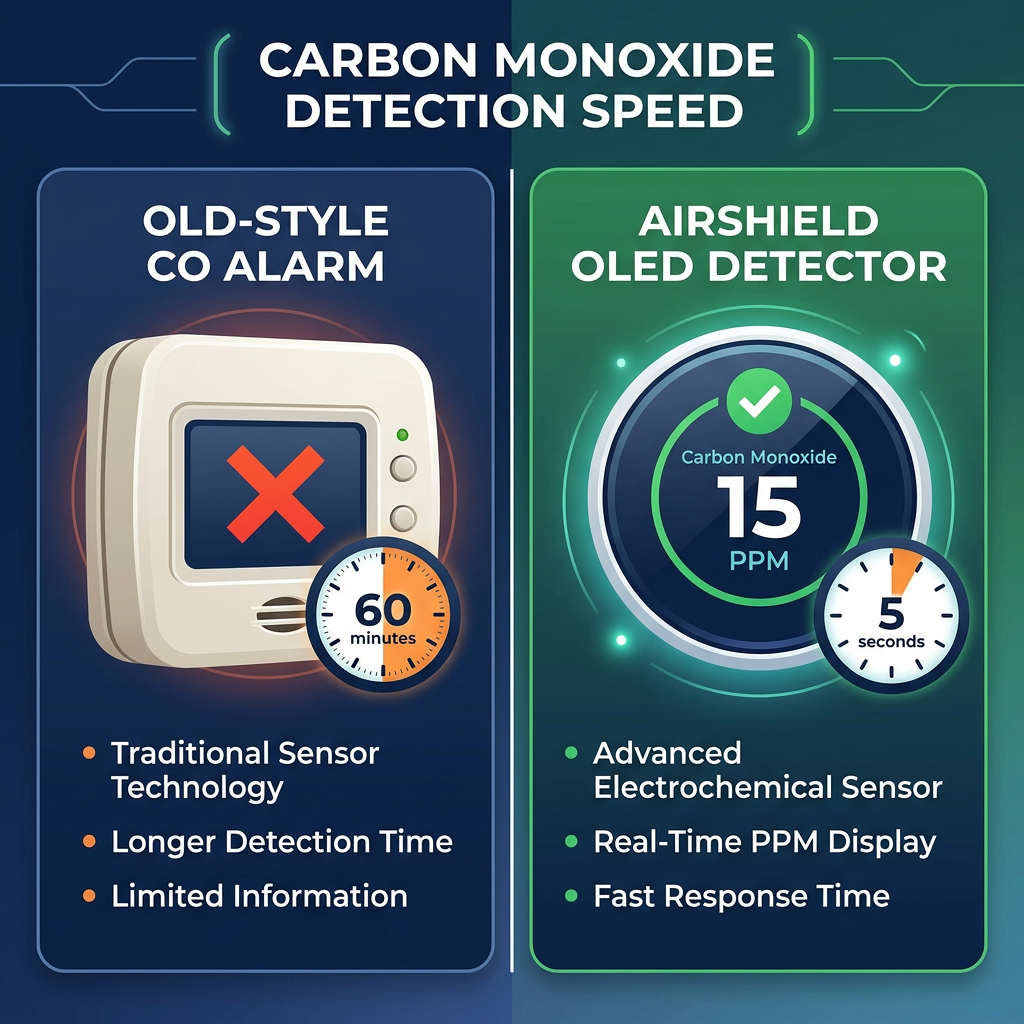
Loading comments...