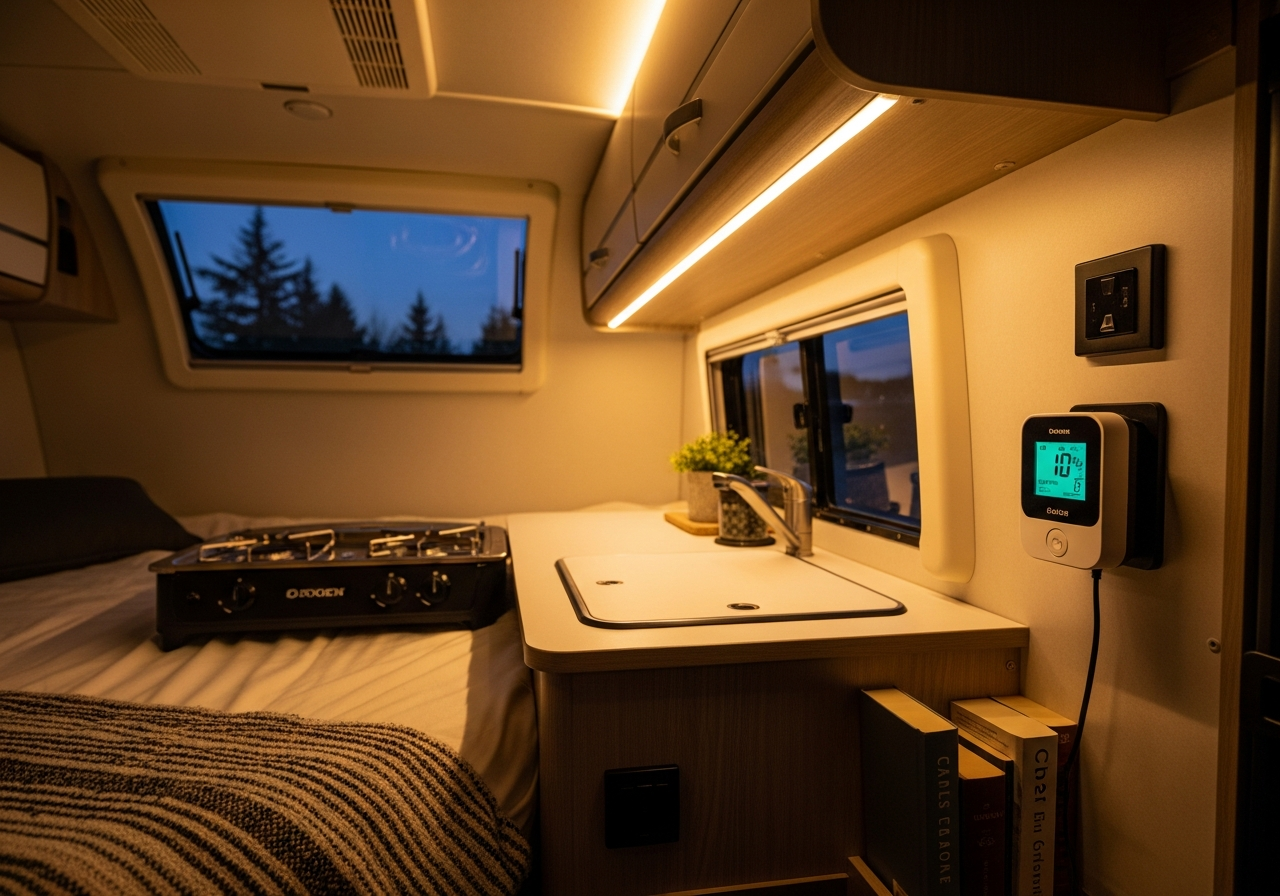
An RV is, by design, a small enclosed space filled with propane appliances. The furnace runs on propane. The stove and oven run on propane. The water heater runs on propane. In many older RVs, the refrigerator runs on propane. All of these appliances produce carbon monoxide as a byproduct of combustion — and the enclosed space means that byproduct has nowhere to go except the air you breathe. Add a generator running outside the rear wall, an engine idling in a covered area, or a campsite neighbor's portable generator 15 feet away, and the CO equation becomes more complex. Portable carbon monoxide detectors are one of the most important safety upgrades an RV owner can make — and for the specific demands of RV life, the type of detector matters as much as whether you have one at all. This guide covers the specific CO risks in RVs, why built-in alarm-only detectors fall short, and what to look for in a portable CO detector for RV use. Generator Carbon Monoxide Dangers This Hurricane Season
Why RVs Create Unique Carbon Monoxide Risk
RVs concentrate CO risk in a way that most permanent residences do not. A home has multiple rooms that dilute CO production from any single appliance. An RV has one to three small rooms — often with a combined living, sleeping, and cooking area — where CO from a malfunctioning propane burner can accumulate faster than any ventilation system can clear it. The sleeping area in a Class B van conversion may be within four feet of the propane furnace. The bedroom in a Class C RV shares a wall with the engine compartment. The propane oven in any RV is being used in a kitchen that is physically smaller than most residential bathroom. Propane appliances produce CO at a rate that depends heavily on combustion efficiency — and combustion efficiency in aging RV appliances degrades with altitude changes, dirty burners, aging pilot assemblies, and inadequate maintenance — all common realities of RV ownership. An RV furnace that ran cleanly at sea level may run inefficiently at altitude, producing three times the CO. A water heater that was serviced two seasons ago may have a partially blocked flue that doesn't fail completely but vents imperfectly. These are slow-moving risks that an alarm-only detector at 70 PPM will never register. Digital Carbon Monoxide Detector: Why the Number on the Screen Changes Everything Takeaway: RVs concentrate CO production and limit dilution in ways that make low-level monitoring — not just alarm-threshold detection — essential for real safety.
Why Built-In RV CO Detectors Are Not Enough
NFPA 1192, the standard governing new RV construction, requires CO detectors in new recreational vehicles. This is a meaningful baseline — but it has significant limitations in practice. First, the requirement applies to new RVs. Millions of RVs on the road predate mandatory CO detector requirements and have no built-in detector at all. Second, even compliant built-in detectors are alarm-only units calibrated to the UL 2034 threshold: 70 PPM for four hours before the alarm triggers. This standard was designed to prevent acute fatal poisoning in healthy adults — not to protect against the lower concentrations that cause chronic headaches, fatigue, and cognitive effects during multi-night stays in a propane-heavy environment. Third, built-in detectors age and drift. Most electrochemical sensors have a rated lifespan of 5 to 7 years. An RV purchased in 2017 with an original factory CO detector may have a sensor that is outside its reliable operating range, yet will continue to show a green light until a dangerous threshold is crossed. An RV with a 2016 factory CO detector has a sensor that may be past its rated electrochemical accuracy window — it may alarm eventually, but the readings on any numeric display (if it has one) are not reliable. A portable CO detector with a fresh electrochemical sensor plugged in at each campsite is the reliable alternative. How Long Do Carbon Monoxide Detectors Last? When to Replace Yours Takeaway: built-in RV CO detectors are a starting point — but age, alarm-only design, and pre-regulation vintage leave significant coverage gaps that a portable detector fills.
Generator CO in the RV: The Overnight Risk Nobody Talks About
RV generators — both built-in and portable — are one of the most significant CO sources for RV travelers, and the one most consistently underestimated. Built-in generators are mounted in an exterior compartment but share wall space, ventilation pathways, and structural gaps with the living area. Portable generators placed behind or beside the RV produce a CO plume at exactly the height and location of the vehicle's rear ventilation and window openings. The risk is highest when the generator runs overnight for climate control — air conditioning in summer, heat in shoulder seasons. During the day, occupants are alert, moving, and likely to notice early CO symptoms. At night, early symptoms — headache, fatigue, vivid dreams — are attributed to the previous day's exertion or the unfamiliar sleeping environment. CPSC incident reports show that RV generator CO events are disproportionately fatal compared to home generator incidents because occupants are asleep in a small space with the source running for hours before any alarm threshold is reached. The time between an uncomfortable reading and a medical emergency is where a live-display portable CO detector — showing 35 PPM at midnight while you're still conscious — provides protection that an alarm-only unit categorically cannot. This Portable Travel CO Detector Could Save Your Life Takeaway: overnight generator operation in an RV is the highest-risk scenario in the vehicle — live CO readings give you the window to act that alarm thresholds do not.
What to Look for in a Portable CO Detector for RV Use
RV use places specific demands on a portable CO detector that hotel or home use does not. Plug it in at each campsite and it should start reading immediately — no warm-up lag, no need to re-pair or recalibrate between locations. The display should be readable in RV ambient lighting, including at night when you wake and glance at it from the bed. Universal voltage matters if you travel internationally or use shore power at campgrounds with non-standard configurations. Methane and propane detection on the same device adds meaningful protection given that propane appliances are everywhere in an RV — a leak from a stove connection or water heater fitting is a fire and explosion risk in addition to a CO risk.
- Electrochemical sensor — essential for accurate low-level readings in a small enclosed space where CO accumulates faster than in a home
- Live numeric PPM display — so you can monitor CO levels from propane appliances throughout the day and check the reading before going to sleep
- Immediate startup reading — no 10-minute warm-up period; you want to know the CO level in the RV before you decide whether to run the generator
- Methane and propane detection — given the density of propane connections in an RV, combined gas detection on one device adds meaningful coverage
- Universal 100-240V input — for international travel and non-standard campground shore power configurations
- Compact plug-in form factor — small enough to move between the bedroom and common area as needed, with no battery dependency
RV travel is one of the best ways to see the country — and carbon monoxide is one of the risks that can turn a dream trip into a tragedy when it is not taken seriously. The AirShield™ 3-in-1 Portable Carbon Monoxide Detector detects CO, methane, and propane on a single live OLED display — updated in real time by the Smart M8 electrochemical chip, UL 2034 certified, and built to plug into any outlet worldwide. Plug it in when you arrive at camp, check the reading before you start the generator, and know what is actually in the air of your RV. Visit airshield.store.
Frequently Asked Questions
Sources & References
- NFPA 1192: Standard on Recreational Vehicles — NFPA standard requiring CO detectors in new RVs and governing their installation
- CPSC: Carbon Monoxide from Portable Generators — CPSC guidance on generator CO risk in RV and camping settings
- CDC: Carbon Monoxide in Recreational Settings — CDC overview of CO poisoning in recreational vehicles and camping environments
Protect Your Home with AirShield™
The only portable CO detector that shows you real-time PPM readings on a live OLED display. Electrochemical sensor, multi-gas detection, UL listed.
Check Availability →
Loading comments...