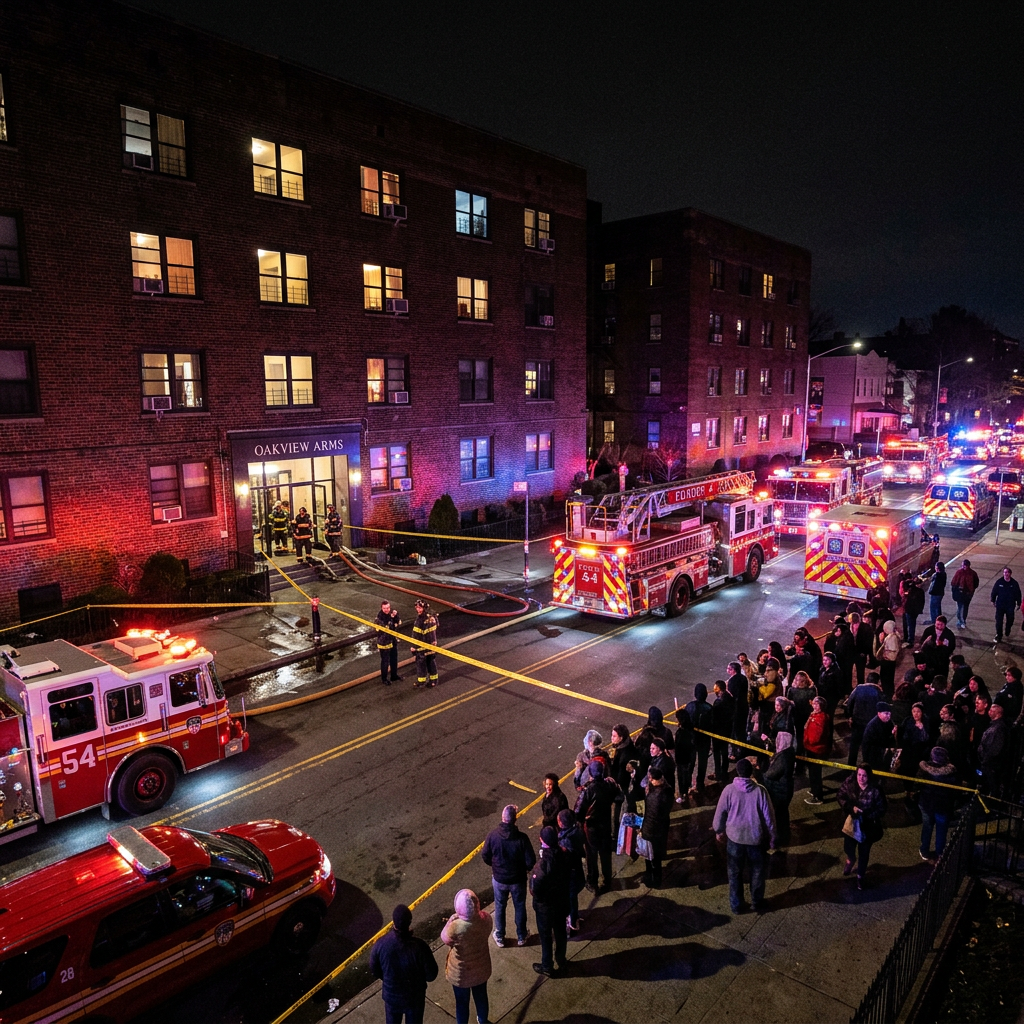
Three west-side Madison apartment units were evacuated today — August 14, 2026 — after investigators found high levels of carbon monoxide inside the building. Emergency responders were called to the scene after CO was detected, and residents were ordered out while crews identified the source. No one died. But the scenario is the same one that has killed apartment residents across the country: high CO levels in a shared building, residents exposed before they knew anything was wrong, evacuation happening because someone else's detector caught it — or because symptoms were severe enough to call for help. Carbon Monoxide Poisoning Symptoms: What to Know Before It's Too Late For anyone renting an apartment, this is the CO safety gap that most landlords, most lease agreements, and most state laws do not close.
How CO Spreads Through an Apartment Building
A single-family home with a malfunctioning furnace affects only that home. An apartment building with the same problem can affect dozens of units simultaneously — because the systems that make multi-unit buildings efficient also make CO more dangerous in them. Shared HVAC systems — common in mid-size and large apartment buildings — distribute air across multiple units from a central heating or cooling plant. A combustion problem in the boiler room can produce CO that the shared system pumps into every unit on the same duct run. Ventilation pathways, hallways, and the pressure differential between floors can carry CO from one unit's appliance malfunction into neighboring units through gaps around pipes and electrical conduits. A renter in unit 4B can receive a dangerous CO concentration from a malfunction in unit 3B, the building's utility room, or the parking garage below — with no appliance of their own producing anything. This is why CO incidents in apartment buildings often result in building-wide evacuations, not just single-unit responses. The source may be isolated, but the exposure is not. What Causes Carbon Monoxide in a House? 7 Hidden Sources Takeaway: CO in apartment buildings does not respect unit boundaries — shared systems and building ventilation can distribute gas from one source to many units simultaneously.
What Landlords Are — and Aren't — Required to Do
CO detector requirements for rental properties vary by state, and most renters do not know what their state actually requires. As of 2026, more than 30 states have some form of CO detector requirement for residential rentals — but the specifics matter enormously. Some states require detectors only in units with attached garages or fuel-burning appliances. Others require them in every unit regardless. Some require annual testing; others simply require presence at move-in. Several states have no residential CO detector requirement for rentals at all. Enforcement is also inconsistent. A landlord who installs a detector with a dead battery, places it in an ineffective location, or lets an expired unit stay in place may technically satisfy local ordinance while providing no actual protection. The detector in the hallway outside your apartment, with a battery that has not been changed in three years, is not protecting you from the furnace in the basement. In most states, the legal requirement for CO detectors in rentals creates the appearance of protection without any mechanism to verify the protection is actually working. The Madison evacuation is a reminder that building-provided CO detection catches events after they've already developed into emergencies — not before. Carbon Monoxide Detectors in Rental Properties: What Landlords Are Required to Do Takeaway: state CO detector requirements for rentals vary widely, enforcement is inconsistent, and landlord-provided detectors have common failure modes that a renter's own device would catch.
What Renters Can and Cannot Control
A renter cannot control the building's HVAC system, the condition of the appliances in neighboring units, or whether the parking garage below has adequate ventilation. Those are entirely within the landlord's domain, and they are the sources most likely to produce CO that travels across unit lines. What a renter can control is the CO monitoring inside their own unit — independently of whatever the building has or hasn't installed. A portable CO detector with a live PPM display, such as the , provides real-time concentration data inside your specific unit. It does not care whether the building's detector is expired, low-battery, or poorly placed. It shows the number in the air where you are, right now, and alarms if that number rises to a dangerous level. A portable detector you own and maintain is the only CO protection you fully control in a rental — everything else depends on someone else's maintenance habits and compliance with laws that may not even apply to your building. After today's Madison evacuation, residents displaced from three units have no guarantee that the source has been fully identified and repaired before they are asked to return. A live PPM reading when you re-enter tells you something definitive. An absence of alarms does not. Carbon Monoxide Detectors That Show PPM: Why a Number Matters More Than an Alarm Takeaway: the only CO protection a renter fully controls is the detector they own — building-provided equipment depends on the landlord's maintenance, placement decisions, and regulatory compliance.
What to Do If You're a Renter
- Get your own portable CO detector — one you own, maintain, and control independently of what the building provides
- Place it at sleeping height in or near your bedroom — CO exposure during sleep is the most dangerous scenario
- Check your state's CO detector requirements for rentals — many require landlords to provide detectors, and your landlord may be non-compliant
- If your building does not have visible CO detectors in the hallways and utility rooms, ask your landlord in writing — this creates a record
- Know where the building's main gas shutoff is and what the evacuation protocol is — ask property management if this information is not posted
- If you wake up with a headache, dizziness, or nausea and no obvious cause, leave the unit immediately and call 911 before trying to troubleshoot
- When returning to a unit after a CO incident or evacuation, use a live PPM reading to confirm the air is clear — don't rely only on the absence of alarms
Three Madison apartments were emptied today because CO levels were high enough to require emergency response. The residents had no warning before responders arrived. That is how apartment CO events unfold — quickly, without any signal the occupants can act on, until the situation is already an emergency. The AirShield™ 3-in-1 Portable Carbon Monoxide Detector requires no installation, no landlord approval, and no lease modification. It plugs into any outlet in your apartment and shows live CO PPM continuously — so you see the number rising before an alarm has to sound. Visit airshield.store.
Frequently Asked Questions
Sources & References
- WMTV 15 News: Madison Apartment Evacuation August 14 — Original August 14, 2026 report on the Madison, WI apartment CO evacuation.
- CPSC: Carbon Monoxide Information Center — CPSC guidance on residential CO detector requirements and apartment safety.
- CDC: Carbon Monoxide Poisoning Prevention — CDC guidance on CO sources in residential buildings.
Protect Your Home with AirShield™
The only portable CO detector that shows you real-time PPM readings on a live OLED display. Electrochemical sensor, multi-gas detection, UL listed.
Check Availability →
Loading comments...