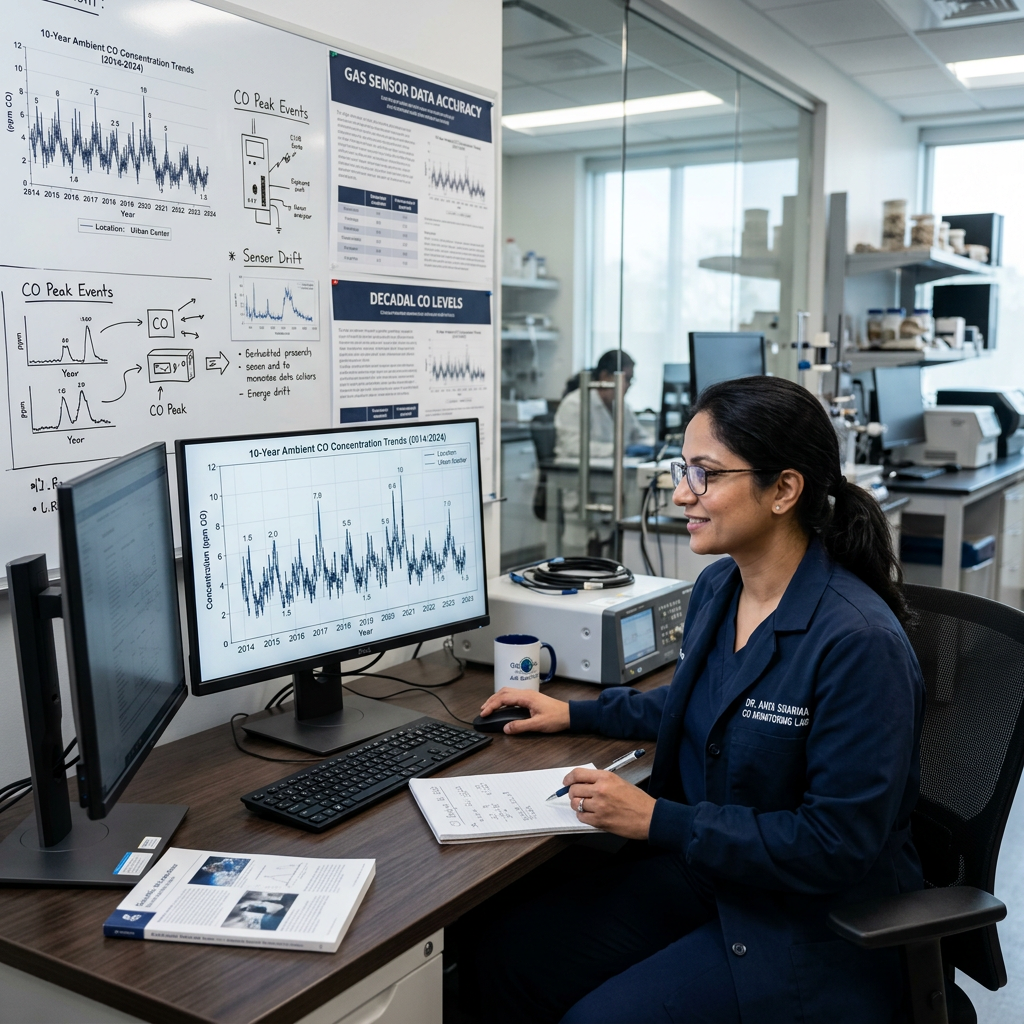
Most CO research focuses on the acute end: the garage with a running car, the apartment where the furnace backdrafts, the camping tent with a charcoal burner. These are the scenarios that end up in toxicology reports and CPSC fatality data. They are the scenarios that UL 2034 — the standard governing every residential CO alarm sold in the United States — was designed to prevent. Dr. Blaine Shilling spent the better part of ten years asking a different question: what about everything below that threshold? What happens to the people in homes where CO never reaches 70 PPM — where the detector never alarms — but where 15 or 25 or 40 PPM is present for eight hours every night while the family sleeps? His research, conducted over a decade of CO exposure study and directly informing AirShield's design philosophy, produced an answer that fundamentally changes how carbon monoxide detection should be framed. Low-Level Carbon Monoxide Exposure: The Silent Risk Your Alarm Never Triggers
The Sub-Threshold Problem: What Standard Detectors Are Designed to Miss
UL 2034 specifies alarm timing as follows: a CO detector must alarm within 60–240 minutes at 70 PPM, within 10–50 minutes at 150 PPM, and within 4–15 minutes at 400 PPM. These thresholds were derived from acute toxicology data — concentrations and durations that produce measurable physiological distress in healthy adults. What they were not designed to capture: the range of 10–50 PPM, where CO begins competing meaningfully with oxygen for hemoglobin binding without producing acute symptoms severe enough to prompt emergency treatment. Dr. Shilling's decade of research established that this sub-threshold range is where the majority of chronic CO health impact occurs — not in the dramatic acute-poisoning scenarios that make news, but in the quiet daily accumulation that millions of Americans experience without knowing it. At 10–35 PPM sustained over 6–8 hours of sleep: - Carboxyhemoglobin saturation rises to 3–8% (normal baseline is under 3% for non-smokers) - Cerebral oxygen delivery decreases measurably - Sleep quality deteriorates without the occupant experiencing what they'd describe as a CO symptom - Cognitive performance the following day is impaired None of this triggers a standard detector. The occupant wakes up with a headache, blames stress or seasonal allergies, and goes to sleep the next night in the same air. When Carbon Monoxide Looks Like the Flu: How CO Poisoning Gets Misdiagnosed Takeaway: the standard alarm threshold was designed to prevent death — not to protect health at chronic low-level exposures. These are different goals, and a detector that only addresses the first cannot address the second.
The Pattern Dr. Shilling Identified: The Accumulation Cycle
One of the key findings from Dr. Shilling's research was the identification of what he termed the accumulation cycle — the mechanism by which sub-threshold CO produces compounding health impact over weeks and months. The cycle works as follows: **Night 1:** Furnace runs with a slightly degraded heat exchanger. CO rises to 20 PPM in the sleeping area. Detector shows nothing. Carboxyhemoglobin rises to 4% during sleep. Occupant wakes with a dull headache and fatigue. **Day 1:** Carboxyhemoglobin clears during the day (CO has a half-life in the bloodstream of 4–6 hours at rest, 60–90 minutes with exercise and fresh air). Occupant feels better. Attributes morning symptoms to poor sleep. **Night 2–30:** Same exposure, same cycle. The occupant adapts psychologically — the morning headache becomes the new normal. The detector never alarms. The cause is never investigated. After 30–60 days of this pattern, the occupant's baseline cognitive performance and cardiovascular function has been measurably degraded. They may seek medical attention for fatigue, persistent headache, or mood changes — conditions that are treated symptomatically because no one tested for CO. The reason this cycle continues uninterrupted is that standard detectors have no way to communicate sub-threshold readings. They are binary: alarm or no alarm. Without a live PPM display, the occupant has no way to know that 22 PPM is present at 2 AM. Takeaway: the accumulation cycle is how CO does most of its damage in residential environments — not in acute incidents, but in repeating sub-threshold exposures that a standard detector is functionally blind to. Carbon Monoxide Looks Exactly Like Being Drunk
How This Research Shaped AirShield's Design
The practical implication of Dr. Shilling's research is straightforward: if the real CO risk is sub-threshold chronic exposure, then a detector that only alarms at threshold provides an incomplete safety solution for most homes. AirShield was designed from the outset around the principle that occupants need to see the number — not just hear an alarm when the number gets high enough. The OLED live PPM display is not a premium feature added for marketing differentiation. It is the design response to a decade of research showing that the information gap between 0 PPM and the 70 PPM alarm threshold is where most CO health impact lives. When you glance at your AirShield at 11 PM and see 0 PPM, you go to bed informed. When you see 18 PPM, you open a window, and in the morning you call for a furnace inspection. Neither action is possible with an alarm-only detector — because the alarm never triggered. The accumulation cycle continues. The source goes undetected. Dr. Shilling's contribution to AirShield was the research foundation that made the live display not just a nice-to-have but a safety requirement — the difference between a detector that prevents death and a detector that protects health. Visit airshield.store.
Frequently Asked Questions
Sources & References
- CDC: Carbon Monoxide Health Effects — CDC guidance on CO health effects across exposure levels.
- EPA: Health Effects of Carbon Monoxide — EPA documentation on CO health impacts at varying concentrations.
- NIOSH: Carbon Monoxide Exposure Limits — NIOSH occupational exposure limits showing health effects below standard residential alarm thresholds.
Protect Your Home with AirShield™
The only portable CO detector that shows you real-time PPM readings on a live OLED display. Electrochemical sensor, multi-gas detection, UL listed.
Check Availability →
Loading comments...