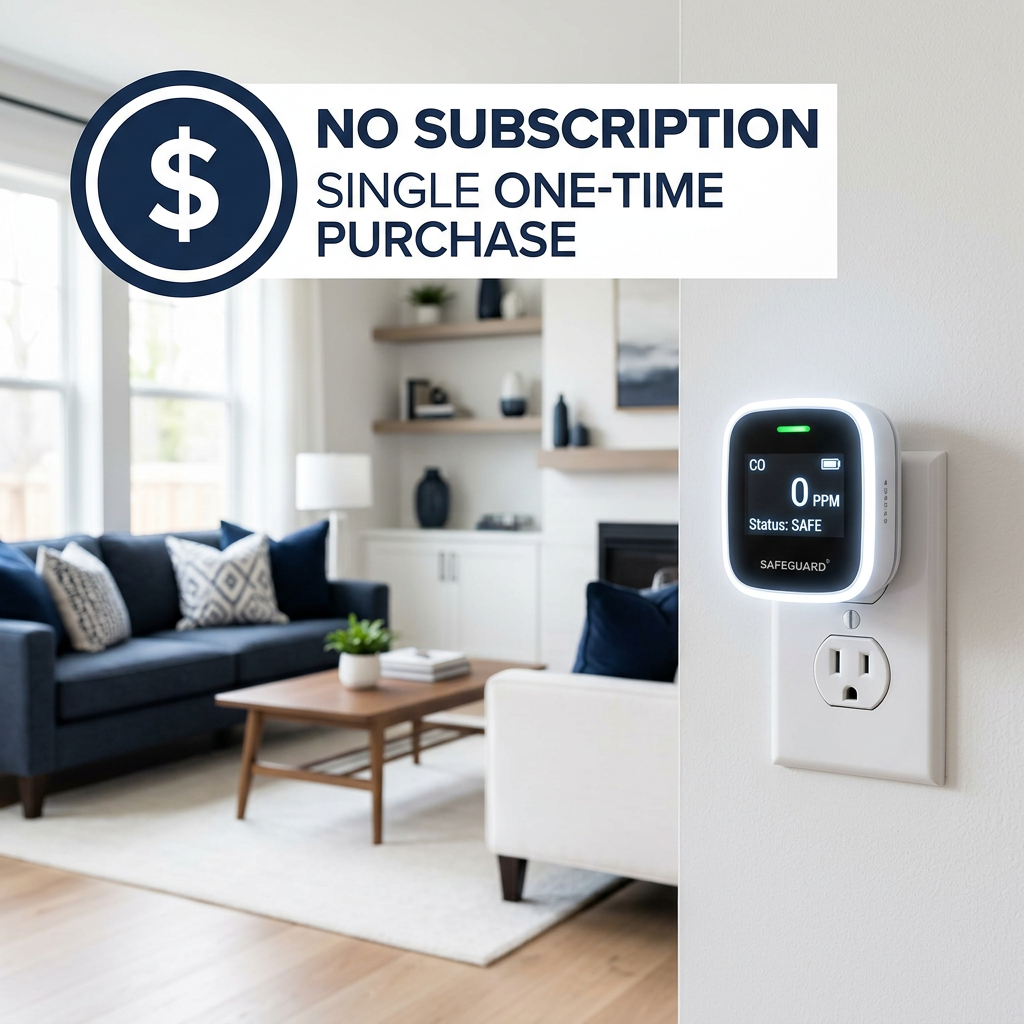
The carbon monoxide detector market quietly split in two around 2019. On one side: traditional plug-in and battery detectors that you buy once and they work. On the other: smart-home CO detectors integrated into subscription ecosystems — Nest Protect, Ring Alarm, ADT equipment — where the hardware purchase is the entry fee and the recurring monthly charge is where the company actually makes its money. For buyers who aren't paying close attention, this has made CO detection quietly expensive. A homeowner who buys a Nest Protect for their three-bedroom home — replacing units every 5–7 years as the electrochemical sensor degrades — and stays subscribed to a cloud monitoring plan over ten years can easily spend $700–$1,400 per home on carbon monoxide detection. A buyer who uses a subscription-free plug-in detector from the beginning spends $49–$150 over the same period. The safety outcomes between these two options are essentially identical — CO detection is regulated by UL 2034, and every detector sold in the US must alarm at the same threshold regardless of whether it has a subscription feature. The subscription pays for cloud alerts, history logs, and integration with a broader security ecosystem. It does not buy you a better sensor or earlier alarm timing. Electrochemical vs. Semiconductor CO Detectors: Which Sensor Type Actually Protects You This guide breaks down exactly what you pay — and what you get — across the major CO detector categories in 2026.
The 5-Year Cost Comparison: Subscription vs. No Subscription
Here is the actual 5-year math for a single CO detector in a US home, based on retail and subscription pricing as of August 2026: **Nest Protect (Wired or Battery):** Hardware: $119. Google Home subscription with CO monitoring: $8–$15/month. 5-year total: $599–$1,019. Replacement required after 5–7 years. **Ring Alarm CO Listener:** Hardware: $35. Ring Home subscription (required for remote alerts): $10–$20/month. 5-year total: $635–$1,235. Note: the CO Listener does not function as a standalone alarm without a Ring Base Station ($99). **Kidde KN-COPP-3 (No subscription):** Hardware: $30–$35. Monthly cost: $0. 5-year total: $30–$35. Replacement required after 5–7 years. **First Alert CO400 (No subscription):** Hardware: $25. Monthly cost: $0. 5-year total: $25. **AirShield 3-in-1 (No subscription):** Hardware: $49. Monthly cost: $0. 5-year total: $49. Includes live OLED PPM display (not available on Kidde/First Alert at this price point). UL 2034 listed. The subscription premium for smart-home CO detection ranges from $550 to $1,200 over five years — for features that do not affect the detector's fundamental ability to protect you from CO poisoning. Takeaway: every UL 2034 detector sounds at the same thresholds; the subscription buys cloud integration, not better CO detection. Digital Carbon Monoxide Detector: Why the Number on the Screen Changes Everything
What the Subscription Actually Buys (And What It Doesn't)
To be fair to subscription-based CO detectors: the cloud features are real and useful for some households. What a subscription provides: **Remote alerts:** If your CO alarm sounds while you're away from home, you receive a push notification. Useful if you have pets or children home alone, or if you want to verify an alarm remotely before calling emergency services. **Alarm history:** Cloud logs of every alarm event, including time, duration, and CO level (on Nest). Useful for documentation or if you suspect recurring low-level exposure. **Cross-device communication:** Nest Protect units communicate with each other; one alarm triggers all units. This can also be accomplished with interconnected wired Kidde units at no subscription cost. **Professional monitoring add-on:** Some plans include dispatch of emergency services if the alarm triggers and you don't respond to the alert. This feature costs an additional $10–$25/month. What the subscription does NOT buy: A subscription does not change the sensor type, alarm threshold, detection speed, or fundamental CO safety capability of the device. A $49 subscription-free detector certified to UL 2034 will alarm at the same CO concentration as a $299 subscription model certified to the same standard. The sensor in both is an electrochemical cell. The UL 2034 standard mandates alarm within a defined time window at defined PPM thresholds. Both products must pass the same test to be sold in the US. The cloud layer sits on top of — and does not improve — the base safety function. Best Portable Carbon Monoxide Detector in 2026
When a Subscription Detector Makes Sense
There are legitimate use cases for subscription-based CO detection: **Vacation homes and rentals:** If you own a property that sits empty for months and you can't rely on someone being home to hear an alarm, remote alerting is genuinely useful. A CO event in an empty property wouldn't be caught by a standalone alarm until someone returned. **Households with hearing impairment:** Some subscription platforms integrate with strobe light flashers and bed shakers — though these are also available as standalone systems. **Existing smart-home ecosystems:** If you already pay for a Google Home, Ring, or ADT subscription for other reasons (cameras, motion sensors, door locks), adding CO monitoring to that existing subscription may add only a few dollars per month. For the majority of households — a family living in a primary residence who is home most evenings — a subscription-free UL-listed CO detector provides equivalent safety protection at a fraction of the cost. Takeaway: subscription CO detectors add value in specific scenarios (remote properties, existing subscriptions); for standard residential use, they cost 10–20x more over five years for the same core safety function.
The Live PPM Display Advantage — No Subscription Required
One feature that genuinely improves CO safety above the UL 2034 baseline is a live PPM display. Traditional CO detectors are binary: they alarm or they don't. A detector with a live PPM number visible on its screen tells you what's actually in your air — even at 10, 20, or 50 PPM, well before the alarm threshold of 70 PPM. This matters because chronic low-level CO exposure — 10–35 PPM sustained over hours — causes health effects (headache, cognitive impairment, fatigue) without ever triggering a standard alarm. Documented CO poisoning cases consistently show victims experiencing symptoms for days or weeks before exposure reached alarm threshold, or before they connected the symptoms to CO at all. A live display shows you 30 PPM at 11 PM. You know something is producing CO. You can investigate, ventilate, and call for a furnace inspection the next morning — instead of waking up feeling like you have the flu and not knowing why. The AirShield 3-in-1 includes a live OLED PPM display, costs $49 with no subscription, and is UL 2034 listed — combining the information value of a live readout with a zero-ongoing-cost model. Visit airshield.store to check availability.
Frequently Asked Questions
Sources & References
- Google Nest Protect Product Page — Subscription Pricing — Official Google hardware pricing and Nest Aware subscription tiers.
- CPSC: Carbon Monoxide Detector Standards and Testing — CPSC guidance on CO detector standards and what certification means.
- UL 2034 Standard for Single and Multiple Station Carbon Monoxide Alarms — The UL standard that defines minimum alarm thresholds for CO detectors sold in the US.
- NFPA 720: Standard for the Installation of CO Detection and Warning Equipment — NFPA placement and installation requirements for residential CO detectors.
Protect Your Home with AirShield™
The only portable CO detector that shows you real-time PPM readings on a live OLED display. Electrochemical sensor, multi-gas detection, UL listed.
Check Availability →
Loading comments...