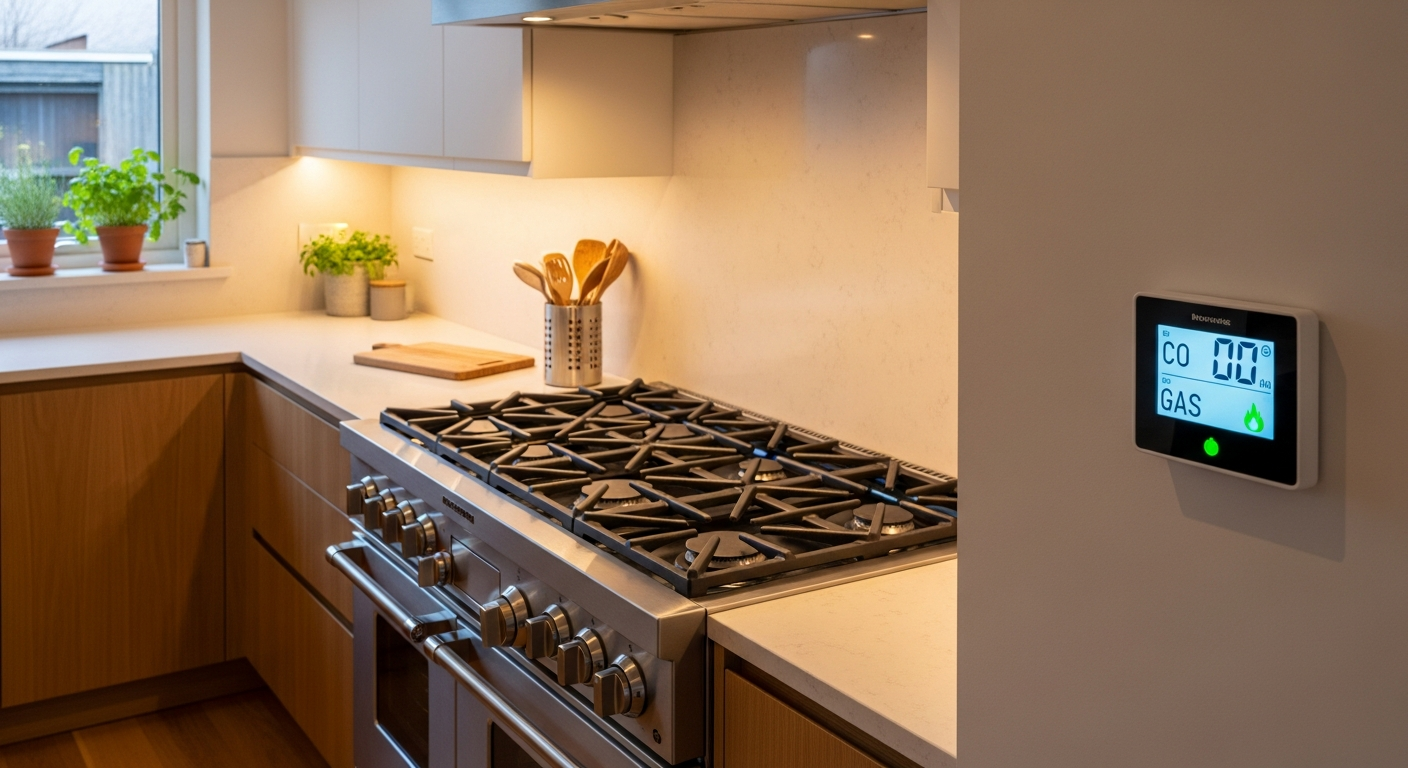
Most homeowners with gas appliances believe their carbon monoxide detector also protects them from gas leaks. It does not. A standard CO detector and a natural gas detector are fundamentally different instruments that detect entirely different hazards using completely different sensor technology. If your home has gas appliances, you need both — ideally in one device.
The Three Gases You Need to Detect
Residential gas hazards fall into three distinct categories:
- Carbon monoxide (CO): produced by incomplete combustion of any fuel; colorless, odorless; toxic at parts-per-million concentrations; detected by electrochemical sensors
- Natural gas (methane, CH4): the fuel delivered by your gas utility; odorized with mercaptan (the 'gas smell'); flammable and explosive; detected by catalytic or semiconductor sensors
- Propane (LP gas, C3H8): delivered in tanks for homes without natural gas service, RVs, and grills; heavier than air so it pools at floor level; flammable and explosive; detected by the same sensor types as methane
Why You Can't Rely on Smell Alone for Gas Leaks
Natural gas is odorized with mercaptan specifically because the gas itself is odorless — but this system has limits:
- Some people (particularly the elderly) have reduced ability to detect odors at low concentrations
- Olfactory fatigue can occur with prolonged low-level exposure — you stop noticing the smell
- Very slow leaks may not produce a detectable odor until the concentration is already dangerous
- Propane at floor level can accumulate below the level where you'd typically smell it
- CO, which is also produced during incomplete combustion, produces no smell at any concentration
The Risk of Relying on a CO-Only Detector
A CO-only detector protects against combustion byproducts — but a gas leak is a different event entirely. An undetected gas leak creates two distinct risks:
- Explosion and fire: natural gas and propane are highly flammable; even a small ignition source (a light switch, a spark from a thermostat) can trigger an explosion in a gas-enriched atmosphere
- Asphyxiation: high concentrations of natural gas displace oxygen, causing oxygen deprivation in enclosed spaces
- CO production: a gas leak that eventually ignites incompletely (pilot light re-ignition, for example) will produce CO — creating a combined hazard that a CO-only detector won't catch until the combustion has already begun
Where to Place a Combo Detector
Because CO, methane, and propane distribute differently in air, placement matters for multi-gas detectors:
- CO is roughly air-weight — place detectors at breathing height (5 ft)
- Methane (natural gas) is lighter than air — it rises and accumulates at ceiling level
- Propane is heavier than air — it sinks and accumulates at floor level
- A multi-gas detector at breathing height is a practical compromise that catches dangerous concentrations of all three gases, though placement near gas appliances (but not directly above) improves sensitivity
- Near sleeping areas is the highest priority location for any gas detector
What to Look For in a Multi-Gas Detector
- CO detection: electrochemical sensor with UL 2034 certification
- Methane detection: certified sensitivity down to the LEL (lower explosive limit) — typically 5% for methane
- Propane detection: separate alarm threshold for propane concentration
- Live display: shows individual readings for each gas rather than a single alarm
- 85+ dB alarm that distinguishes between gas types or shows which gas triggered it
- UL listed or ETL certified for all three detection modes
AirShield detects carbon monoxide, methane, and propane simultaneously with a single device — using an electrochemical sensor for CO and a calibrated catalytic sensor for combustible gases. The OLED display shows live readings for all three gases, so you know exactly which hazard is present and at what concentration. For any home with gas appliances, this is the only format that provides complete protection.
Protect Your Home with AirShield™
The only portable CO detector that shows you real-time PPM readings on a live OLED display. Electrochemical sensor, multi-gas detection, UL listed.
Check Availability →

Loading comments...