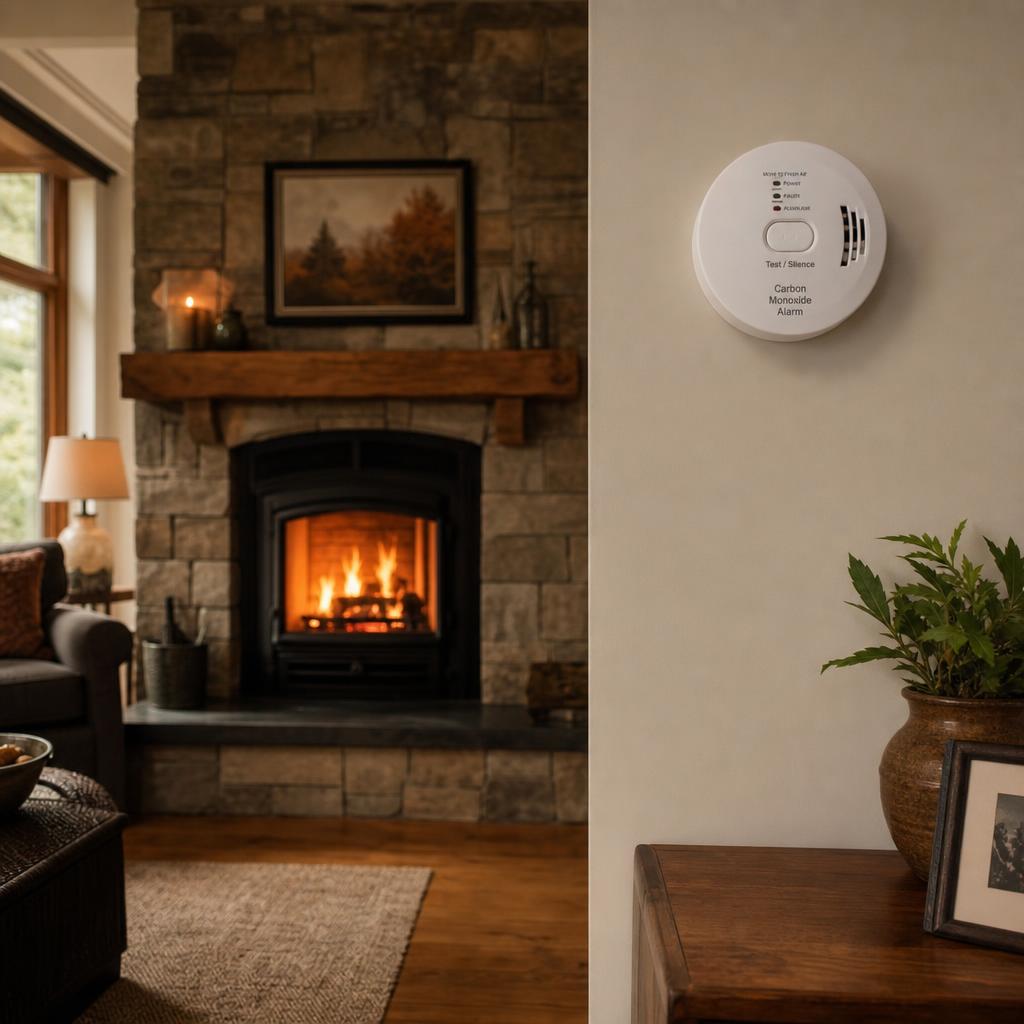
Why Fireplaces Produce Carbon Monoxide
A wood fire is never a clean reaction. The ideal combustion of wood produces carbon dioxide and water vapor. But wood contains moisture, the fire zone is not a controlled laboratory environment, and the oxygen supply fluctuates constantly as the fire burns. Incomplete combustion — where carbon is oxidized only partially — produces CO instead of CO2. The CO produced by combustion is normally carried up the flue by thermal draft: the hot column of gas rising through the chimney creates negative pressure that draws more air from the room and pushes all combustion byproducts outside. When the draft works correctly, CO stays in the flue and exits the house. When it fails — from a blocked flue, a cold chimney, a backdraft, or smoldering rather than active combustion — CO accumulates in the living space.
Wood-Burning Fireplaces: The Highest-Volume Residential CO Source in Winter
The Consumer Product Safety Commission identifies home heating equipment — including fireplaces and wood stoves — as the leading source of non-fire residential CO incidents. Several conditions elevate risk: Cold chimney startup: When a fireplace has not been used in days, the flue is filled with cold, dense air. That cold air column resists the upward draft from the fire, causing the first minutes of combustion gases (including significant CO) to spill into the room until the flue warms. Opening the damper and warming the flue with a rolled newspaper torch before lighting the main fire reduces this risk. Wet or green wood: Unseasoned wood burns at lower temperatures with incomplete combustion. CO concentrations in the combustion gases can be 3-5x higher than the same volume of seasoned wood burned at the same air supply. Smoldering overnight: Banking a fire to last overnight typically means a low-oxygen, low-temperature burn — exactly the conditions for maximum CO production with minimum draft to carry it away. Smoldering fires in sealed rooms are responsible for a disproportionate share of fireplace CO incidents.
Gas Fireplaces: Vented vs Unvented
Gas fireplaces divide into two fundamentally different safety categories. Vented gas fireplaces and gas inserts have a dedicated flue or sealed glass front that routes combustion gases outside. When the venting system is intact and maintained, indoor CO from a vented gas fireplace is minimal. Unvented gas fireplaces and decorative unvented gas log sets are a different product entirely. They burn natural gas or propane inside a sealed room with no exhaust path. All combustion products — CO, nitrogen dioxide, water vapor — are released directly into the living space. Manufacturers argue that modern unvented gas appliances burn cleanly enough to keep CO below alarming thresholds. Independent testing has found CO levels in rooms with unvented gas logs at concentrations that cause measurable carboxyhemoglobin elevation in occupants over hours of use. Several states and municipalities ban unvented gas appliances in bedrooms. AirShield's live PPM display is particularly valuable in rooms with unvented gas burning — you can see the CO concentration rising before it approaches alarm levels.
Annual Inspection: The One Thing That Prevents Most Fireplace CO Incidents
A blocked flue is the proximate cause of most fireplace-related CO poisonings. Animals build nests in chimneys during the off-season (birds, squirrels, and raccoons are common). Creosote deposits from incomplete combustion build up and eventually restrict or block the flue. Mortar joints crack and can allow CO to migrate into adjacent wall cavities and rooms. A CSIA-certified chimney sweep inspects the flue liner, damper function, cap condition, and creosote deposits. Annual inspection before the first fire of the season costs $100-$200 and is the single most effective CO prevention measure for fireplace users.
Where to Place a CO Detector Near a Fireplace
Do not place a CO detector inside the fireplace room if you use the fireplace regularly. A working fire in a normal wood-burning fireplace produces small amounts of CO that escape around the damper during startup and during smoldering — enough to trigger an alarm even when the fireplace is functioning properly. Instead, place the detector in the adjacent hallway, the room where people sleep nearest to the fireplace, or on the ceiling 10-20 feet from the firebox. This placement catches CO migration before it reaches sleeping areas while avoiding nuisance alarms from normal combustion. For homes with gas fireplaces, the detector can be closer — place it at sleeping height in the same room if the gas fireplace is in the primary living or sleeping area. AirShield's live PPM display is especially useful for fireplace households: after lighting, you can watch the display confirm that CO is not migrating into the living space. If the number climbs above 15-20 PPM while burning, that is a signal to check draft and damper function before continuing.
Frequently Asked Questions
Sources & References
- CPSC: Carbon Monoxide From Home Heating — Residential CO incident data by source type
- CSIA: Chimney Safety Institute of America — Chimney inspection standards and CO risk from fireplace appliances
- EPA: Wood Smoke and Indoor Air Quality — CO and particulate emissions from wood-burning appliances
Protect Your Home with AirShield™
The only portable CO detector that shows you real-time PPM readings on a live OLED display. Electrochemical sensor, multi-gas detection, UL listed.
Check Availability →
Loading comments...