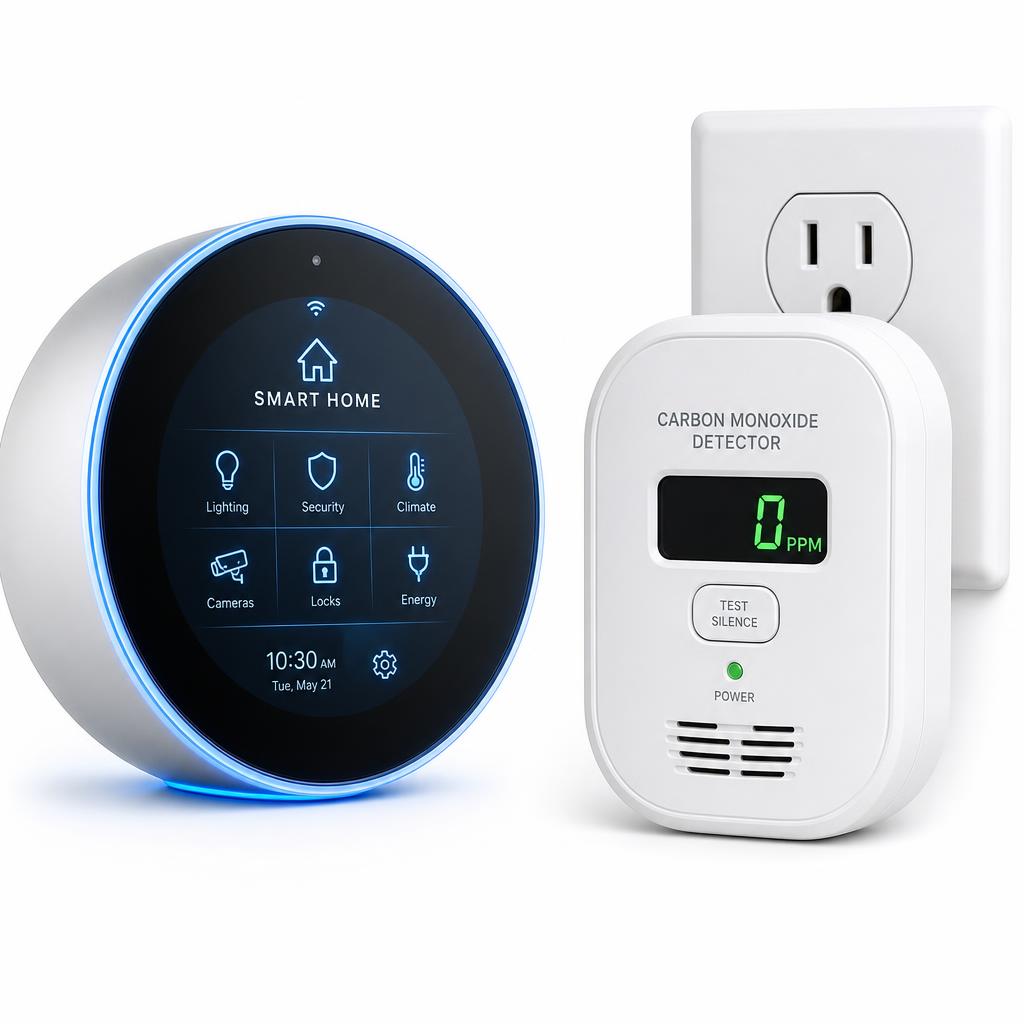
What a Smart CO Detector Actually Does
The term 'smart' covers a range of features depending on the manufacturer, but the core additions are consistent: Push notifications: When the alarm triggers, your phone gets an alert. This is useful if you are not home or if you sleep through alarms. Remote silence: You can silence a false alarm from your phone without standing on a chair. Smart home integration: The detector can communicate with Google Home, Amazon Alexa, Apple HomeKit, or other platforms — triggering automations when CO is detected (turn on ventilation, unlock doors, etc.). Voice alerts: Some models (including Nest Protect) announce which room has CO through built-in speakers, useful in multi-story homes. What is not added: a different sensor. The electrochemical cell inside a Nest Protect and the electrochemical cell inside a $25 plug-in detector use the same chemistry, meet the same UL 2034 standard, and alarm at the same 70 PPM sustained concentration. The WiFi radio does not make the sensor more sensitive.
The Real Cost of Smart CO Detection
The Google Nest Protect (smoke and CO) retails for $119. It requires the Nest app and a Google account. Battery replacement costs roughly $6-$8 every 1-2 years. The unit lifespan is 7 years before replacement is required, putting the lifetime hardware cost at $119 plus batteries. A standard plug-in CO detector with a live PPM display retails for $49. No subscription, no account, no app. It plugs into an outlet, the sensor reads current CO concentration every 5 seconds, and the display shows the number. Lifetime cost over 5-7 years: $49. For the $70 premium on the smart detector, you get: push notifications if you are away from home when the alarm triggers, and remote silence. For a household where someone is almost always home, these features have limited practical value. For a vacation property owner who spends weeks away, the push notification is the difference between learning about a CO event in real time versus discovering it on your next visit.
The Gap That Neither Smart Nor Standard Detectors Fill — Except One Type
Both smart detectors and standard threshold-only detectors have the same limitation: they tell you nothing until CO reaches alarm level. You do not know whether CO in your home is 0 PPM, 15 PPM, or 65 PPM — all three look identical on a detector without a live display. The alarm is the only output. A CO detector with a live digital display changes this. At any moment, you can glance at the display and see the actual concentration. A reading of 0 confirms the air is clean. A reading of 18 PPM tells you there is a source — not enough to alarm, but enough to investigate. A reading of 55 PPM tells you to leave immediately, before the alarm has even triggered. This is the only form of CO information that gives you actionable data below the alarm threshold. Smart detectors do not provide it. The Nest Protect app does not show you real-time PPM. The push notification arrives when the alarm triggers — not at 35 PPM when you still have time to calmly identify and eliminate the source.
Who Actually Needs a Smart CO Detector
There are specific scenarios where the remote notification feature of a smart detector provides genuine value: Vacation home and cabin owners: If your second property is unoccupied for weeks at a time, a smart detector with push notifications means you learn about a CO event before your next visit. A malfunctioning furnace in an unoccupied home can cause significant structural issues and is a liability risk for visiting guests. Landlords with rental properties: Remote alerting gives landlords early notification of CO events in occupied units, allowing faster response and documentation of system function. People who sleep through alarms: If you or a family member have documented difficulty waking to audio alarms, a phone notification as a secondary alert has real value. Note that a louder alarm (above 85 dB, which most detectors meet) combined with a bed-shaker or strobe is typically more reliable for heavy sleepers than a phone notification. For everyone else in a primary residence: the $50 live-reading detector provides more actionable CO information than the $119 smart detector with no live display.
The Right CO Detector for Most Households
For a primary residence, the detector features that provide the most safety improvement over the minimum UL 2034-compliant alarm are: 1. Live digital PPM display — see CO before the alarm 2. Electrochemical sensor — no false alarms from cooking, humidity, or chemicals 3. Plug-in power — no battery to die silently 4. 5-7 year sealed unit design — replace on schedule, not when it fails AirShield is built around these four features. The OLED display updates every 5 seconds with the current CO reading. The electrochemical cell is selective to CO molecules — not to VOCs, smoke, or humidity. The unit plugs into a standard outlet. Replacement interval is 5-7 years from manufacture date. For vacation homes and rental properties, add a smart detector with push notification capability in addition to — not instead of — a live-reading detector. The push notification tells you the alarm has triggered. The live display tells you what the CO level is when you arrive. Visit [airshield.store](https://airshield.store) to see specifications.
Frequently Asked Questions
Sources & References
- Google Nest Protect Specifications — Smart CO and smoke detector specifications and app features
- UL 2034: Standard for Single and Multiple Station Carbon Monoxide Alarms — Alarm timing and sensor standards applicable to all listed CO detectors
- NFPA 720: CO Detection Standard — Installation and performance requirements for residential CO detection
Protect Your Home with AirShield™
The only portable CO detector that shows you real-time PPM readings on a live OLED display. Electrochemical sensor, multi-gas detection, UL listed.
Check Availability →
Loading comments...