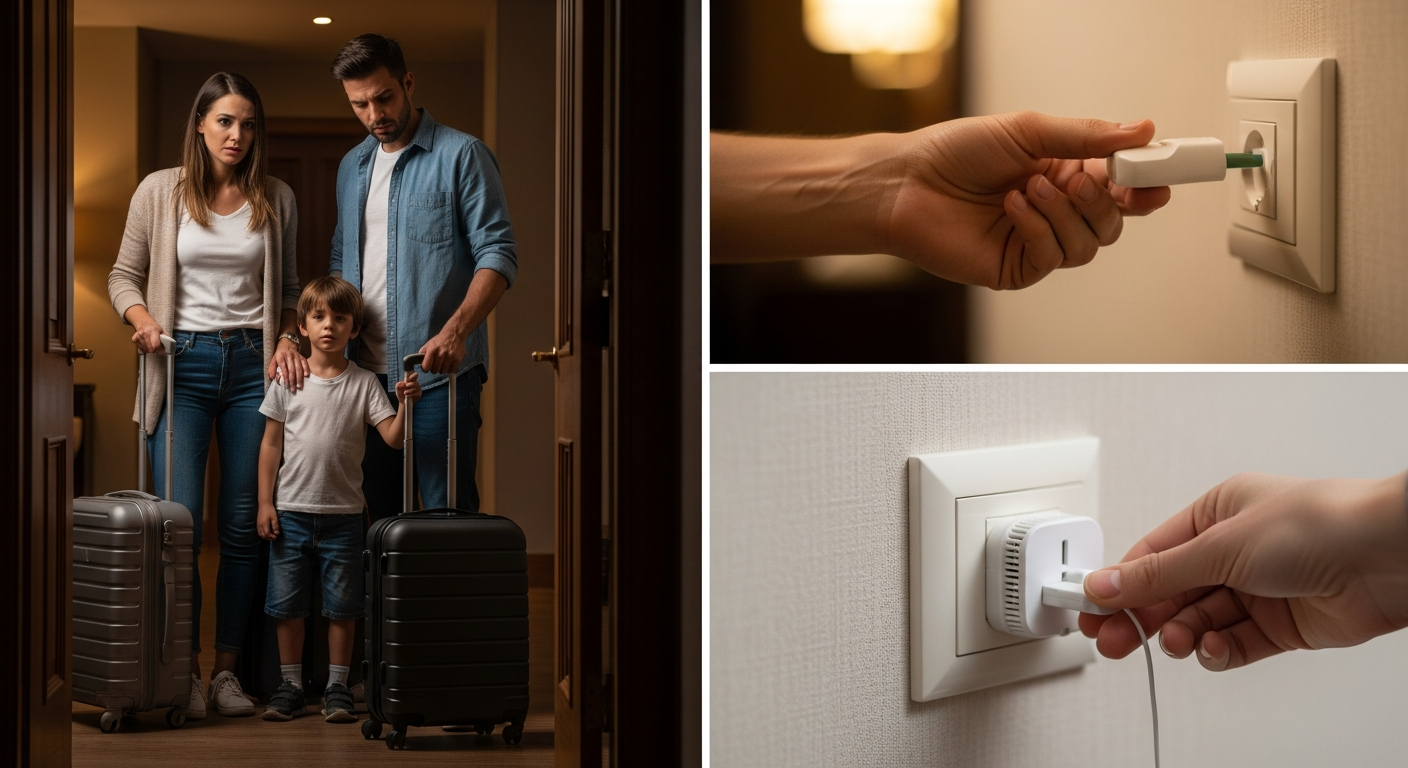
In March 2018, an Iowa family of four — Kevin and Amy Sharp and their two children, Sterling and Adrianna — were found dead in a VRBO condo in Tulum, Mexico. A rusted propane water heater had been leaking carbon monoxide all night. There was no detector in the unit. Seven years later, in March 2025, 14-year-old Miller Gardner — son of former Yankees outfielder Brett Gardner — died at a five-star resort in Costa Rica. Toxicology measured 64% carboxyhemoglobin saturation in his blood.
These weren't budget rentals. One was a vacation condo. The other was a luxury resort. And in both cases, the same thing was true: the family had no way to know the air was poisoning them until it was too late.
If you travel — to Airbnbs, hotels, resorts, or in an RV — you have probably never stopped to ask whether the room you're sleeping in tonight has a working detector. This article walks through why most don't, why even the ones that exist often fail, and what a real portable carbon monoxide detector for travel actually needs to do to keep you safe.
The Hidden Gap in Rental Property Safety
Most travelers assume short-term rentals follow the same safety rules as hotels. They don't. Airbnb only began requiring hosts to confirm they have a CO detector in 2021 — and even then, 'confirm' means the host self-attests in a checkbox. There is no inspection. NBC News identified 19 deaths at Airbnb properties linked to carbon monoxide poisoning since 2013, and that number reflects only what was reported in press coverage.
Hotels aren't immune either. An NIH study documented 905 guests poisoned across 115 carbon monoxide incidents at U.S. hotels and motels between 2005 and 2018, resulting in 22 fatalities. A recurring detail in nearly every fatal case: the victims initially thought they had food poisoning or the flu before they lost consciousness.
The pattern is consistent. Older properties have appliances that age out faster than regulations catch up. Vacation rentals in countries with weaker building codes — Mexico, Costa Rica, parts of Europe — often have propane water heaters located near sleeping areas. And cleaning crews aren't trained to test the detector battery between guests.
Why 'Alarm-Only' Detectors Give a False Sense of Security
Even when a detector is present, the kind matters more than most people realize. The standard wall-mounted unit you'll find in a typical rental is an alarm-only model: it beeps when CO concentration crosses a threshold — usually 70 parts per million sustained over an hour, or 150 ppm over 10 minutes, per UL 2034 standards.
Here's the problem. Symptoms of carbon monoxide poisoning — headache, nausea, dizziness, confusion — start showing up at exposures as low as 35 ppm if you breathe them in for several hours. Children, who breathe faster and have smaller body mass, react even sooner. A detector that stays silent until 70 ppm is not protecting your kids during a long sleep. It's protecting them from a worst-case spike.
A detector with a live PPM readout is fundamentally different. Instead of waiting for an alarm threshold, it tells you the actual concentration in the room — right now, in real time. You can glance at the screen when you walk in, see '0 ppm,' and know the air is clean before you take your coat off. If the number starts climbing during the night, you see it climb. You don't wait for the beep.
What a Travel-Grade Detector Actually Needs
Not all portable detectors are equal. Here's what separates a real travel-grade unit from a $15 toy:
- Electrochemical sensor — the same sensor class used by professional HVAC technicians and fire-service first responders. Accurate at low concentrations — exactly where the danger to children begins. Cheap detectors use biomimetic or semiconductor sensors that drift over time and miss low-level exposure.
- Real-time PPM display — a number on a screen tells you the air's status before any alarm has a reason to fire. This is the single most important feature for travelers.
- Multi-gas detection — carbon monoxide is the most common silent threat, but propane and methane leaks are also lethal. A detector that catches all three covers your full risk surface.
- Plug-and-play portability — a unit that plugs into any standard outlet and starts working in seconds. No batteries to remember, no installation. The detectors that protect you are the ones you have with you.
The Populations Most at Risk — and Most Overlooked
Carbon monoxide doesn't affect everyone equally. Pediatrician Dr. Joel Gator Warsh, speaking to TODAY.com after the Miller Gardner case, noted that children breathe faster and have developing systems, making them more vulnerable to CO exposure at lower thresholds than adults. Three groups face elevated risk and rarely get specific safety guidance:
- Traveling families with young children — kids sleep deeper, breathe faster, and weigh less. The same CO concentration that gives a parent a mild headache can cause loss of consciousness in a toddler hours sooner.
- Adult children with aging parents who live alone — older homes often have decade-old detectors. CO detectors have a typical sensor lifespan of 5 to 7 years, after which they continue to power on but stop detecting accurately.
- RV and camping enthusiasts — propane stoves, generators, and heaters inside a sealed cabin are the textbook setup for CO accumulation. RV-installed detectors degrade faster due to vibration, temperature swings, and humidity.
How to Actually Use a Portable Detector on a Trip
Buying a portable detector is step one. Using it well is the part most people skip.
- When you check into any rental, plug your detector in within the first five minutes — in or near the room you'll sleep in, not the living room.
- Watch the PPM reading for two or three minutes. Anything above 9 ppm warrants asking a question; anything climbing toward 35 ppm warrants opening windows and contacting the host or front desk.
- At night, leave it plugged in within earshot. The 85-decibel alarm is loud enough to wake a deep sleeper, but you want it close enough to hear through closed bedroom doors.
- In an RV, run the detector continuously whenever the propane system, generator, or built-in heater is in use. Do not rely on the factory-installed unit alone — most are alarm-only and most are past their sensor life.
- If buying for an elderly parent, set it up for them on the first visit. Show them what a clean reading looks like, and set a calendar reminder to replace the unit every five years.
The Bottom Line
The data is clear, the death toll is documented, and the gap between what most rental properties claim to provide and what they actually provide is wider than most travelers know. A wall-mounted alarm-only unit, when it exists at all, is the bare minimum of a safety standard built for permanent residents — not for a family staying one night in a stranger's condo.
A travel-grade portable carbon monoxide detector closes that gap. It tells you the air is safe before you fall asleep, it covers the gases the host's unit doesn't, and it goes with you on every trip — which is the only standard that actually matters. The AirShield portable CO and gas detector was built exactly for this: real-time PPM display, electrochemical pro-grade sensor, multi-gas detection, plug it in anywhere.
Protect Your Home with AirShield™
The only portable CO detector that shows you real-time PPM readings on a live OLED display. Electrochemical sensor, multi-gas detection, UL listed.
Check Availability →
Loading comments...